

-
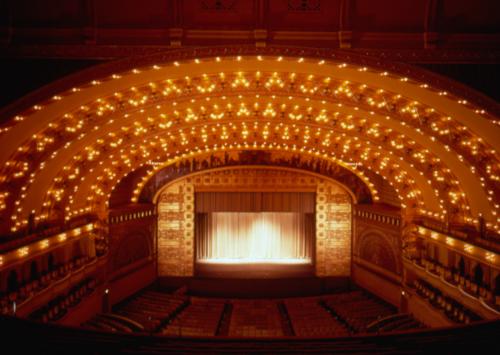
Studs Terkel discusses the history of Chicago architecture and its future with Carl Condit, Richard Nickel, and Ben Weese
1957 Studs Terkel rebroadcasts a discussion on the Chicago School of Architecture and its future in memory of Carl Condit. Carl Condit, Richard Nickel, and Ben Weese share their opinions on the Auditorium Theatre, University of Illinois-Circle Campus, Chicago Civic Center, Monadnock Building, and historical continuity.
-

Studs Terkel discusses the global status of theater with Croatian director Vlado Habunek
Apr. 25, 1962 Vlado Habunek, the Director of The Croatian National Theater, also a teacher at the University of Zagreb and board member for the Debrovnik Summer Festival discusses how all arts are seeking new revelations with Studs Terkel. Terkel asks Habunek to compare American Actors with Croatian actors because they are subsidized by the state. He sees Croatian actors as too secure and admires the ambition of American actors. The fact that theater reflects life and life is difficult begins a discussion on the status of theater today.
-
Studs Terkel discusses the English language with Bergen Evans ; part 1
Feb. 26, 1962 Studs Terkel discusses the English language with Bergen Evans, television host, writer, and Northwestern University professor of English.
-
Studs Terkel discusses the creation of the U.S.-U.S.S.R. Initiatives with founder Sharon Tennison
Jun. 17, 1988 Sharon Tennison was concerned with U.S. and U.S.S.R. relations in the early 1980's when there was a nuclear threat and decided to form a group of ordinary citizens to travel to Moscow and immerse themselves in the culture. They got firsthand accounts and dispelled decades old myths. They not only formed the Center for U.S.-U.S.S.R. Initiatives but created branches of Alcoholics Anonymous in the Soviet Union as well as teacher and young adult exchanges. The ordinary citizen has created participatory democracy and began a dialogue and exchange with a former enemy.
-
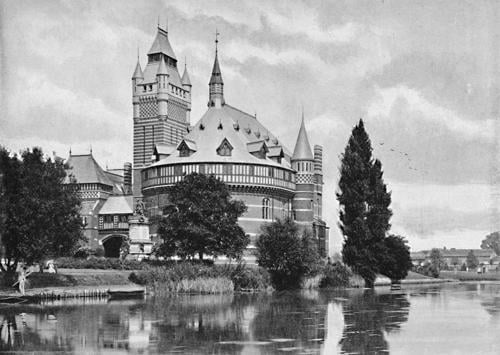
Studs Terkel discusses the changing role accents play on class distinctions in England with guests in the parlor of the Mayor in Stratford-upon-Avon ; part 2
1962 Studs Terkel gathers a cross section of opinions on accents and their changing role on class distinctions in British Society. He asks the Mayor and Mayoress of Stratford-upon-Avon, the Huxleys, their opinions on the influence of education on accents and class. Also present to offer opinions are Mr. & Mrs. Lawrence, pub owners from Lower Quinton near Stratford-on-Avon, and Mr. Morris, a London stockbroker and his wife. Bookending the conversation at the mayor's home are two conversations with Mr. and Mrs. Lawrence.
-
Studs Terkel discusses the book " Daughters and Mothers Mothers and Daughters" with author Signe Hammer
Mar. 17, 1976 Studs Terkel discusses the changing role of feminism, women and rights with author, Signe Hammer, also a teacher of a Women's School in New York that caters to women aged 24 through 78 that are seeking information on new ideas of identity. Signe Hammer interviewed three generations of women to explore the importance of supporting womanhood and how Mothers must have a strong sense of self in order to see their Daughters as also having value.
-

Studs Terkel discusses television and advertising with Nicholas Johnson of the FCC
Apr. 3, 1970 Johnson had recently released a book, "How to Talk Back to Your Television Set". Topics of conversation include the history and role of advertising in television and radio programming, and how advertising revenue influences the media. Emphasis is placed on cigarette advertising, which was particularly prevalent and controversial at the time of this interview.
-
Studs Terkel discusses songs about domestic violence against women
Aug. 5, 1981 Terkel presents songs that discuss the subject of domestic violence against women. Songs range from ballads in musicals, to jazz torch songs, to popular music at the time.
-
Studs Terkel discusses religion with Msgr. John Egan, Dr. Howard Schomer and Rabbi Arnold Wolf ; part 2
Feb. 13, 1965 Studs continues his discussion of religion in contemporary society with Catholic Msgr. John Egan, Dr.
-
Studs Terkel discusses religion with Msgr. John Egan, Dr. Howard Schomer and Rabbi Arnold Wolf ; part 1
Feb. 12, 1965 Studs discusses religion in contemporary society with Catholic Msgr. John Egan, Dr.
-
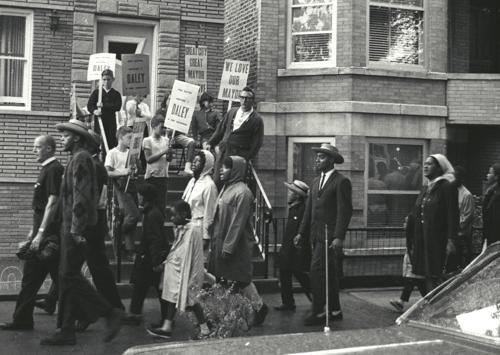
Studs Terkel discusses race relations and economic disparity with four Chicago area women ; part 2
Jan. 27, 1965 Studs discusses race relations and economic disparity with four Chicago area women in a program entitled "Each of us can act". This recording was the last of a 6-part series, "Rearing the Child of Good Will", broadcast under the auspices of the National Conference of Christians and Jews.
-
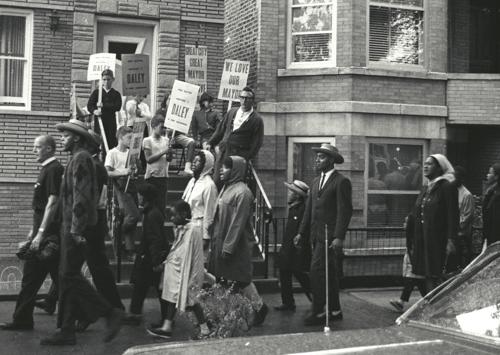
Studs Terkel discusses race relations and economic disparity with four Chicago area women ; part 1
Jan. 27, 1965 Studs discusses race relations and economic disparity with four Chicago area women in a program entitled "Each of us can act". This recording was the last of a 6-part series, "Rearing the Child of Good Will", broadcast under the auspices of the National Conference of Christians and Jews. The series focused on prejudice, race, religion, and community. Interviewees are: Madeline Bonsigniore of Chicago's south suburbs, Naomi Brodky of the Marynook neighborhood of Chicago, Lynn Williams of Winnetka, and Harriet White of the NCCJ.
-
Studs Terkel discusses poetry with writer Ed English
1970 Studs Terkel discusses poetry with writer and poet Ed English. Topics include race, history, religion, English's biography, and his creative process. Ed reads from his work throughout the interview.
-
Studs Terkel discusses literature, mining and Moberly, Missouri with author Jack Conroy
1968 Studs discusses literature, mining and Moberly, Missouri with author Jack Conroy. Conroy had recently (1966) released "Anyplace But Here", a republished version of "They Seek A City", in collaboration with Arna Bontemps. Topics include proletarian literature, coal mining in America, Conroy's home town of Moberly, Missouri, and Conroy's earlier work, including "The Disinherited" (1933).
-
Studs Terkel discusses literature, Judaism, and the Holocaust with Richard Elman ; part 2
1967 Studs Terkel discusses literature, Judaism, and the Holocaust with the novelist, poet, journalist, and teacher Richard M. Elman (1934-1997). Their discussion revolves around Elman's recently published work of historical fiction, "The 28th Day of Elul", much of which takes place in the village of Clig, Hungary, during the time of the Nazi occupation of Hungary during World War II. Topics include Jewish identity, The Holocaust, persecution of The Jews, feelings of guilt and social prejudice among Holocaust survivors.