

-

Greta Keller discusses her life and work
Mar. 22, 1976 Greta Keller, cabaret singer and actress, discusses her life and singing career. Keller also explains technique and thoughts behind her singing. At the end of the interview, Keller describes her work on Cabaret and singing "Heiraten."
-
Giora Feidman discusses klezmer music
Jun. 14, 1990 Interviewing Giora Feidman, an Argentinian clarinetist who specializes in the klezmer musical tradition.
-
George Shearing discusses his career as a jazz musician and his interpretations of songs from various composers
May. 10, 1979 Studs interviews George Shearing about his career and performances at Rick's Cafe in Chicago. Shearing shares the events and people who influenced his Jazz music. He describes European audiences and studio musicians. Studs quotes Leonard Feather, music critic, on Shearing's take on the song "San Jose." The musical pieces are removed from this edited version of the original recording.
-
George Esteves discusses the music that will be performed by the Chicago Chamber Choir in the Mother's Day concert
Apr. 17, 1980 Studs interviews George Esteves, the director of the Chicago Chamber Choir. They discuss the musical numbers that the choir will perform in their Mother's Day concert. Dexter Bailey will accompany. Esteves reads the lyrics in Italian of "Ecco Mormorar L'Onde" a Torquato Tasso poem, and Studs reads it in English. Esteves also reads some lyrics of the "Contate Irene Kiesewetter" by Schubert Franz. Esteves shares how members of the choir are recruited. Esteves names all the soloist members of the choir.
-
-
-
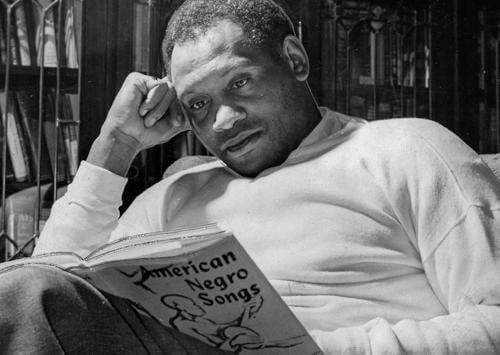
Gathering of friends discussing Paul Robeson
May. 8, 1970 Recorded live on Chicago's South Side. Robeson is ill at the time of recording. Speakers: Earl Dickerson, Etta Moten Barnett, Judge Sidney Jones, J. Mayo "Ink" Williams, Joan Brown (possibly Abena Joan Brown), Charles Hamilton, Margaret Burroughs, [John Gray's sister], [Stevens?]
-
Garry Davis discusses renouncing his American citizenship ; part 2 and Ray Davies discusses the album "Arthur"
May. 23, 1973 Garry Davis concludes by telling the audience he's in town to gain moral, political and financial support for the group he founded, The World Service Authority. Davis' final thought -- any man who defends his own rights is defending the rights of all men. Ray Davies of the English rock band, The Kinks, talks about the studio album, "Arthur (Or the Decline and Fall of the British Empire)". Davis reads lyrics from the songs, "Victoria," "Yes Sir, No Sir" and "Some Mother's Son".
-
Gana M'Bow discusses Senegalese folk music
Oct. 1, 1965 In addition to talking about Senegalese music, Gana M'Bow goes over the history of the "talking drum." M'Bow also plays various songs from Senegal and West Africa. Through the State Department, M'Bow was touring various cities across the US.
-
Frederick Ritter discusses and preforms classic Austrian Vienna Volks Theatre music
May. 23, 1963 Frederick Ritter, professor, preforms musical numbers from Austria. He also discusses the history of baroque theater and Volk's Theatre, along with Viennese culture. He is joined by Sabine Roupp, Joseph Gardner and David Miller on piano during the performances. Ritter also compares Bertolt Brecht with earlier writers, Johann Nestroy and Ferdinand Raimund. Selected pieces includes works by Mozart and Ferdinand Raymond and Johann Nestroy.
-
-
Frank Morgan discusses jazz.
May. 25, 1988 Terkel comments and presents a performance at the Jazz Showcase
-
Frank Abbinanti, Peter Gena in conversation with Studs Terkel
May. 2, 1983 Discussing the "Cornelius Cardew Memorial Concert" with pianist Peter Gena and composer Frank Abbinanti.
-
Folk singer Mary Travers talks about music and her career
Nov. 18, 1976 Folk singer Mary Travers - of the group Peter, Paul & Mary - talks about some of the artists that inspired her, like Pete Seeger and The Weavers.*Please note: some sections have been edited out from the original recording due to copyright considerations
-
Fleming Brown plays the banjo and discusses his career with Studs Terkel
Jan. 12, 1982 Fleming Brown, banjo player, discusses the influences Uncle Dave Macon, Pete Seeger, The Almanac Singers, and his teacher, Doc Hopkins had on him. He and Terkel also discuss the influence of WLS's Barn Dance radio show in Chicago and the Grand Ole Opry's WSM had on folk music. Fleming plays "Uncle Buddy" by Arthur Smith, to open and close the show. He also discusses the themes of Appalachian music such as lost love, mystery and murder, and plays examples for the audience.