Listen to New Voices on Studs Terkel our partnership with 826CHI-here! Read the Story


-

George Shearing discusses his career as a jazz musician and his interpretations of songs from various composers
May. 10, 1979 Studs interviews George Shearing about his career and performances at Rick's Cafe in Chicago. Shearing shares the events and people who influenced his Jazz music. He describes European audiences and studio musicians. Studs quotes Leonard Feather, music critic, on Shearing's take on the song "San Jose." The musical pieces are removed from this edited version of the original recording.
-
George Scato talks with Studs Terkel
Mar. 31, 1965 Interviewing George Scato portrait painter.
-
George Rose discusses his career and upcoming role at the Globe Theatre ; part 2
1963 Tony award-winning actor and singer George Rose discusses his role in the play "Common man: a man for all seasons" by Robert Bolt.
-
George Nelson discusses industrial design and the effects on people; part 4
Jan. 16, 1962 George Nelson discusses the importance of education, teachers, and how we learn as society changes.
-
George Nelson discusses industrial design and the effects on people; part 3
Jan. 16, 1962 George Nelson discusses what this generation will leave behind, the role of the individual in society, and the belief in things.
-
George Nelson discusses industrial design and the effects on people; part 2
Jan. 16, 1962 George Nelson discusses consumerism, business in war and peacetime, destruction leading to creation, and what culture looks like.
-
George Nelson discusses industrial design and the effects on people; part 1
Jan. 16, 1962 George Nelson discusses his impression of industrial design in Brasilia ,Russia, and American Main Street and how business is prioritized over what is better for people.
-
George Nakashima discusses architecture and design
Oct. 4, 1977 Interviewing designer-architect George Nakashima.
-
George Malko discusses the book "A Certain Art"
1967 Nicolai Malko was a Russian-born American symphonic conductor, who wrote the book, "A Certain Art." According to George Malko, his father's technique in conducting orchestras had nothing to do with showmanship but rather the senior Malko was more concerned with giving his audiences a theatrical experience by conveying the music at hand.
-
George Keithley discusses his book "The Donner Party"
Mar. 3, 1972 Author George Keithley describes his process for researching and composing the long narrative poem, The Donner Party.*Please note: some sections have been edited out from the original recording due to copyright considerations
-
George Flynn discusses his career as a contemporary American composer and explains how worldly events influence his compositions
Nov. 1, 1982 Studs rebroadcasts an interview he did five years ago with George Flynn, composer and head of the music department at DePaul University. Flynn explains the creative part of his music and how worldly events such as the Vietnam War help him and other musicians like him, write their avant-garde music. Flynn defines some of his compositions that include: "Wound," "American Rest," and "Canal." He shares the people and events in his life from a teenager who have influenced his work.
-
George Esteves discusses the music that will be performed by the Chicago Chamber Choir in the Mother's Day concert
Apr. 17, 1980 Studs interviews George Esteves, the director of the Chicago Chamber Choir. They discuss the musical numbers that the choir will perform in their Mother's Day concert. Dexter Bailey will accompany. Esteves reads the lyrics in Italian of "Ecco Mormorar L'Onde" a Torquato Tasso poem, and Studs reads it in English. Esteves also reads some lyrics of the "Contate Irene Kiesewetter" by Schubert Franz. Esteves shares how members of the choir are recruited. Esteves names all the soloist members of the choir.
-
George Drossos, The Thacker Family, Mrs. Webb and Benny Bearskin discuss living in Chicago
1968 The third program of "Division Street: America" features four profiles: George Drossos, an elderly, Greek man, the Thacker family who recently moved to Chicago, Mrs. Webb, a corner store owner and Native American Benny Bearskin. George Drossos talks about first moving to Chicago and getting acclimated to the city. He recalls visiting other states for a month and then having that feeling of "nostos," or wanting to return home to Chicago. A mother of 15 children and 21 grandchildren, Mrs. Thacker said she doesn't like all the hoodlum business that goes on in Chicago.
-
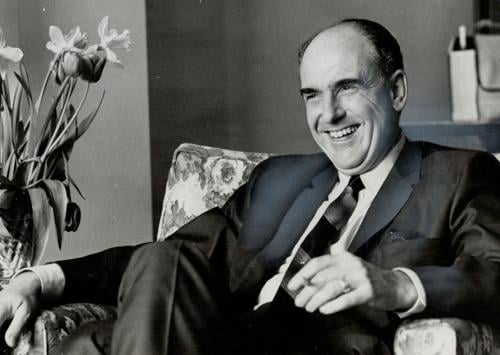
George Blanksten, Irma Edelman, Robert Eisner and Dr. Nicolas Pedritis discuss economist Andreas Papandreou's imprisonment
Apr. 1, 1967 Mr. Blanksten, Ms. Edelmen, Mr. Eisner and Dr. Pedritis, all educators, talk about economist and Prime Minister of Greece Andreas Papandreou's imprisonment.
-
George Anastaplo discusses his denial into the Illinois State Bar Association
Feb. 6, 1986 Before admittance, 17 members of the Illinois Bar Association asked George Anastaplo two questions. Should people in the Communist Party be allowed to practice law, to which Anastaplo answered yes. The members then asked Anastaplo if he was a member of the party. Anastaplo refused to answer that question because he deemed it an improper question for the Bar to ask. Anastaplo himself argued his case in front of the U.S. Supreme Court.