Listen to New Voices on Studs Terkel our partnership with 826CHI-here! Read the Story


Showing 466 - 480 of 5186 results
-

Studs Terkel discusses the book " Daughters and Mothers Mothers and Daughters" with author Signe Hammer
Mar. 17, 1976 Studs Terkel discusses the changing role of feminism, women and rights with author, Signe Hammer, also a teacher of a Women's School in New York that caters to women aged 24 through 78 that are seeking information on new ideas of identity. Signe Hammer interviewed three generations of women to explore the importance of supporting womanhood and how Mothers must have a strong sense of self in order to see their Daughters as also having value.
-
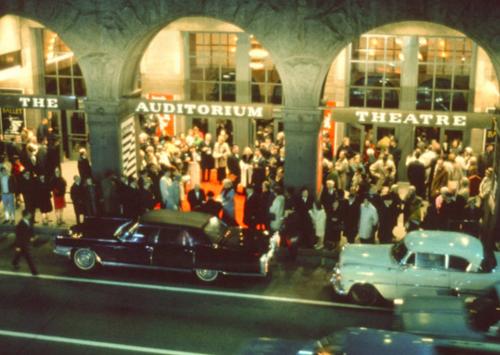
Studs Terkel discusses the Auditorium Theater with friends ; part 2
Jun. 1, 1967 Studs Terkel sits down with three guests who convey their memories of the Auditorium Theater in Chicago. Mary Garden, John Glickman and architect Harry Weese all agree that the theater's acoustics were extraordinary and there wasn't a bad seat in the house. Weese helped Chicago rediscover the Auditorium.
-

Studs Terkel discusses television and advertising with Nicholas Johnson of the FCC
Apr. 3, 1970 Johnson had recently released a book, "How to Talk Back to Your Television Set". Topics of conversation include the history and role of advertising in television and radio programming, and how advertising revenue influences the media. Emphasis is placed on cigarette advertising, which was particularly prevalent and controversial at the time of this interview.
-
Studs Terkel discusses songs about domestic violence against women
Aug. 5, 1981 Terkel presents songs that discuss the subject of domestic violence against women. Songs range from ballads in musicals, to jazz torch songs, to popular music at the time.
-
Studs Terkel discusses religion with Msgr. John Egan, Dr. Howard Schomer and Rabbi Arnold Wolf ; part 2
Feb. 13, 1965 Studs continues his discussion of religion in contemporary society with Catholic Msgr. John Egan, Dr.
-
Studs Terkel discusses religion with Msgr. John Egan, Dr. Howard Schomer and Rabbi Arnold Wolf ; part 1
Feb. 12, 1965 Studs discusses religion in contemporary society with Catholic Msgr. John Egan, Dr.
-
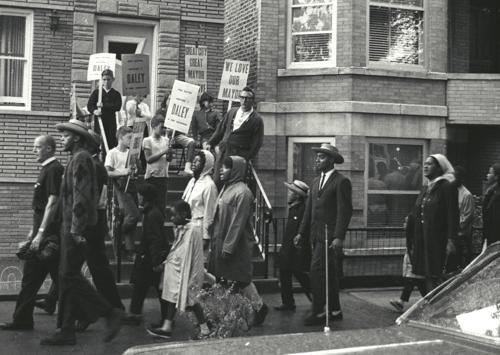
Studs Terkel discusses race relations and economic disparity with four Chicago area women ; part 2
Jan. 27, 1965 Studs discusses race relations and economic disparity with four Chicago area women in a program entitled "Each of us can act". This recording was the last of a 6-part series, "Rearing the Child of Good Will", broadcast under the auspices of the National Conference of Christians and Jews.
-
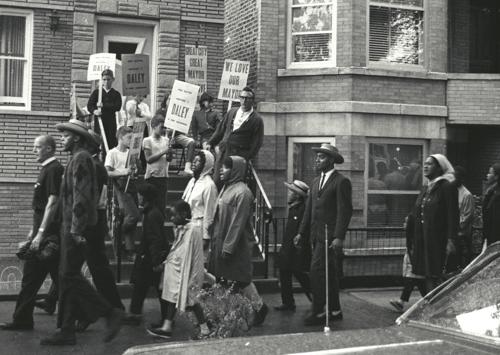
Studs Terkel discusses race relations and economic disparity with four Chicago area women ; part 1
Jan. 27, 1965 Studs discusses race relations and economic disparity with four Chicago area women in a program entitled "Each of us can act". This recording was the last of a 6-part series, "Rearing the Child of Good Will", broadcast under the auspices of the National Conference of Christians and Jews. The series focused on prejudice, race, religion, and community. Interviewees are: Madeline Bonsigniore of Chicago's south suburbs, Naomi Brodky of the Marynook neighborhood of Chicago, Lynn Williams of Winnetka, and Harriet White of the NCCJ.
-
Studs Terkel discusses poetry with writer Ed English
1970 Studs Terkel discusses poetry with writer and poet Ed English. Topics include race, history, religion, English's biography, and his creative process. Ed reads from his work throughout the interview.
-
Studs Terkel discusses literature, mining and Moberly, Missouri with author Jack Conroy
1968 Studs discusses literature, mining and Moberly, Missouri with author Jack Conroy. Conroy had recently (1966) released "Anyplace But Here", a republished version of "They Seek A City", in collaboration with Arna Bontemps. Topics include proletarian literature, coal mining in America, Conroy's home town of Moberly, Missouri, and Conroy's earlier work, including "The Disinherited" (1933).
-
Studs Terkel discusses literature, Judaism, and the Holocaust with Richard Elman ; part 2
1967 Studs Terkel discusses literature, Judaism, and the Holocaust with the novelist, poet, journalist, and teacher Richard M. Elman (1934-1997). Their discussion revolves around Elman's recently published work of historical fiction, "The 28th Day of Elul", much of which takes place in the village of Clig, Hungary, during the time of the Nazi occupation of Hungary during World War II. Topics include Jewish identity, The Holocaust, persecution of The Jews, feelings of guilt and social prejudice among Holocaust survivors.
-
Studs Terkel discusses literature, Judaism, and the Holocaust with Richard Elman ; part 1
1967 Studs Terkel discusses literature, Judaism, and the Holocaust with the novelist, poet, journalist, and teacher Richard M. Elman (1934-1997). Their discussion revolves around Elman's recently published work of historical fiction, "The 28th Day of Elul", much of which takes place in the village of Clig, Hungary, during the time of the Nazi occupation of Hungary during World War II. Topics include Jewish identity, The Holocaust, persecution of The Jews, feelings of guilt and social prejudice among Holocaust survivors.
-
Studs Terkel discusses journalism and mass media with Norman Corwin
1968 Studs discusses poetry and mass media with American writer Norman Corwin, who was visiting Chicago to receive an honorary award from Columbia College. Works discussed include Corwin's radio address, "On A Note of Triumph," which the author delivered on May 8, 1945 to mark the end of World War II in Europe, and "Ballad for Americans", a cantata produced by Corwin on CBS radio in 1939. Topics include Corwin's personal and professional history, the process of writing "for the ear", World War II, the dawn of the nuclear age, and the television's role in eclipsing radio in popularity.
-
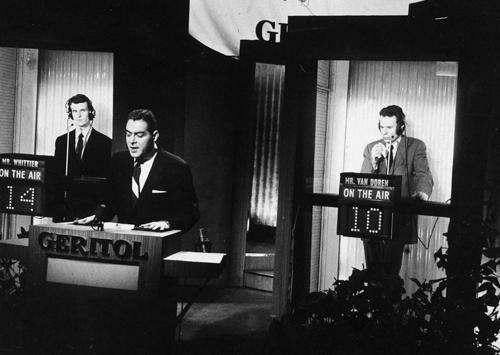
Studs Terkel discusses investigative journalism with author Fred J. Cook
May. 13, 1966 Studs and investigative journalist Fred J. Cook discuss Cook's book "The Corrupted Land: The Social Morality of Modern Americans" (Macmillan, 1966). The main topics of conversation are social morality and the corruption of the American business ethic. Terkel and Cook discuss unsung heroes, television quiz scandals,
-
Studs Terkel discusses interviews he conducted for his book "Working"
Aug. 22, 1978 Studs Terkel plays reenacted excerpts of interviews of various people from his book "Working." These interviews include people in a number of occupations including a car hiker, newspaper delivery boy, farm worker, homemaker, and waitress.