Listen to New Voices on Studs Terkel our partnership with 826CHI-here! Read the Story


Showing 11 - 20 of 21 results
-

Will Campbell discusses his book “Forty Acres and a Goat: A Memoir”
Feb. 13, 1987 Preacher Will Campbell discusses and reads from his book “Forty Acres and a Goat: A Memoir” and recounts his experience during the Civil Rights movement in the South. Studs plays “His Eye Is On The Sparrow” - Mahalia Jackson (1958).
-
Studs Terkel discusses religion with Msgr. John Egan, Dr. Howard Schomer and Rabbi Arnold Wolf ; part 1
Feb. 12, 1965 Studs discusses religion in contemporary society with Catholic Msgr. John Egan, Dr.
-
Studs Terkel discusses religion with Msgr. John Egan, Dr. Howard Schomer and Rabbi Arnold Wolf ; part 2
Feb. 13, 1965 Studs continues his discussion of religion in contemporary society with Catholic Msgr. John Egan, Dr.
-
St. Clair Drake and Paul Mundy discuss prejudice ; part 2.
1965 Discussing prejudice in communities with Dr. St. Clair Drake and Dr. Paul Mundy. They discuss prejudice towards the races, religions, and ethnicities of people.
-
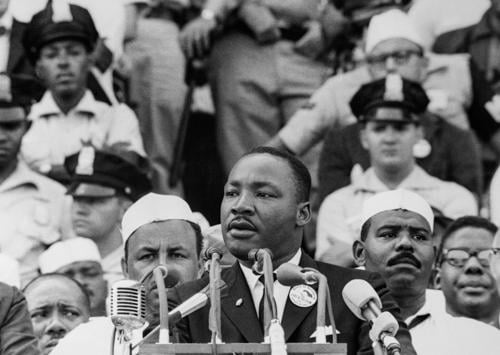
Dr. Martin Luther King Jr. discusses civil rights in regards to his "I Have a Dream" speech
Oct. 22, 1964 Studs Terkel interviews Dr. Martin Luther King Jr. at the home of gospel singer Mahalia Jackson. They discuss King's "I Have a Dream" speech that he made in 1963, at the foot of the Lincoln Memorial. At the end of the program there are various gospel music selections featuring Jackson and others.
-

Madalyn Murray discusses her family history, feminism, and theology
Dec. 13, 1966 Madalyn Murray discusses her family history, feminism, and theology and how her experiences with those subjects have shaped her worldview.
-

Erich Lüth talks with Studs Terkel on life under Hitler and its aftermath ; part 2
1968 Studs continues his interview with Erich Luth in Hamburg, Germany. The audio breaks at 25:23 and continues on a Sat at 25:28 till its conclusion at 35:43. Erich Luth conveys stories of humanity by both German prisoners towards Russian prisoners whose treatment was dictated by the Nazi party to not offer any winter clothing or shoes to provide comfort. The German laborers provided a human solidarity that brought them food, clothes, and soap.
-
Excerpts from the Division Street recordings Oral Histories, regarding race, religion and humanity
1970 Studs presents excerpts from the Division Street recordings, regarding race, religion and humanity.
-
William Stringfellow discusses politics, race, and theology
Interviewing William Stringfellow, American lawyer and activist. He discusses various topics including religion, social issues, and activism. Includes an interview with Cora Weiss. Content Warning: This conversation has the presence of outdated, biased, offensive language. Rather than remove this content, we present it in the context of twentieth-century social history to acknowledge and learn from its impact and to inspire awareness and discussion.
-
Horace Cayton discusses his book "Long Old Road" ; part 2
Sep. 7, 1966 Content Warning: This conversation has the presence of outdated, biased, offensive language. Rather than remove this content, we present it in the context of twentieth-century social history to acknowledge and learn from its impact and to inspire awareness and discussion. Loneliness and hardships of both fitting in and finding a job are covered in the continuation of Horace Cayton's, "Long Old Road: An Autobiography." By living in a middle class home in Seattle with a full time Japanese servant, Cayton was seen as better off than most people.