Listen to New Voices on Studs Terkel our partnership with 826CHI-here! Read the Story


Showing 11 - 20 of 40 results
-
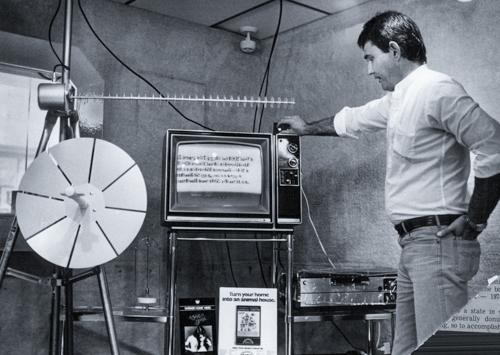
Studs Terkel discusses commercial and public broadcasting Nicholas Johnson of the FCC
Apr. 1, 1971 Studs Terkel discusses television and advertising with Nicholas Johnson, Commissioner at the Federal Communications Commission. Johnson had recently delivered a speech in Dubuque, IA about possibilities for the future of broadcasting, and had released a book a year prior, "How to Talk Back to Your Television Set". Topics of conversation include censorship, the role of advertising and corporate sponsorship of radio and television, and the hope and promise of public television.
-

Frank Donner discusses the article he wrote "Theory and Practice of American Political Intelligence" ; part 1
Surveillance, informants, and provocateurs are some of topics covered by Frank Donner with his article, "Theory and Practice of American Political Intelligence". Donner explained that intelligence practices exist so that everyone has something to fear.
-
Frank Donner discusses the article he wrote "Theory and Practice of American Political Intelligence" ; part 2
In his article, "Theory and Practice of American Political Intelligence," Frank Donner brings up the poisonous effect of surveillance on people's invasion of privacy. Donner explained people adjust their lives to it. Donner's last reflection is for people to not just be frightened by surveillance but rather to do something about it like study how much money is spent on surveillance and who is accountable.
-
George Anastaplo discusses his background and career
Mar. 24, 1976 The American Bar Association asked George Anastaplo if he was a Communist. Anastaplo refused to answer the question because he believed the Bar shouldn't have asked the question and knowing the answer was none of their business.
-

Studs Terkel discusses television and advertising with Nicholas Johnson of the FCC
Apr. 3, 1970 Johnson had recently released a book, "How to Talk Back to Your Television Set". Topics of conversation include the history and role of advertising in television and radio programming, and how advertising revenue influences the media. Emphasis is placed on cigarette advertising, which was particularly prevalent and controversial at the time of this interview.
-
-
David Hamlin discusses his book, "The Nazi/Skokie Conflict: A Civil Liberties Battle"
Mar. 5, 1981 David Hamlin, author and former Executive Director of ACLU, discusses his book "The Nazi/Skokie Conflict: A Civil Liberties Battle." Hamlin talks about Frank Collin, a jewish man turned leader of American Nazi Party leader and the court battle over the right to demonstrate in Skokie, Illinois. He also talks about the retaliation against the ALCU for defending Collin's case in court. At the end of the interview, Hamlin gives some advice on how to deal with people like Frank Collin.
-
Bill Cunningham discusses court cases he has participated in
Jan. 5, 1979 Bill Cunningham, Jesuit priest and lawyer, discusses some court cases he has participated in. He talks about the Berrigan Brothers who protested against the Vietnam War. Cunnginham also talks about the Rice-Poindexter case, where two Black Panther Party members were charged for murder. He also discussed the Freedom of Information Act and the COINTELPRO the FBI's Counter Intelligence Program. Studs reads poetry from David Rice and plays a song by Hank Ferguson.
-
Leonard Boudin discusses various cases he's tried
May. 20, 1986 Dr. Benjamin Spock, Paul Robeson and Jimmy Hoffa are a few of Leonard Boudin's clients. Although some people were outraged Boudin welcomed Hoffa as a client, Boudin's belief had always remained that whether a person be good or bad, that person is, like all people, entitled to civil liberties and good representation. Boudin lastly explained he liked law students and that from what he witnessed, he was hopeful for their/our futures.
-
Donna A. Demac discusses censorship and her book "Liberty Denied"
Jun. 16, 1988 In her book, “Liberty Denied: The Current Rise of Censorship in America,” Donna Demac points out that we, as a society, are not as free as we think we are. Demac can’t understand why anyone would want to keep people from reading great pieces of literature. While some groups called certain books anti-Christian, Demac said no one has ever died from reading a four-letter word.