

-

Studs Terkel discusses the creation of the U.S.-U.S.S.R. Initiatives with founder Sharon Tennison
Jun. 17, 1988 Sharon Tennison was concerned with U.S. and U.S.S.R. relations in the early 1980's when there was a nuclear threat and decided to form a group of ordinary citizens to travel to Moscow and immerse themselves in the culture. They got firsthand accounts and dispelled decades old myths. They not only formed the Center for U.S.-U.S.S.R. Initiatives but created branches of Alcoholics Anonymous in the Soviet Union as well as teacher and young adult exchanges. The ordinary citizen has created participatory democracy and began a dialogue and exchange with a former enemy.
-
Robert Del Tredici discusses his book "At Work in the Fields of the Bomb"
Jun. 6, 1988 Robert del Tredici photographer, artist, and author discusses the history of nuclear weapon production plants around the United States and the effects of nuclear radiation.
-
Panel discusses nuclear warfare and its consequences
Jun. 19, 1981 Discussing nuclear armageddon and the medical consequences of nuclear war with panel Herbert Scoville, George Kistiakowsky, Dr. Jack Geiger and Dr. Quentin Young.
-
Noted Norwegian adventurer and ethnographer Thor Heyerdahl discusses his most recent book
Oct. 9, 1981 Noted Norwegian adventurer and ethnographer Thor Heyerdahl discusses his most recent book "The Tigris Expedition: In Search of Our Beginnings" in which Heyerdahl and a crew of 10 men built a reed boat in Iraq and sailed it through the Persian Gulf, around the Horn of Africa, to Pakistan and eventually the Red Sea. Their goal was to prove that the ancient peoples of Mesopotamia and the Indus Valley could have been in contact through marine trade and migration.
-
Bertrand Russell discusses science and world peace. Phyllis Evans discusses the National Health Plan ; part 1
1962 Sir Bertrand Russell says scientists have a fundamental obligation to let the authorities know if and when what they're working on could lead to or cause a war. Russell claims, no matter the side, there are no winners as a result of war. The world could be a far better place, Russell explained, if it weren't for the fact of man's hatred toward other men. If one lives in the United States and has a grave illness or needs a major surgery, Phyllis Evans says one should not have to go into bankruptcy because of all the costs.
-
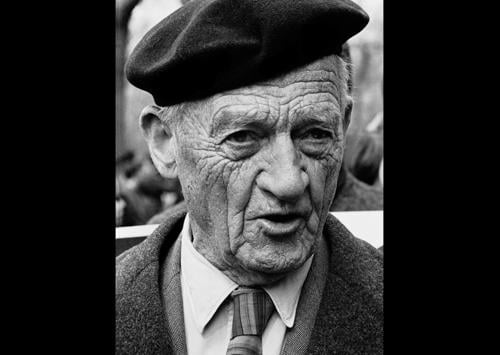
A. J. Muste talks with Studs Terkel
Feb. 15, 1965 Peace advocate and labor activist, A. J. Muste, discusses war and how human conflict can be overcome; recorded at the home of Sidney Lens shortly after Muste's 80th birthday.