

-
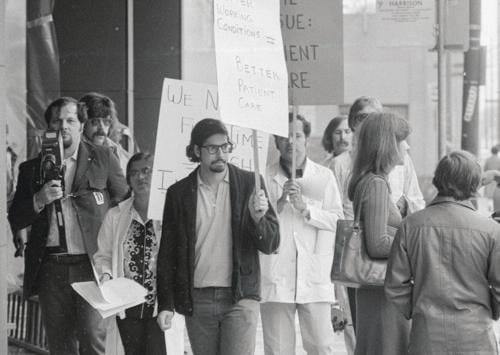
Studs Terkel interviews three Cook County Hospital doctors about their 1975 strike
Nov. 12, 1975 Studs interviews three Cook County Hospital doctors: Dr. Tessa Fischer Dr. Mark Bonnell Dr. David Moore Main topic of conversation is the 18-day residents and interns strike at Cook County Hospital, Chicago, October-November 1975. At the time it was the longest doctors’ strike in U.S. history. Topics include: Patient care, benefits and wages, and working conditions. The distinction is made between a "strike" and what the doctors call a "job action".
-

Studs Terkel interviews Professor Charles V. Hamilton on his book written with Stokely Carmichael entitled "Black Power: Politics of Liberation in America" ; part 1
Nov. 21, 1967 Using the backdrop of James Baldwin's "Nobody Knows My Name" and Baldwin's feelings that Blacks were ashamed of where they came from, Terkel interviews Professor and Chairman of the Political Science Department of Roosevelt University on his book coauthored with Stokely Carmichael entitled" Black Power: Politics of Liberation in America". Hamilton states that Blacks were taught to hate themselves and leave school believing that. Institutional racism and the deliberate oppression it creates, holds blacks back. Blacks are left out of crucial decision making processes that concern them.
-

Studs Terkel interviews Professor Charles V. Hamilton on his book written with Stokely Carmichael entitled "Black Power: Politics of Liberation in America" ; part 2
Nov. 21, 1967 Using the backdrop of James Baldwin's "Nobody Knows My Name" and Baldwin's feelings that Blacks were ashamed of where they came from, Terkel interviews Professor and Chairman of the Political Science Department of Roosevelt University on his book coauthored with Stokely Carmichael entitled" Black Power: Politics of Liberation in America". Hamilton states that Blacks were taught to hate themselves and leave school believing that. Institutional racism and the deliberate oppression it creates, holds blacks back. Blacks are left out of crucial decision making processes that concern them.
-

Studs Terkel interviews Japanese percussionist Stomu Yamash'ta
Jun. 24, 1969 The virtuoso percussionist, Stomu Yamash'ta, sits down with Studs Terkel and discusses from his heart how he creates the sound of his music. Sound is created in your head and heart. The ocean creates a different sound by day and night. Yamash'ta writes down his thoughts on the sounds he hears and creates the music. For the Akira Kurasawa film "YoJimbo" where he did solo musical work, he analyzed the character and what type of sound was in his mind and thought how to create it and convey that to his audience musically. Technology is not the answer to the development of sound.
-
Studs Terkel interviews Friedrich Luft in the home of Dr Erich Heller of Northwestern University
1968 Friedrich Luft, Chief Drama Critic for Die Welt discusses German theater and Bertolt Brecht as well as new playwrights such as Peter Weiss. Unlike American theaters, Germany has over 200 theaters that are subsidized and each town of 50,000 has a theater. Just like the days of The People's Stage (which still exists) the grocer and cobbler of Germany enjoy the theater. They are as devoted to the theater as going to a museum or church. They are treated to 12 to 16 new or old plays from Sophocles to Sartre or Pinter.
-

Studs Terkel interviews Curtiss Brooks, Jane Weston and Philip Hauser on the status of Blacks and housing, jobs and education in Chicago ; part 4
1965 Discussing "Discrimination in metropolitan Chicago" with Curtiss Brooks, employment specialist, Chicago Urban League, Jane Weston, housing specialist, American Friends Service Committee, and Philip Hauser, Sociology Department of University of Chicago. Brooks, Weston and Hauser provide data, reports and statistics to debunk the myths concerning the Black market for housing in Chicago. Weston states that public attitudes have changed and Real Estate must listen and accommodate open occupancy. Another myth that is discussed is that property values will go down if Blacks move in.
-
Studs Terkel interviews author-dramatist Frank Norman in his Bloomsbury Square Hotel, London ; part 2
1968 Terkel wraps up his discussion with Frank Norman. Norman gives his opinion on present conditions in prisons and orphanages. He opens up about his relationship with his daughter and a family he has never met.
-
Studs Terkel interviews author-dramatist Frank Norman at his Bloomsbury Square Hotel ; part 1
1968 Terkel delves into the life of Frank Norman, a London ex-con who turned his life around and became a novelist and playwright by writing on his experiences. He wrote "Bang to Rights" shortly after his prison release which brought him great fame. He followed that with "The Monkey Pulled it's Hair" that had a U.S. release under the name "Don't Darling Me Darling". Norman opened up to Terkel discussing his illegitimacy, his illiteracy till age 14, his institutionalization in an orphanage which he turned into the novel "Banana Boy".
-

Studs Terkel interviews author Sandra Cisneros
Jun. 30, 1991 Sandra Cisneros recounts the creation of her works from her new release "Woman Hollering Creek and Other Stories" as well as "House on Mango Street". The following have been removed due to copyright restrictions: "Eleven", "Mexican Movies", "Eyes of Zapata", "Bien Pretty" and "One Holy Night". From "House on Mango Street" she reads "A Smart Cookie", "Hips", "My Name", and "Mi Tocayo," "Those Who Don't."
-
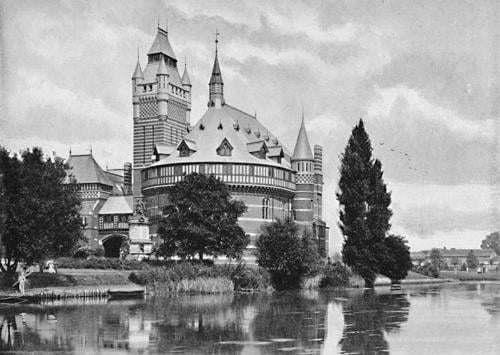
Studs Terkel in Stratford-Upon-Avon. At the National Theatre and at the Falcon Hotel ; part 1
1962 Studs Terkel heads to the British town of Stratford-upon-Avon (the birthplace of William Shakespeare) intending to interview Sir John Gielgud, and getting a few words before Studs realizes that Sir John is not intending to be interviewed. He speaks instead to other members of the company. Then he meets Mr. and Mrs. Lawrence in the Falcon Hotel.
-
-
Studs Terkel in conversation with Buffy Sainte-Marie
Apr. 21, 1972 Studs Terkel interviews Canadian singer-songwriter Buffy Sainte-Marie.
-
Studs Terkel gets reactions on the upcoming destruction of McLaren school and a newly created mural by the school children
Jul. 20, 1978 Studs Terkel returns to his alma mater, McLaren school, prior to its destruction to gain reactions on the loss of a newly created mural by the school children. Terkel provides the reactions of the student artists who can't understand why they were told to complete the oceanography mural when it was to be destroyed with the building. He also talks with parents, teachers and administrators about this loss. Parents pledge $500 to create negatives of mural to save as photographs.
-
-
Studs Terkel discusses, through music, inventions that made the lives of men and women easier
Jun. 10, 1988 Songs include "Hello, Frisco" sung by Sam Ash and Elida Morris; "He'd Have to Get Under - Get Out and Get Under (To Fix Up His Automobile)" sung by Will Halley; "Come Josephine in my Flying Machine" sung by Blanche Ring; "Jay Gould's Daughter" sung by Ed McCurdy; "Mr.