Listen to New Voices on Studs Terkel our partnership with 826CHI-here! Read the Story


Showing 106 - 120 of 1202 results
-

Talking about A Streetcar Named Desire, with Jackie Taylor
Mar. 23, 1987 The playwright, director, actress, and founder of the Black Ensemble Theater joins Studs to discuss her role as Blanche DuBois in the Tennessee Williams play, A Streetcar Named Desire.*Please note: some sections have been edited out from the original recording due to copyright considerations
-
Sylvia Kronstadt in conversation with Studs Terkel
Dec. 9, 1975 Interviewing writer and editor Sylvia Kronstadt.
-

Susan Sontag discusses Tuberculosis
Jun. 30, 1978 Sontag reads from "Illness as Metaphor" and discusses differences between diseases, particularly tuberculosis and cancer, regarding historic understanding and cultural representation.
-
Susan Brownmiller discusses her book "Against Our Will"
Oct. 23, 1975 In Susan Brownmiller's book, "Against Our Will: Men, Women and Rape," Brownmiller shows her audience how and why rape is a crime of one's mind and not one of passion. According to Brownmiller, rape is man's dominance over a woman.
-
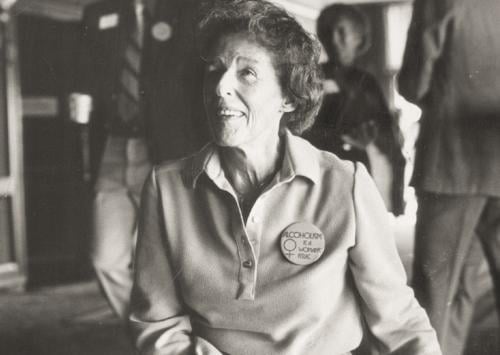
Susan Brownell Anthony discusses her book "The Ghost in My Life"
Oct. 29, 1971 Ms. Anthony, the grand-niece of Susan B. Anthony, comments on the women's liberation movement, her personal political life and her view of Christian life.
-
Studs, teachers and students have a conversation at a high school where there is controversy over the use of the book "Working"
1982 Discussing the controversy over the use of the book "Working" by author Studs Terkel in a senior vocational class. Interviews with Kay Nichols, teacher, and two high school classes, as well as Bob Burns and Jim Richardson. The students talk of how the "bad" language in the book is heard from their peers on a daily basis and they don't find it offensive. [recorded in Girard, Pennsylvania]
-
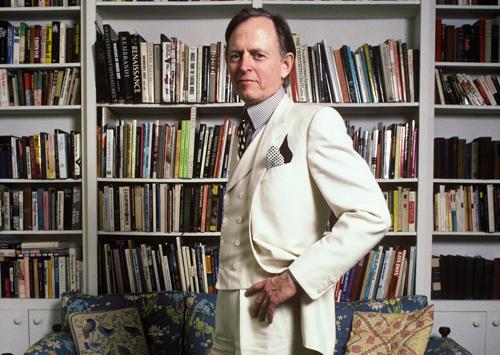
Studs Terkel interviews Tom Wolfe ; part 2
Jul. 26, 1965 Studs Terkel and Tom Wolfe discuss Wolfe's first collection of essays, "The Kandy-Kolored Tangerine-Flake Streamline Baby". Terkel and Wolfe begin their conversation by listening to and discussing an excerpt from an interview with a young motorcycle enthusiast named Chuck. Topics of conversation include Wolfe's writing process and personal history, the generation gap, class and income disparity, motorcycle culture, Las Vegas, and stock car racing.
-
Studs Terkel interviews Professor Charles V. Hamilton on his book written with Stokely Carmichael entitled "Black Power: Politics of Liberation in America" ; part 1
Nov. 21, 1967 Using the backdrop of James Baldwin's "Nobody Knows My Name" and Baldwin's feelings that Blacks were ashamed of where they came from, Terkel interviews Professor and Chairman of the Political Science Department of Roosevelt University on his book coauthored with Stokely Carmichael entitled" Black Power: Politics of Liberation in America". Hamilton states that Blacks were taught to hate themselves and leave school believing that. Institutional racism and the deliberate oppression it creates, holds blacks back. Blacks are left out of crucial decision making processes that concern them.
-
Studs Terkel interviews Professor Charles V. Hamilton on his book written with Stokely Carmichael entitled "Black Power: Politics of Liberation in America" ; part 2
Nov. 21, 1967 Using the backdrop of James Baldwin's "Nobody Knows My Name" and Baldwin's feelings that Blacks were ashamed of where they came from, Terkel interviews Professor and Chairman of the Political Science Department of Roosevelt University on his book coauthored with Stokely Carmichael entitled" Black Power: Politics of Liberation in America". Hamilton states that Blacks were taught to hate themselves and leave school believing that. Institutional racism and the deliberate oppression it creates, holds blacks back. Blacks are left out of crucial decision making processes that concern them.
-
Studs Terkel interviews Friedrich Luft in the home of Dr Erich Heller of Northwestern University
1968 Friedrich Luft, Chief Drama Critic for Die Welt discusses German theater and Bertolt Brecht as well as new playwrights such as Peter Weiss. Unlike American theaters, Germany has over 200 theaters that are subsidized and each town of 50,000 has a theater. Just like the days of The People's Stage (which still exists) the grocer and cobbler of Germany enjoy the theater. They are as devoted to the theater as going to a museum or church. They are treated to 12 to 16 new or old plays from Sophocles to Sartre or Pinter.
-
Studs Terkel interviews author-dramatist Frank Norman in his Bloomsbury Square Hotel, London ; part 2
1968 Terkel wraps up his discussion with Frank Norman. Norman gives his opinion on present conditions in prisons and orphanages. He opens up about his relationship with his daughter and a family he has never met.
-
Studs Terkel interviews author-dramatist Frank Norman at his Bloomsbury Square Hotel ; part 1
1968 Terkel delves into the life of Frank Norman, a London ex-con who turned his life around and became a novelist and playwright by writing on his experiences. He wrote "Bang to Rights" shortly after his prison release which brought him great fame. He followed that with "The Monkey Pulled it's Hair" that had a U.S. release under the name "Don't Darling Me Darling". Norman opened up to Terkel discussing his illegitimacy, his illiteracy till age 14, his institutionalization in an orphanage which he turned into the novel "Banana Boy".
-

Studs Terkel interviews author Sandra Cisneros
Jun. 30, 1991 Sandra Cisneros recounts the creation of her works from her new release "Woman Hollering Creek and Other Stories" as well as "House on Mango Street". The following have been removed due to copyright restrictions: "Eleven", "Mexican Movies", "Eyes of Zapata", "Bien Pretty" and "One Holy Night". From "House on Mango Street" she reads "A Smart Cookie", "Hips", "My Name", and "Mi Tocayo," "Those Who Don't."
-
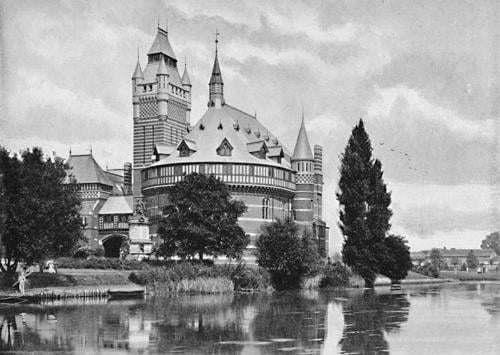
Studs Terkel in Stratford-Upon-Avon. At the National Theatre and at the Falcon Hotel ; part 1
1962 Studs Terkel heads to the British town of Stratford-upon-Avon (the birthplace of William Shakespeare) intending to interview Sir John Gielgud, and getting a few words before Studs realizes that Sir John is not intending to be interviewed. He speaks instead to other members of the company. Then he meets Mr. and Mrs. Lawrence in the Falcon Hotel.
-
Studs Terkel discusses writing and acting with John Schultz, Paul Pekin, and their students
1968 Studs discusses writing and acting with John Schultz, Paul Pekin, and six of their students: Alex Wayne, Linda Gilbert, Will Jackson, Dan Michalski, Bill Johnson, and Fred Game. The main topic of conversation is the "Story Workshop" method of teaching writing, which Schultz had recently developed and were leading at CAM (Christian Action Ministries) Academy in Chicago. The group discuss their history as teachers and writers, and they demonstrate some of the techniques they employ in their methodology. Some of the students also express the successes they have had in developing their writ