Listen to New Voices on Studs Terkel our partnership with 826CHI-here! Read the Story


Showing 421 - 435 of 1202 results
-

Jeanne Stellman discusses her book "Work Is Dangerous to Your Health: A Handbook of Health Hazards in the Workplace and What You Can Do About Them"
Feb. 11, 1974 Jeanne Stellman discusses her book, "Work Is Dangerous to Your Health: A Handbook of Health Hazards in the Workplace and What You Can Do About Them," and workplace safety issues in a variety of industries. Topics of discussion include the importance of prioritizing health in the workplace and consulting workers on workplace safety issues, and industry responses to occupational hazards.
-
Jean Vilar and Eugène Ionesco discuss French theater
1968 In the first part of this program Studs Terkel discusses French theater with critic Jean Vilar. In the second part, Studs and Eugène Ionesco discuss Ionesco’s work and the Theater of the Absurd.
-
Jean Shepherd discusses his book "In God We Trust: All Others Pay Cash"
Dec. 1, 1966 Jean Shepherd discusses his book "In God We Trust: All Others Pay Cash." Includes earlier clips of Shepherd speaking and excerpts of him reading from the book.*Please note: some sections have been edited out from the original recording due to copyright considerations
-
Jean Shepherd discusses his book "A Fistful of Fig Newtons"
Mar. 26, 1982 Storyteller, humorist, radio personality, and author Jean Shepherd discusses his book, A Fistful of Fig Newtons. Shepherd considers how his various career paths, particularly that of a radio personality, have affected his writing.*Please note: some sections have been edited out from the original recording due to copyright considerations
-
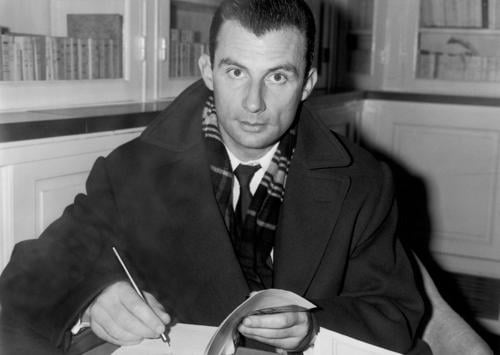
Jean Cau discusses his book "La pitié de Dieu" ; part 2
Nov. 1, 1962 When asked how he found time to write his book, Jean Cau said he took vacation time from his full time job. Cau was also asked if he wrote his book using a typewriter and Cau explained that he did all his writing with his own penmanship because he hated machinery, like the typewriter. In conclusion, Cau said he was writing a play about the Algerian War and its paratroopers. The play he finished writing was about the life and death of Adolf HiItler.
-
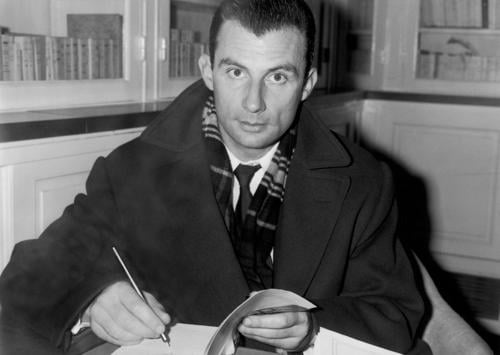
Jean Cau discusses his book "La pitié de Dieu" ; part 1
Nov. 1, 1962 Through an interpreter, Jean Cau discusses his book "La pitié de Dieu", or translated, "The Mercy of God". Cau's book is about four prisoners and their interactions with one another. Cau explained, in one way or another, with a reference to Kafka, we are all condemned and it will be a great surprise to all to learn what we are guilty of.
-
Jean Auel discusses her novel, "The Clan of the Cave Bear"
Sep. 10, 1980 Jean Auel discusses her novel, "The Clan of the Cave Bear," including the anthropological research that informed her writing, feminism in her main character, Ayla, and the book's themes of cooperation, adaptation, tribal memory, and reverence for life. Includes excerpts from the book and recordings of pygmy music made by anthropologist Colin Turnbull.
-
Jan Myrdal in conversation with Studs Terkel
Apr. 4, 1992 Discussing the books "Childhood" and "The Confession of a Disloyal European" (both published by Lakeview Press) with the author Jan Myrdal.
-
-
-
-
James Mills discusses his book "Report to the Commissioner," his newest publication
Oct. 3, 1972 James Mills, a novelist and journalist, talks to Studs about his book "Report to the Commissioner". Mr. Mills and Studs discuss the story and Mr. Mills goes in depth into the process of police detectives working a case. Studs plays an excerpt of a Chicago policeman talking about working on the tactical squad on the police force. The policeman tells of how they go into a neighborhood as civilians to stop crime.
-
James McPherson discusses his book "Battle Cry of Freedom: The Civil War Era" ; part 2
Jun. 6, 1989 Historian James McPherson discusses the his book, "Battle Cry of Freedom: The Civil War Era." McPerson explores the American Civil War and introduces some Civil War music. He talks about black soldiers, photography, and reconstruction. Content Warning: This conversation has the presence of outdated, biased, offensive language. Rather than remove this content, we present it in the context of twentieth-century social history to acknowledge and learn from its impact and to inspire awareness and discussion.
-
James McPherson discusses his book "Battle Cry of Freedom: The Civil War Era" ; part 1
Jun. 6, 1989 Historian James McPherson discusses the his book, "Battle Cry of Freedom: The Civil War Era." McPerson explores the American Civil War and talks about some Civil War music. He also discusses the reasoning behind the Civil War and some of the key figures during that time and how many songs came to be written about the battles and leaders.
-
James Graham-Lujan discusses the works of Federico Garcia Lorca; part 2
1964 James Graham-Lujan concludes by talking about Garcia Lorca's most celebrated plays, Blood Wedding, Yerma, and The House of Bernarda Alba. Tragedy is brought about due to the passion of a woman in each of the plays.