

-

Carlo Curly discusses the history and future of the organ as an instrument and his career as a classical organist
Dec. 15, 1983 Studs interviews Carlo Curly, a RCA recording classical organist. Includes an interview from two years earlier with Curly giving a commentary about Virgil Fox, his greatest influence. Curly describes his family background in music. He explains in great detail the history of the organ, how it is made, and the music written for it. He explains the difference in music between pipe organs and electronic organs. Curly talks about his experience playing in Japan. He speaks of Bach and Mendelson and their influence on the organ as a classical instrument.
-
-
Carl Vigeland discusses his book about the Boston Symphony Orchestra
Feb. 8, 1990 Author Carl Vigeland discusses his latest book, a portrait of the 1986-1987 concert season of the Boston Symphony Orchestra (BSO). Vigeland focuses on the nexus between art, business, and music, seen through the tense relationship between Kennedy Center Honoree conductor Seiji Ozawa and principal trumpeter Charles Schlueter.
-
Carl Smith discusses his book "Urban Disorder and the Shape of Belief: the Great Chicago Fire, the Haymarket Bomb, and the Model Town of Pullman"
Feb. 27, 1995 Non-fiction author Carl Smith discusses his latest work which focuses on the history of Chicago. Topics covered include labor movements, specifically the Pullman strike and the 1970's case trial with the Chicago Seven.
-

Carl Sagan discusses the book "Contact"
Oct. 4, 1985 Discussing the book "Contact" (published by Simon & Schuster) with the author, astronomer and science writer Carl Sagan. Starts with clip from Arthur C. Clarke (1856688-3-1).
-

Carl Sagan and Ann Druyan discuss their book "Shadows of Forgotten Ancestors"
Oct. 5, 1992 Evolution and the future of the human race are among topics in Carl Sagan's and Ann Druyan's book, "Shadows of Forgotten Ancestors: A Search for Who We Are." Included is an excerpt of the astronomer Harlow Shapley speaking at the beginning. Carl Sagan also reads an excerpt from the book at the end.
-
Carl Condit, Richard Nickel and Ben Weese discuss architecture ; part 2
Discussing Chicago architecture and interviewing Carl Condit, Richard Nickel and Ben Weese.
-
Carl Condit, Richard Nickel and Ben Weese discuss architecture ; part 1
Discussing Chicago architecture and interviewing Carl Condit, Richard Nickel and Ben Weese.
-
Carl Charnett, Director of Gateway House, and residents ; part 2.1
1970 Carl Charnett discusses Gateway House, a community for the cure of drug addiction (part 2 of 2). Includes interviews of Ira Robinson, Bill Jacobson, and other residents. This has additional content not included in part 2.
-
Carl Charnett, Director of Gateway House, and residents ; part 2
1970 Carl Charnett discusses Gateway House, a community for the cure of drug addiction (part 2 of 2). Includes interviews of Ira Robinson, Bill Jacobson, and other residents.
-
Carl Charnett, Director of Gateway House, and residents ; part 1
1970 The director of Gateway House, Carl Charnett, discusses Gateway House, a community for the cure of drug addiction (part 1 of 2). Includes interview of a resident, Linda.
-
Carl Bernstein reads from and discusses his book "Loyalties"
Apr. 4, 1989 Carl Bernstein's parents had always hoped that government would be used to better the lives of the American people. Bernstein's book, "Loyalties: A Son's Memoir," happened as a result of his parents being accused of being disloyal and of being communists. The book also covers Bernstein's relationship with his father.
-
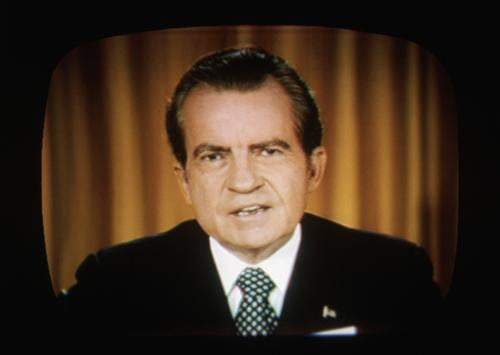
Carl Bernstein and Bob Woodward discuss the book "All the President's Men"
Jun. 21, 1974 Washington Post journalists discuss their book "All the President's Men" about breaking the Watergate scandal.
-
Carl and Hallie Foster discuss living their lives in Newburgh, Indiana
1970 Carl and Hallie Foster talk about the good and the bad of Newburgh, Indiana. Having been a welder for most of his life, Carl Foster, reflects on the time he got sick while on the job. He had gotten cancer and had to be fed intravenously for six months. While he was out sick, the company did not compensate him. When asked about his hobby of growing banana trees, a true calm and passion takes over his personality, as noticed by Studs Terkel.
-
Cao Ngoc Phuong discusses being a Buddhist in Southern Vietnam and starting the Buddhist School of Youth for Social Service
Feb. 25, 1970 Discussion with Cao Ngoc Phuong a Buddhist educator from Southern Vietnam and, one of the founding members of the Buddhist Student Movement, and the Buddhist School of Youth for Social Service. Includes poetry reading by Thich Nhat Hanh from his book "Vietnam: Lotus in a sea of fire-a Buddhist proposal for peace" Includes songs sung by Cao Ngoc Phuong: "The old man and the child" by Trinh Cong Son, "The Cio Linh mother" by Pham Duy, and "Lullaby" by Chinh Ba and Nhat Hanh.