

-

Henry Ollendorff discusses refugees and migrants in Europe
Feb. 14, 1974 Content Warning: This conversation includes racially and/or culturally derogatory language and/or negative depictions of Black and Indigenous people of color, women, and LGBTQI+ individuals. Rather than remove this content, we present it in the context of twentieth-century social history to acknowledge and learn from its impact and to inspire awareness and discussion. Henry Ollendorff spent much of his life working as a social worker. Ollendorff talks about the migrant workers in Europe and how there were many job openings.
-

Mckinley Olson discusses the book "Unacceptable Risk: The Nuclear Power Controversy." and the dangers of atomic energy
Aug. 23, 1974 The interview begins with Mr Olson reading the first 3 paragraphs of his book. McKinley Olson discusses the dangers of atomic energy plants and the book "Unacceptable Risk: The Nuclear Power Controversy." Mr Olson describes several forms of alternative/renewable energy sources as a safe replacement of nuclear energy.
-
-
Interview with Andreas Papandreou
1968 Interview with Andreas Papandreou Leader of the Panhellenic Socialist Movement, Leader of the Opposition, and Prime Minister of Greece. They discuss Mr.Popandreou's contributions in the political and socio-economic climate of Greece after World War II. Mr. Papandreou, Mrs. Papandreou and their oldest son George speak.
-
Interview with Andreas Papandreou
1968 Interview with Andreas Papandreou Leader of the Panhellenic Socialist Movement, Leader of the Opposition, and Prime Minister of Greece. Discussing the censoring of musical and theatrical arts by the Junta in Greece before the Coup.
-
Andreas, Margaret, and George Papandreou discuss the 1967 Greek coup d'at
Apr. 1, 1968 Studs Terkel joins the Papandreou family in their living room in Elmhurst, Illinois, to discuss their exile after the Junta’s coup d’état and occupation of Greece.
-
Dorothy Parker discusses her plays and the state of literature
Feb. 6, 1959 Dorothy Parker’s thoughts as a critic and writer on the state of American literature.
-
In this interview with Random House President and CEO Bob Bernstein and James Mitchell, Editor-in-Chief of the new Random House Encyclopedia talk with Studs Terkel
Sep. 26, 1977 In this interview with Random House President and CEO Bob Bernstein and James Mitchell, Editor-in-Chief of the new Random House Encyclopedia, the three gentlemen discuss the content and revolutionary layout of the single-volume 3,000 page tome, which was divided into 2 sections: the Colorpedia and the Alphapedia. Bernstein and Mitchell demonstrate how to use the encyclopedia and point out the explanatory diagrams throughout, which served a two-fold purpose: to catch the reader's attention, and then provide further information.
-
-
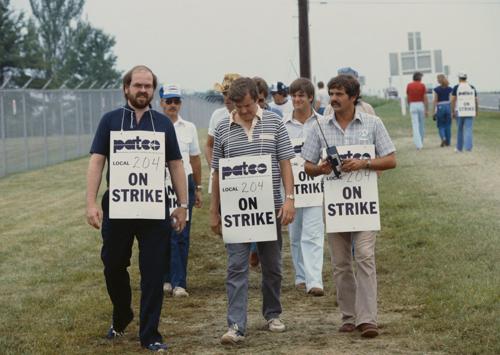
Jim Paulei of PATCO discusses the air traffic controller's strike and describes a day on the job
Oct. 5, 1981 Mr. Paulei talks with Studs about the air traffic controllers strike in 1980 and subsequent firing of over 1000 air traffic controllers. They discuss what a normal shift as an air traffic controller consists of, and the unions reasons for the strike in 1980.