Listen to New Voices on Studs Terkel our partnership with 826CHI-here! Read the Story


Showing 151 - 160 of 212 results
-

From the Wax Museum - 009 - South African writer Alan Paton discusses life in South Africa
1963 South African writer Alan Paton likened the white South African people to the ostrich. Paton said the ostrich keeps its head in the sand, and some people do the same in South Africa, too. With their heads in the sand, they don’t see any problems existing. Paton said he can not understand his country’s government. He can’t understand why the Black people are not allowed to own homes. Because of the government, Paton also talks about having to be careful about what he writes and he says the Americans are very lucky to have their U.S. Constitution.
-
Stephen B. Oates discusses his book "Let the Trumpets Sound: A Biography of Martin Luther King"
Sep. 9, 1982 Stephen B. Oates discusses his book "Let the Trumpets Sound: A Biography of Martin Luther King;" 2 short excerpts played during the program: one of Terkel interviewing Martin Luther King and another of E.D. Nixon speaking about MLK.
-

Heinrich Gruber and Howard Schomer discuss Nazi Germany and resistance
1968 German theologian Heinrich Gruber and pastor Howard Schomer discuss Nazi Germany and resistance
-
Ellen Afterman, Clinton Sanders, and Spellman Young discuss the drug epidemic
1980 Ellen Afterman and Clinton Sanders (authors of "Drugs and Your Life") and Spellman Young discuss drug use through the lenses of race, sex, and socioeconomic status.
-

Both Kathy [no last name] and John Beecher discuss their feelings about the South ; part 4
Apr. 1, 1965 Content Warning: This conversation includes racially and/or culturally derogatory language and/or negative depictions of Black and Indigenous people of color, women, and LGBTQI+ individuals. Rather than remove this content, we present it in the context of twentieth-century social history to acknowledge and learn from its impact and to inspire awareness and discussion. After hearing Martin Luther King, Jr.
-

Nancy Milio reads from and discusses her book "9226 Kercheval"
Jun. 13, 1970 Nancy Milio's book, "9226 Kercheval: The Storefront That Did Not Burn," is about community health services offered in a ghetto on the south side of Detroit, Michigan. As a nurse, Milio knew how important it was to offer quality health services to poor and uneducated individuals. With their real names changed, Milio talks about her experiences with Mrs. Watkins, Johhnie West and others at the center.
-
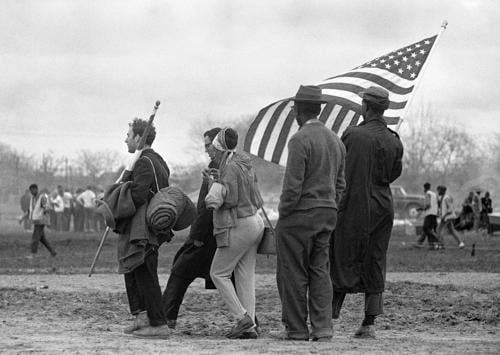
Robin Moran discusses preparing for the Selma, Alabama civil rights with Studs Terkelmarch
Apr. 9, 1965 Interviewing in Montgomery, Alabama, with Robin Moran [part 7, tape 1 of 2]. Robin described the feelings and activities before the march.
-
Gilbert Moses discusses "Waiting for Godot" and the Free Southern Theatre with Studs Terkel ; part 1
Aug. 10, 1966 Studs interviews Gilbert Moses about the Free Southern Theatre that performed throughout Mississippi depicting the lives of Southern blacks. Moses describes the audiences and their reactions to the plays and their own participation in acting out their lives.
-
Gilbert Moses discusses The Free Southern Theater and his play "Blues for Mister Charlie" with Studs Terkel ; part 2
Aug. 10, 1966 Studs interviews Gilbert Moses about his play, "Blues for Mister Charlie" and The Free Southern Theater. They discuss a variety of plays that include, "White America," "Roots," and "Blues of Mister Charlie."
-

Madalyn Murray discusses her family history, feminism, and theology
Dec. 13, 1966 Madalyn Murray discusses her family history, feminism, and theology and how her experiences with those subjects have shaped her worldview.