Listen to New Voices on Studs Terkel our partnership with 826CHI-here! Read the Story


Showing 51 - 60 of 60 results
-
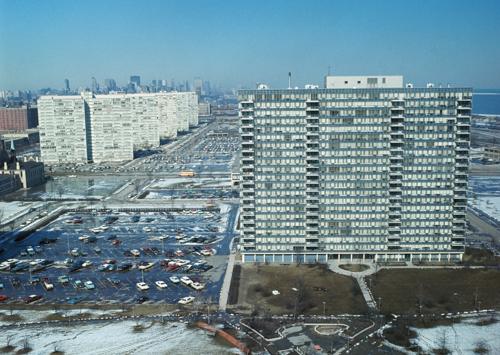
Interviewing Elizabeth Wood ; part 1
Feb. 6, 1964 Wood, the first (ca. 1950s) Executive Secretary of the Chicago Housing Authority, about her experiences as a social worker in the United States and at international programs funded by the Ford Foundation, and about public housing.
-

Florence Scala and Studs Terkel on the site of Hull House as it is dismantled ; part 1
Jul. 9, 1963 Florence Scala gives Studs Terkel a guided tour of the area around Hull House. Terkel talks to people in the neighborhood. Mr. Briata spoke of how he would go to Hull House once a week to take a bath. Mrs. Picardi liked the area because it had good schools for her kids. Together they visit Scala's favorite butcher, who will have to relocate his business after 40 years.
-
Florence Scala and Studs Terkel on the site of Hull House as it is dismantled ; part 2
Jul. 9, 1963 The tour continues on Maxell and Halsted Streets. Anita is sad to be leaving a place where she was born & raised. Mrs. Belmont said the mayor promised housing but they're currently living in a hotel. A 17-year resident of Hull House, Mrs. Morales says there will never be another place like it. The general feeling from everyone was that of sadness in having to leave their homes and businesses.
-
Interviewing political activists for senior citizens in the Chicago area
Oct. 14, 1981 Interviewing political activists for senior citizens in the Chicago area: Leonard Fuchs of the Gray Panthers and Margaret Person, founder and director of Metro Seniors in Action.
-
Gale Cincotta discusses community organizing
Jul. 6, 1982 The song "America the Beautiful" always reminded Gale Cincotta about how great it was to live in America, the land with great schools and great jobs. It wasn't until Cincotta became a community organizer that she realized all schools and all jobs are not great for everyone. Cincotta's hope was to give people the power to make their lives better, not solely by pointing out problems but by doing something about them.*Please note: some sections have been edited out from the original recording due to copyright considerations
-
Bill Ayers discusses his book "To Teach"
Jun. 23, 1993 According to Bill Ayers, in order to be a good teacher, one must 1st become a student of his/her students' lives. New ideas on how to become a better teacher are offered in Ayers' book, "To Teach: The Journey of a Teacher.'
-
Irwin St. John Tucker and Carolyn Ashbaugh discuss labor history and Lucy Parsons
Apr. 4, 1977 Friar Tuck, as he was also known, was very active in socialist causes in Chicago. In the sweatshops, working fourteen or fifteen hours was the norm. Carolyn Ashbaugh's book "Lucy Parsons" goes over Parsons' movement for the 8-hour work day.
-
Allan Evans and Henry Jordan discuss "The Foundation Years" ; part 1
1970 Allan Evans and Henry Jordan, two young man who grew up in Chicago and attended Dartmouth, discuss their childhoods and adolescent dealing with crime. The two also talk about their gang, The Vice Lords, and the police brutality they experienced. Next, the group talks about the The Foundation Years, a project from Dartmouth.
-
Allan Evans and Henry Jordan discuss The Foundation Years ; part 2
1970 Allan Evans and Henry Jordan, two young man who grew up in Chicago and attended Dartmouth, discuss The Foundation Years project. They talk about trying to recruit friends to Dartmouth, their campus experiences, and their coursework. They also talk about their experiences going through the public school system in Chicago, where they point out many of the inequalities for black students.
-
Interviewing Peggy Terry and Roger Phillips
Jul. 13, 1976 Content Warning: This conversation includes racially and/or culturally derogatory language and/or negative depictions of Black and Indigenous people of color, women, and LGBTQI+ individuals. Rather than remove this content, we present it in the context of twentieth-century social history to acknowledge and learn from its impact and to inspire awareness and discussion. Terry is an organizer of poor Southern whites in Chicago's Uptown neighborhood