Listen to New Voices on Studs Terkel our partnership with 826CHI-here! Read the Story


Showing 11 - 20 of 28 results
-

Francine du Plessix Gray discusses her book “Soviet Women: Walking the Tightrope”
Mar. 8, 1990 Author Francine du Plessix Gray discusses and reads from her book “Soviet Women: Walking the Tightrope.” The discussion is heavily focused on the feminist movement in Russia as it compares to the 1960s feminist movement in the United Sates; as Gray states the Russian movement being much more radical in terms of free love, eroticism, and artistic expression. Studs plays "Chastushki" - Zinaida Kozakova (1961).
-
-
Anne Sidon, Susan Fisher, and Sandra Nye discuss womens' changing roles in society and its connection with mental health
Nov. 6, 1985 Physician Anne Sidon, psychiatrist Susan Fisher, and attorney Sandra Nye discuss womens' changing roles in society and its connection with mental health problems and solutions. The group discusses domestic violence, and notes how the normalization of divorce affects the mental health of women and the parental roles between father and mother. Studs plays “She Sits on the Table” - Tom Paxton (1980).
-
-

R. Buckminster (Richard ) Fuller talks with Studs Terkel
Jan. 20, 1965 A sprawling conversation with R. Buckminster Fuller including his great aunt Margaret Fuller, future communication, the nature of work, human nature, and physics.
-
Barbara Kingsolver discusses her book "Holding the Line: Women in the Great Arizona Mine Strike of 1983"
Sep. 17, 1990 Since no men were allowed to picket against the Phelps Dodge Corp., Mexican American women showed up and according to Kingsolver’s book, “Holding the Line,” the picket lines were a brand new experience for the women. Some of the women had to get their husbands’ permission to picket. The group of women found their lives transformed not only with their cause but with new bonds of friendship from the other women.
-
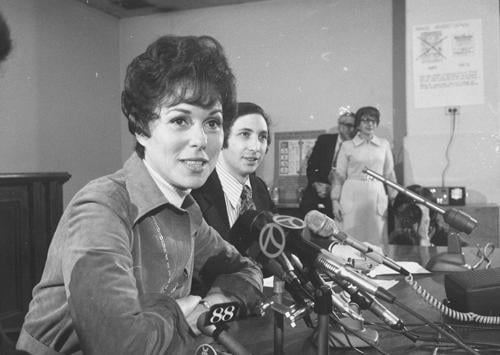
Bess Myerson discusses her career
Jun. 12, 1974 Bess Myerson discusses her career including her experiences as Miss America and as Commissioner of Consumer Affairs for New York City.
-
Barbara Kopple discusses her documentary "American Dream"
Mar. 20, 1992 Academy Award winning documentarian Barbara Kopple talks with Studs about her documentary "American Dream" and the battle fought and lost by union workers in Austin, Minnesota during the mid-80s. They set the backdrop in the small, tight-knit community that Hormel Foods had such a profound impact on, how the UFCW international union declined to support the local union, the gripping dynamics between family members who crossed picket lines, and the healing that occurred when the film was screened in the town several years later.
-
Juliet Mitchell discusses women, family, and oppression
Apr. 25, 1971 An interview with teacher and lecturer, Juliet Mitchell, who is a Marxist. She shares her support for the women's movement and talks about issues that affect women especially gender inequality. Juliet also refers to some comparisons between British and American women's movement.
-
William Stringfellow discusses politics, race, and theology
Interviewing William Stringfellow, American lawyer and activist. He discusses various topics including religion, social issues, and activism. Includes an interview with Cora Weiss. Content Warning: This conversation has the presence of outdated, biased, offensive language. Rather than remove this content, we present it in the context of twentieth-century social history to acknowledge and learn from its impact and to inspire awareness and discussion.