Listen to New Voices on Studs Terkel our partnership with 826CHI-here! Read the Story


Showing 11 - 20 of 22 results
-

Ralph Ellison discusses music
Jun. 18, 1992 The blues and jazz are topics covered by Ralph Ellison. Ellison himself started to play the trumpet at the age of seven. Ellison said for him, when hearing classical music, he then had to go and find classical literature.
-
Interviewing Bessie Burke, Bessie Jones, and Avon Gillespie
1970 Georgia Sea Island Singers Bessie Burke and Bessie Jones join Studs and music teacher Avon Gillespie to talk about gospel music, before an upcoming concert at the National College of Education in Evanston.*Please note: some sections have been edited out from the original recording due to copyright considerations
-
Big Bill Broonzy discusses the blues
Sep. 13, 1955 Big Bill Broonzy discusses the blues with Studs. Big Bill talks about getting ready for a European tour, his young life, and his life as a musician. The following performances have been removed for copyright reasons: "Ride Alberta, ride," "Going Down the road feeling bad," "House rent stomp," "The glory of love," "Plow hand," "I feel so good," and "Make my getaway."
-
-
-
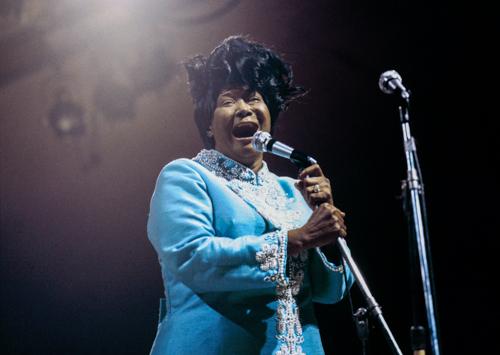
Mahalia Jackson discusses the civil rights movement and the upcoming freedom rally
May. 17, 1963 Studs Terkel interviews gospel vocalist Mahalia Jackson. Jackson discusses the freedom rally that will be taking place at McCormick's Place in Chicago, IL.
-
Maya Angelou discusses her early life and African American culture and people
Apr. 1, 1960 Angelou discusses: her early life; her international travels; dancing; blues and jazz music; and the book "Youngblood" by John Oliver Killens. In this program "In the Evening (When the Sun Goes Down)" and "Joe Turner No. 2 (Blues of 1892)" by Big Bill Broonzy, "I Ain't Gonna Pick No More Cotton" by Sam Lightnin' Hopkins is played, as well as other musical selections.
-
Langston Hughes, John Sellers, James Cotton and Otis Spann discuss blues music
Jul. 15, 1960 Langston Hughes, John Sellers, James Cotton, and Otis Spann discuss their origins and blues music. The interview focuses heavily on Langston Hughes and how deeply he is influenced by the blues. Hughes also discusses his upcoming book "An African Treasury" at length. Hughes, Sellers, Spann, and Cotton perform a number of songs during the interview, they have been removed due to copyright.
-
Maya Angelou discusses her early life and African American culture and people
Apr. 1, 1960 Angelou discusses: her early life; her international travels; dancing; blues and jazz music; and the book "Youngblood" by John Oliver Killens. Musical selections have been removed due to copyright.
-
Ella Jenkins discusses call and response music
Jul. 17, 1993 Using past recordings, Ella discusses how she works with children to help them find their rhythms using call and response music and percussion. She explains the West African and Latin music influences within her own music. Music played includes Jenkins' own music such as "Miss Mary Mack," "Tahboo," and "Where Has My Little Dog Gone?" She also plays song written by Carl Orff and performed by the Chorus of the Children's Opera Group, such s "Pat-a-Cake," and "Name-Calling." Untitled West African music is also played. Music has been removed due to copyright restrictions.