Listen to New Voices on Studs Terkel our partnership with 826CHI-here! Read the Story


-

Dale Clevenger discusses his career as a Jazz musician and member of the Chicago Symphony Orchestra
May. 13, 1980 Studs interviews Dale Clevenger about his music with the Chicago Symphony and his jazz group, Ears, playing at Orphans in Chicago. Clevenger discusses his work with the symphony. He explains why he credits David Amram for his interest in Jazz music. He names artists like Billie Holiday, Jack Teagarden, and Clark Terry as musical influences in his life. The music is removed from this edited version of the original recording.
-
Mary Collins discusses her husband, Lee Collins, autobiography “Oh, Didn’t He Ramble” and his career as a Jazz musician
Sep. 3, 1974 Studs interviews Mary Collins about her husband, Lee Collins. They discuss the book that she and Lee wrote together until his death in 1960. Mary shares interesting stories of Lee’s experiences when he toured. She and Studs reflect on the other artists that Lee Collins worked with and those that influenced his music. Mary shares the story of how she and Lee reconnected in Chicago. She explains how Lee’s depression because of his health led to his attempted suicide and the horrible way he was treated at the psychiatric hospital.
-
Terkel comments and presents musical performance of Pat Ferreri, Ron Steele and Jim Crockett
Jun. 30, 1980 Presenting music and interviewing studio musicians Pat Ferreri, Ron Steele and Jim Crockett editor of Guitar Play Magazine.
-
Bill Crofut discusses his career as a folk singer and his work with other musicians
Dec. 8, 1981 Studs interviews Bill Crofut about his career. They discuss Crofut’s recording label, “Cousin Jacks” and his album with Benjamin Luxon, “Simple Gifts.” Crofut shares his experiences working with various musicians and describes some of his songs. He reflects on his work with the Natalie Wood film, “Brainstorm.” Crofut sings part of the “Grandfather’s Clock” and an unnamed children’s song. The music is removed from this edited version of the original recording.
-
Carlo Curly discusses the history and future of the organ as an instrument and his career as a classical organist
Dec. 15, 1983 Studs interviews Carlo Curly, a RCA recording classical organist. Includes an interview from two years earlier with Curly giving a commentary about Virgil Fox, his greatest influence. Curly describes his family background in music. He explains in great detail the history of the organ, how it is made, and the music written for it. He explains the difference in music between pipe organs and electronic organs. Curly talks about his experience playing in Japan. He speaks of Bach and Mendelson and their influence on the organ as a classical instrument.
-
-
Ryland Davies and Margaret Price discuss opera and their performance in Mozart's "Don Giovanni"
1972 Ryland Davies and Margaret Price discuss opera, Welsh art and culture, and their musical upbringings. They discuss various characters and operas they have performed in, including "Don Giovanni" and "Lulu". Music is played throughout the original airing, but has been removed from this recording for copyright reasons.
-
Blind John Davis discusses Chicago blues
Sep. 20, 1977 Blind John Davis, Chicago blues pianist, discusses his time playing in Germany and at the Blue Note jazz club, chitlin' parties, growing up on the West side of Chicago. He also recalls meeting and working with musicians like Tampa Red and Big Bill Broonzy. Music has been removed from this recording for copyright reasons.
-
Stafford Dean and Catherine Malfitano discuss opera and "The Marriage of Figaro"
Nov. 6, 1975 Stafford Dean and Catherine Malfitano analyze their characters in "The Marriage of Figaro" and aspects of opera. They also discuss their upbringings, musical influences, and the future of opera. The original show opened with a recording of the Overture from "The Marriage of Figaro", which has been removed from this recording for copyright reasons.
-
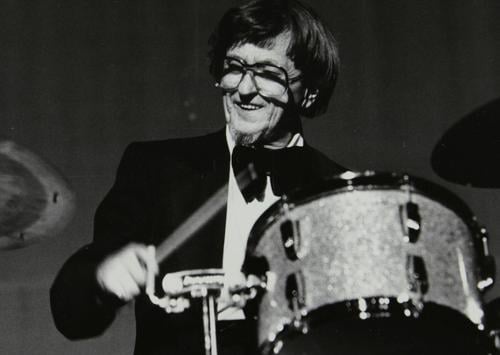
Barrett Deems discusses jazz drumming
Mar. 27, 1979 Barrett Deems discusses his upbringing where he began drumming at age 4 and recalls touring with Louis Armstrong and other musicians. He also talks about meeting drummers in Africa. Music is played throughout: "Flip"- Joe Venuti, "Shine"- Barrett Deems Hottet, "Now You Has Jazz"- Bing Crosby and Louis Armstrong (from "High Society"), "Muskrat Ramble"- Louis Armstrong, "Struttin' with Some Barbecue"- Louis Armstrong, "Slipped Disc"- Benny Goodman, "Stompin' at the Savoy"- Louis Armstrong. Music has been removed from this recording for copyright reasons.