Listen to New Voices on Studs Terkel our partnership with 826CHI-here! Read the Story


Showing 1 - 10 of 12 results
-

Father Daniel Berrigan discusses his life
Jun. 1, 1972 Fr. Daniel Berrigan speaks about his early life, and relationship with his family, on his becoming a priest, and on being an anti-Vietnam War activist.
-
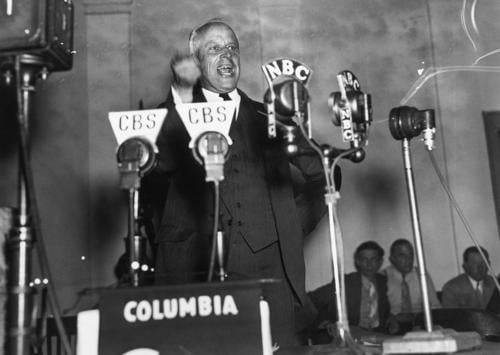
Norman Thomas discusses social progress ; part 2
Dec. 30, 1964 Socialist Party leader and Presbyterian minister Norman Thomas discusses social progress, his political views, and where society is headed with Studs Terkel. This is the final part of his interview.
-
Father John McKenzie and Dr. Howard Schomer discuss personal responsibility, morality and hate, as it pertains to the Vietnam War ; part 2
1965 The interview continues with Father John McKenzie and Dr. Howard Schomer talking about fear and dissent. Schomer says Christians have the duty to dissent when they believe their beliefs are being contradicted by policy. He also talks about not understanding a dampening down of the human mind when it comes to human issues. Father McKenzie adds that society is made up of the best educated ignoramuses that ever existed.
-
Father John McKenzie and Dr. Howard Schomer discuss personal responsibility, morality and hate, as it pertains to the Vietnam War ; part 1
1965 Whether in the United States or Vietnam, Dr. Schomer asks what are our personal responsibilities for the atrocities? Father John McKenzie talks about a lowering of people's moral tone. People have put their morality in their pockets, so as to get cleared of something and not get involved, added Father McKenzie.
-
Professor Adolph Baker, Jurgen Hinze, Professor Richard Lewenton and Father William Wallace discuss science and politics; part 1
Jan. 12, 1971 Professors Adolph Baker, Jurgen Hinze, Richard Lewenton, and Father William Wallace discuss science and politics. The four professors explore question such as whether scientists be involved in political decisions. World War II and Vietnam War are used as examples by the scientists. An earlier interview with scientists Edward Teller and Albert Szent-Gyorgy is played.
-
Thich Nhat Hanh discusses poetry and Vietnam
Apr. 21, 1971 In an interview with Studs Terkel, Buddhist monk, peace activist, and poet Thich Nhat Hanh. The conversation focuses on the devastating effects of the Vietnam War; they discuss the loss of culture and poetry in Vietnam, the anti-war protestors in America and Vietnam, and the sadness and resignation of the Vietnamese. Thich Nhat Hanh talks about America’s role in the war, and his experiences campaigning for peace in the United States and speaking with U.S. anti-war veterans.
-
Thomas Hayes discusses his time ministering to deserters of the Vietnam War
Jan. 20, 1970 An Episcopal priest, Thomas Hayes, talks about the Vietnam War deserters who fled to Stockholm. Unlike Canada, Sweden offered asylum and publicly welcomed resisters. According to Thomas, the men who went to Stockholm worked jobs and some took classes. Thomas also explained that the deserters never put down those who were fighting in the war.
-
Charlie Litkey discusses the impact and significance of winning a Congressional Medal of Honor
Feb. 3, 1987 Discussing the impact and significance of winning a Congressional Medal of Honor with recipient Charlie Litkey. A chaplain with the 25th Infantry in 1967, Litkey received the Medal of Honor for pulling several wounded soldiers to safety without regard to his own safety.
-
Cao Ngoc Phuong discusses being a Buddhist in Southern Vietnam and starting the Buddhist School of Youth for Social Service
Feb. 25, 1970 Discussion with Cao Ngoc Phuong a Buddhist educator from Southern Vietnam and, one of the founding members of the Buddhist Student Movement, and the Buddhist School of Youth for Social Service. Includes poetry reading by Thich Nhat Hanh from his book "Vietnam: Lotus in a sea of fire-a Buddhist proposal for peace" Includes songs sung by Cao Ngoc Phuong: "The old man and the child" by Trinh Cong Son, "The Cio Linh mother" by Pham Duy, and "Lullaby" by Chinh Ba and Nhat Hanh.
-
Lillian Shirley discusses North Vietnam
Apr. 4, 1973 Discussing her reflections of what she saw in North Vietnam, including the bombed hospital, Bach Mai, with former nun Lillian Shirley. An elderly woman told Shirley that she didn't blame the American people for the bombings. Despite seeing 18 of 20 buildings of the Bach Mai Medical Center totally destroyed, Shirley said she found the Vietnamese people to be most cordial and happy.