Listen to New Voices on Studs Terkel our partnership with 826CHI-here! Read the Story


Showing 1 - 10 of 14 results
-

Allan Ryan discusses his book "Quiet Neighbors: Prosecuting Nazi War Criminals in America"
Jan. 29, 1985 Allan A. Ryan, former Director of the Department of Justice's Office of Special Investigations, speaks about his book on the investigation and prosecution of Nazi war criminals in the United States. Ryan says that after WWII, Nazi collaborators and war criminals fled prosecution under the guise of fleeing the threat of communism. Ryan worked on the investigations of prominent war criminals like Ivan the Terrible and John Demjanjuk, and he discusses how he successfully worked with the Soviet Union to obtain crucial evidence located within the USSR for these trials.
-
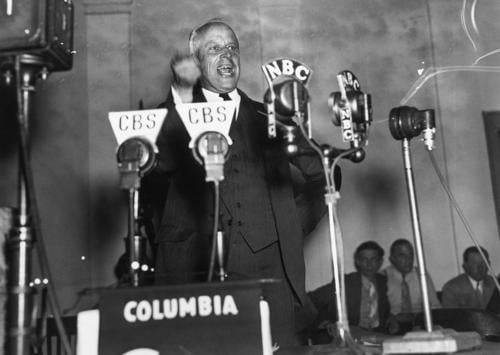
Norman Thomas discusses social progress ; part 2
Dec. 30, 1964 Socialist Party leader and Presbyterian minister Norman Thomas discusses social progress, his political views, and where society is headed with Studs Terkel. This is the final part of his interview.
-
Professor Adolph Baker, Jurgen Hinze, Professor Richard Lewenton and Father William Wallace discuss science and politics; part 1
Jan. 12, 1971 Professors Adolph Baker, Jurgen Hinze, Richard Lewenton, and Father William Wallace discuss science and politics. The four professors explore question such as whether scientists be involved in political decisions. World War II and Vietnam War are used as examples by the scientists. An earlier interview with scientists Edward Teller and Albert Szent-Gyorgy is played.
-
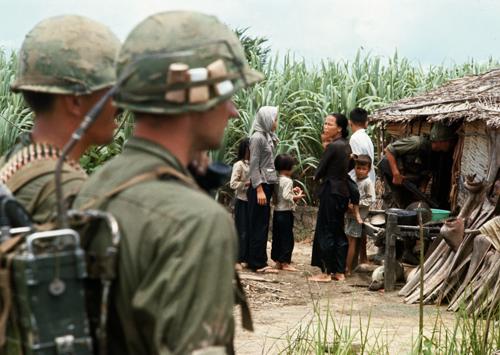
Louis Font and Ed Fox discuss their time in the military and the Vietnam War
Jun. 11, 1971 Louis Font and Ed Fox discuss their time in the military, the Vietnam War, military rituals, and West Point military academy. They express their anti-war sentiments and describe atrocities committed in Vietnam.
-
Hamilton Fish III discusses American history
Colonel Hamilton Fish III discusses American history. Major topics include The Great Depression, Franklin D. Roosevelt, World War II, and Communism. Fish also reads a personal letter sent to him from Martin Dies, Jr. Content Warning: This conversation has the presence of outdated, biased, offensive language. Rather than remove this content, we present it in the context of twentieth-century social history to acknowledge and learn from its impact and to inspire awareness and discussion.
-
A conversation with David Schoenbrun
Jun. 19, 1980 The American broadcast journalist and World War II Army correspondent talks about his book, Soldiers of the Night: The Story of the French Resistance, and the experience of reuniting with some of the people he knew during the war.*Please note: some sections have been edited out from the original recording due to copyright considerations
-
Studs presents program reflecting on President Roosevelt's death
Apr. 11, 1975 Terkel presents program reflecting on individuals' recollection of the day that FDR died and the former President's legacy among younger Americans.
-
-
Willard Van Dyke discusses American history and its effects on the film, photography, and the arts
Apr. 3, 1985 Willard Van Dyke, cinematographer and co-director of documentaries like "The City" and "The River," talks about 20th century American history and how it effected the arts. Using his documentaries and other artists' work, he explores how the Great Depression, World War II, and the Cold War changed American art and culture. He discusses Public Works of Art, war propaganda, and McCarthyism and their challenges for artists. Near the end of this interview, Van Dyke discusses the changes in modern still photography and documentaries as Americans forget history.
-
Studs Terkel talks with three World War Two veterans
Apr. 17, 1985 Interviewing Ed Ruff, Joe Polowski, and Leroy; three veterans of the meeting of U.S. and Soviet forces at the Elbe River on April 25, 1945. The result of this meeting was the splitting of Nazi Germany into two parts and the ensuring of victory in Europe.