Listen to New Voices on Studs Terkel our partnership with 826CHI-here! Read the Story


-

John Egerton discusses his book "Generations: An American Family"
Nov. 3, 1983 Kentucky writer John Egerton discusses his book "Generations: An American Family." The song "Will the Circle Be Unbroken" by Nitty Gritty Dirt Band is played at the opening and closing of the interview. The timestamps are as follows: 00:01:29-00:02:36 (opening) 00:55:33-00:58:40 (closing)
-
John Donahue, Calvin Hill in conversation with Studs Terkel
May. 17, 1995 Interviewing members of the Chicago Coalition for the Homeless, John Donahue and Calvin Hill.
-
John Dominic Crossan in conversation with Studs Terkel
Apr. 10, 1995 Discussing the book "Who Killed Jesus?: Exposing the Roots of Anti-Semitism in the Gospel Story of the Death of Jesus," (published by Harper San Francisco) with the author, teacher John Crossan.
-
John Dinges discusses his book "Assassination on Embassy Row"
Sep. 6, 1980 Because there' s murder, torture, prison terms and terrorism involved, Studs Terkel, mentions that this book reads like a crime novel. "Assassination on Embassy Row," is John Dinges' account of what happened to Orlando Letelier in Washington, D.C. in 1976.
-
John D. Weaver discusses his book "The Brownsville Raid"
Apr. 6, 1971 Events not recorded in history books is what prompted John D. Weaver to write "The Brownsville Raid: The Story of America's Black Dreyfus Affair". Weaver had heard the story of Black Army soldiers causing a raucous, when they were actually set up. Without even being granted a trial, President Theodore Roosevelt, dismissed those soldiers from the United States Army, Weaver explained.
-
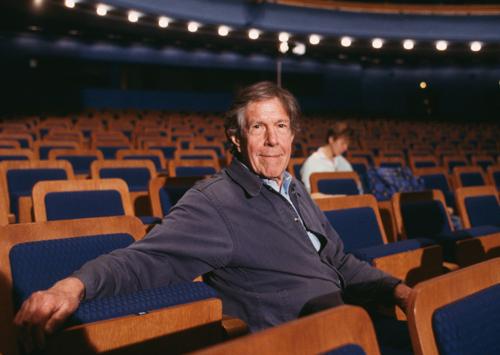
John Cage discusses his music, life, influences, and career
Aug. 13, 1992 John Cage discusses his music, life, influences, and career. Rebroadcast of an interview with John Cage to celebrate his life and what would have been soon his 80th birthday. Includes a clip of John Cage reading/ telling a story in 1969 to Studs Terkel.
-
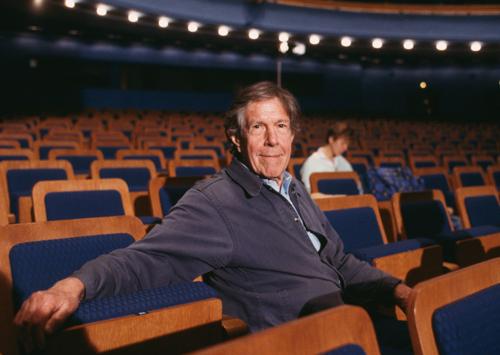
John Cage and Peter Gena discuss their music
1980 Considered one of the most influential 20th-century composers, John Cage and musician/composer Peter Gena discuss their upcoming performance at the Rubloff Auditorium. Cage's pieces will be featured at this performance, including Hymnkus.
-
John Cage and Merce Cunningham discuss their collaborations, careers, choreography, and music
Mar. 10, 1975 John Cage and Merce Cunningham discuss their collaborations of choreography and music. They discuss their influences and careers. Includes a clip of an earlier interview with John Cage.
-
John Bremer discusses educational innovation, "The School Without Walls: Philadelphia's Parkway Program"
Jan. 25, 1971 John Bremer discusses theories of educational innovation. Specifically his innovation of "The School Without Walls: Philadelphia's Parkway Program". Discusses life as education, and the societal element in open plan education.
-
John Bird and Eleanor Bron discuss television and the theatre ; part 2
1962 Eleanor Bron explained that audiences want something new from actors all the time. Bron said she was leery of all the newness because people would get bored. John Bird added that at times, it's difficult to be creative. In the end, they both spoke of their looking around for a two-person show to do together.
-
John Bird and Eleanor Bron discuss television and the theatre ; part 1
1962 Eleanor Bron said television provided its audience with too many facts. Bron also said it’s dreadful to hear about all the misery and tragedy going on in today’s world. In contrast, John Bird said the television offered its audience an opportunity to learn more about world affairs. Switching to the topic of theatre, Bron said she preferred working in the theatre because, as an actor, she has more control over what’s done at every performance. In contrast again, Bird said he did not like acting on the stage.
-
John Bernard discusses his life, politics and his work with the Farmer Labor Party
Aug. 1, 1977 Interviewing labor organizer, civil rights activist, and former Congressman John Bernard. Bernard was elected as a Farmer-Labor candidate to the U.S. House of Representatives and served from 1937-1939.
-
John Bergman, Mike Bail, Jill Reiner, Tom Swift, Geese Theatre Company in conversation with Studs Terkel
May. 23, 1988 Interviewing members of the Geese Theatre Company; Mike Bail, Jill Reiner, Tom Swift, and Artistic Director John Bergman. The Geese Theatre Company specializes in drama therapy in prisons, for correctional staff, and for sexual and violent offenders.
-
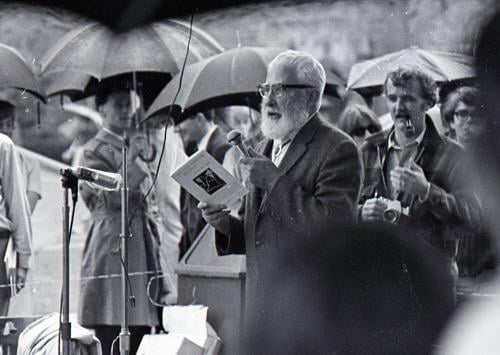
John Beecher talks about his poetry collection "To Live & Die in Dixie"
1969 Discussing "To Live & Die in Dixie & Other Poems". Includes excerpt from Studs' 1965 Montgomery program that features Beecher (1905917-3-1). Beecher reads "To Live and Die in Dixie", "Chainey", "The Better Sort of People", "After Christus", "Bestride the Narrow World", "Wisdom of the Abbott Macarius", "Josiah Turnbull took no part in politics", "A Commemorative Ode".
-
John Bailey, Robert Tucker, and Dick W. Simpson discuss housing and transportation ; part 4
Oct. 9, 1974 Dick Simpson's book, "Chicago's Future: An Agenda for Change," is discussed with the author, John Bailey and Robert Tucker, all employees of Chicago universities. The group discusses housing and transportation issues that many working class citizens face. The group discusses possible ways to fix the issues including government help and re-zoning.