Listen to New Voices on Studs Terkel our partnership with 826CHI-here! Read the Story


Showing 76 - 90 of 206 results
-

Jonathan Kozol discusses his book "Savage Inequalities"
Sep. 18, 1991 With his book, "Savage Inequalities: Children in America's Schools," Jonathan Kozol spent time in six different schools and concluded that the school systems are no better off than they were 20 years ago.*Please note: some sections have been edited out from the original recording due to copyright considerations
-

Jonathan Kozol discusses his book "Children of the Revolution: A Yankee Teacher in the Cuban Schools"
Nov. 10, 1978 Studs has a spirited discussion with Jonathan Kozol who shares his adventures and learnings in Cuba that formed the basis of his book "Children of the Revolution: A Yankee Teacher in the Cuban Schools." Kozol explains the ambitious Cuban Literacy Campaign begun in the 1960s that aimed to educate the entire population, tells of children teaching adults in remote villages by lantern light, and the unity and national pride that resulted. He and Studs explore the idea of generative words in literacy education and contemplate Kozol's hope to adapt a similar approach to American education.
-
Johnny shares his thoughts about the neighborhood ; part 1
1968 Content Warning: This conversation includes racially and/or culturally derogatory language and/or negative depictions of Black and Indigenous people of color, women, and LGBTQI+ individuals. Rather than remove this content, we present it in the context of twentieth-century social history to acknowledge and learn from its impact and to inspire awareness and discussion. Fourteen year-old Johnny attends Harrison High School. When asked if he were God & what changes he would make, Johnny replied he'd see to it that Black people remain on the their side of town.
-
John T. Scopes discusses the "Scopes Monkey Trial" of 1925
Oct. 20, 1960 John T. Scopes was a young teacher who taught biology. He was arrested because in Tennessee, no theory of the origin of man could be taught in schools. Clarence Darrow, an attorney from Chicago, defended Scopes in the "Scopes Monkey Trial" of 1925. Scopes was found guilty and was fined $100.
-
John Peter Jones talks with Studs Terkel about his book "The Feather Pluckers"
Apr. 1, 1965 John Peter Jones discusses English youth, the working class, and his book, "The Feather Pluckers."
-
Joe Rosen, Betsy Clayton, and Jim First discuss child parent centers, DISTAR, and learning to read
Jun. 10, 1976 Discussing the concept of DISTAR (Direct Instructional System for Teaching and Remediation) program, the use of phonics to teach children to read, and interviewing Joe Rosen, Betsy Clayton, and Jim First.
-
Jim Grigsby discusses art classes with sound
Artist Jim Grigsby and other unnamed guests talk about introducing sound into art classes. Includes an unrehearsed production by a woodworking class.
-
Jill S. Robinson discusses her book "Perdido"
Feb. 24, 1993 Jill S. Robinson discusses her book "Perdido," her experiences growing up in Hollywood, CA, and how these experiences influenced her novel; reads a passage from the novel at 2:18 and 49:40, and the epigraph of the novel at 55:45.
-
Jill Nelson discusses her book "Volunteer Slavery"
Jul. 14, 1993 Family and family secrets like Ms. Nelson's bout with alcoholism or her sister's mental health issues are covered in the book. Working for the Washington Post, she thought would be the highlight of her career, however, she talks about losing her journalistic integrity while working at that environment.
-
Jan Myrdal in conversation with Studs Terkel
Apr. 4, 1992 Discussing the books "Childhood" and "The Confession of a Disloyal European" (both published by Lakeview Press) with the author Jan Myrdal.
-
-
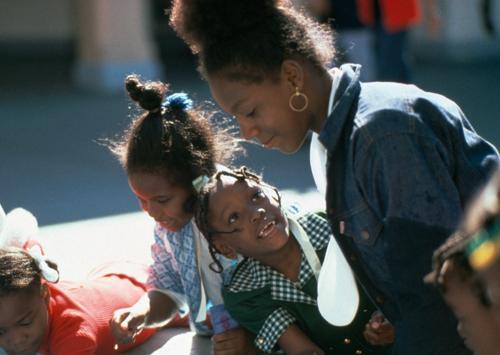
James Comer and Alvin Poissaint talk with Studs Terkel
Aug. 5, 1975 James Comer and Alvin Poissaint discuss their book " Black Child Care: How to Bring Up A Healthy Black Child In American - A Guide to Emotional and Psychological Development". They discuss raising a Black child in America in the 1970's, amid racism. Clip played of Odetta "All the Pretty Little Horses"(Studs Terkel Archive WAV ID 1853133-3-1)
-
James Clement, Mrs. Barry Norton, and Pearl Shaw discuss Chicago schools ; part 1
1965 Discussing the "Chicago Schools Challenge " and interviewing James Clement, Mrs. Barry Norton, and Pearl Shaw.
-
Jaime Escalante discusses his career as a mathematics teacher
Aug. 5, 1988 Studs interviews educator Jaime Escalante about his successful work as a mathematics teacher at Garfield High School in East Los Angeles, which is represented in the film “Stand and Deliver.” Includes an interview with Edward James Olmos.
-
Jack Conroy discusses sign painter Slappy Hooper
Program is only 5 minutes 12 seconds long.