Listen to New Voices on Studs Terkel our partnership with 826CHI-here! Read the Story


Showing 196 - 210 of 222 results
-

Discussing "war toys" with Olga Kreisberg and Jack Wright
Dec. 13, 1965 After listening to some field recordings of staff and customers at a downtown Chicago toy store, social worker Olga Kreisberg and toy manufacturer Jack Wright speak with Studs about the proliferation of toys that glorfiy warfare. A clip of an earlier recording of designer Charles Eames is included.*Please note: some sections have been edited out from the original recording due to copyright considerations
-

Discussing "Dossier : the Secret Files They Keep on You" and interviewing the author Aryeh Neier
Mar. 31, 1975 Discussing "Dossier : the Secret Files They Keep on You" and interviewing the author Aryeh Neier.
-
Dick Gregory discusses American politics
Dec. 17, 1964 This interview begins with a clip of one of Dick Gregory’s performances, where he talks about nonviolence and Native Americans. Studs Terkel introduces his guest as an observer, explaining that comedians are the best observers in society. Gregory offers extended analogies to communicate his views on a variety of topics, including the Vietnam War, race relations, segregation, human rights, and urban renewal. [The date is unclear, but it has to be after 1970, since the Kent State Shootings were mentioned]
-
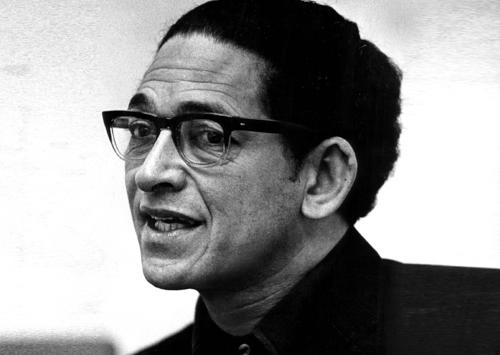
Dennis Brutus, John Fry, and Judith Todd discusses race, South Africa, and Rhodesia
Apr. 28, 1973 Judith Todd, daughter of prime minister of Rhodesia, discusses the book "Right to say no"; Dennis Brutus, poet and involved in protest of Rhodesia taking part in 1972 Olympics, and John Fry pastor First Presbyterian Church and social writer, race, South Africa, and Rhodesia. Excerpt from interview of people in South Africa - a guide, an Afrikaner, and a Chicago policeman regarding race (1895817-6-1 South African Tapes). The three were brought together to have a round table discussion about race relations in South Africa.
-
Dennis Brutus discusses the non-violent fight against Aparthied in South Africa and reads his poetry
Sep. 13, 1972 Dennis Brutus reads several of his poems from the book "Letters to Martha and Other Poems From a South African Prison" (Letters number 1, 9, 17 - "In prison"). Dennis Brutus discusses the 1972 Summer Olympics and being imprisoned for being an activist against Apartheid and the unreasonable laws that went along with Apartheid. Interview begins with excerpt of interview with Chief Albert John Luthuli (excerpt from 1895817-6-1).
-
Debra Evenson and Gisela Lopez discuss the U.S. embargo on Cuba
Sep. 1, 1994 Attorney Debra Evenson and Gisela Lopez discuss the U.S. embargo on Cuba, the 1994 Cuban craft crisis, and food shortages and life in Cuba.
-
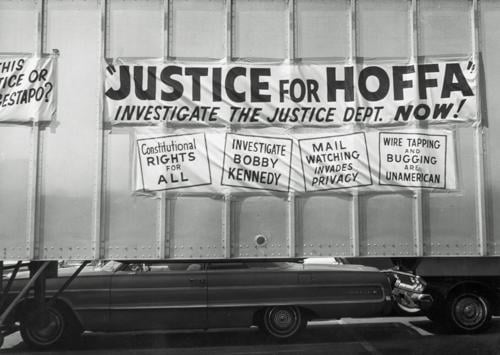
David Wise discusses his book "The Politics of Lying: Government Deception, Secrecy, and Power"
May. 25, 1973 Political author David Wise discusses his book, "The Politics of Lying: Government Deception, Secrecy, and Power", published in 1973. Wise talks about the current state of government information and transparency.
-
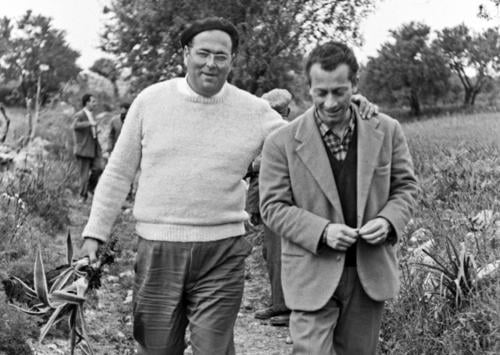
Danilo Dolci discusses his career, life in Italy, and his book "The Man Who Plays Alone"
1970 Danilo Dolci discusses his life in Italy, his book "The Man Who Plays Alone", architecture, agriculture, social activism, his inspirations, and his career. Tom Cornell translates for Danilo Dolci. Includes at the end of the program an Italian song by Jerre Mangione and an Italian song called "Bella Ciao".
-

Cleve Jones talks about the NAMES Project Foundation and AIDS quilt
Sep. 7, 1988 Cleve Jones talks about the AIDS quilt (NAMES project) that he started, the politics surrounding treating AIDS, and the compassionate feelings that the quilt engenders (compared to American barn raisings). There is a postscript with Mike Savage from Dignity Chicago, a lesbian and gay Catholic organization.
-
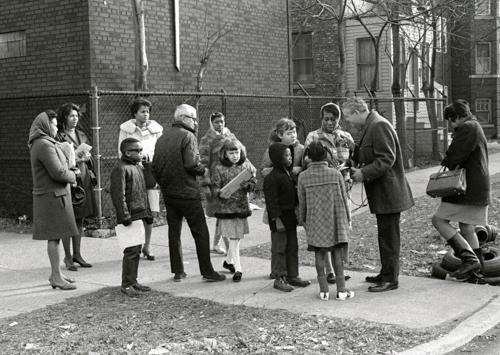
Chicago school teachers and principals discuss Chicago schools
1970 Discussing the state of West side Chicago schools with a panel of teachers and principals from four different schools.
-
Cesar Chavez discusses unionizing migrant farm workers
Jun. 4, 1973 Cesar Chavez discusses unionizing migrant farm workers, and how nonviolent tactics made the farm workers' struggle a cause with nationwide support(grape boycott). Includes excerpt from Hard Times: Voices of the Great Depression.
-
C.D.B. Bryan talks with Studs Terkel
Jul. 14, 1976 C.D.B. Bryan discusses his book "Friendly Fire" and the Vietnam War. Bryan discusses the true story of Michael Mullen who was killed by friendly fire in Vietnam and his family.
-
Bob and Joan Ericksen discuss the literary work of Peter Weiss and environmental ecology
1967 Bob and Joan Ericksen, both educators, artists, and environmental ecologists, discuss the literary work of Peter Weiss' "I Come Out of My Hiding Place" and environmental ecology. Excerpt of Peter Weiss reading from "I Come Out of My Hiding Place." The book speaks of why he writes and why he pursues his art (unknown source). The interview ends with a reading by Studs of an excerpt fro, Gustav Meyrink's "The Green Face."
-
Bill Ayers reads from and discusses his book "A Kind and Just Parent"
Jun. 25, 1997 Bill Ayers' book, "A Kind and Just Parent: The Children of Juvenile Court" takes a look at kids getting caught up and lost in the system. While observing in the courts, Ayers said all kids just became a thing.
-
Bill Ayers discusses his book "To Teach"
Jun. 23, 1993 According to Bill Ayers, in order to be a good teacher, one must 1st become a student of his/her students' lives. New ideas on how to become a better teacher are offered in Ayers' book, "To Teach: The Journey of a Teacher.'