Listen to New Voices on Studs Terkel our partnership with 826CHI-here! Read the Story


Showing 91 - 105 of 241 results
-

Marian McPartland and Jimmy McPartland discuss their Jazz careers
Sep. 27, 1973 Studs interviews Jimmy and Marian McPartland. The McPartlands reflect on the people who influenced their music in Jazz. Studs quotes Jimmy McPartland and reads part of a critic's column about Marian in the Chicago Sun Times. Marian shares a little about what it is like to be a female musician in Jazz. Both discuss their past career and their futures. Jimmy reflects on his hard times in the 1920s-1930s. The musical numbers are removed from this edited version of the original recording.
-
Marian McPartland and Jimmy McPartland discuss their careers in Jazz
Aug. 9, 1978 Studs interviews Marian and Jimmy McPartland. The McPartlands reflect on those in Jazz who have influenced them. Studs talks to Marian about women in Jazz. They discuss the Jazz audience. The musical numbers are removed from this edited version of the original recording.
-
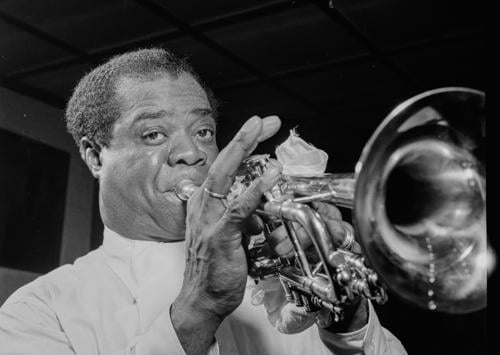
Louis Armstrong discusses music
Jun. 24, 1962 In a nightclub in Chicago, at two in the morning and after a performance, Louis Armstrong talks about his music stylings. Notes are good to learn the tune, says Armstrong, but it's all about the phrasing. Armstrong explained, it's up to you to express yourself. Armstrong shared the one piece of advice that had always stuck with him. King Oliver told Armstrong not to worry about the notes but rather to put some lead into the song.
-
Listening to and discussing the "Living Music Collection '86," with saxophonist, bandleader, and composer Paul Winter
Oct. 20, 1986 Listening to the Living Music Collection
-
-
-
Lena Horne talks about her influences and her career
1984 Lena Horne talks about her memories of Paul Robeson and Billie Holiday, how her skin color affected her career, and her relationship with her audience.
-

Lawrence Ferlinghetti discusses his poetry
Oct. 15, 1959 Includes Lawrence Ferlinghetti reading and discussing his poems from his books "A Coney Island State of Mind" and "Big Table."
-
Lawrence (Bud) Freeman discusses jazz with Studs Terkel
May. 11, 1971 Studs Terkel interviews Lawrence "Bud" Freeman about his career in jazz.
-
Lawrence (Bud) Freeman discusses his career as a tenor sax jazz musician
Dec. 1, 1980 Studs interviews Bud Freeman about his career in Jazz and his book, "Working" as well as his album, "Complete Bud Freeman." Freeman shares stories about his dad and brother during his childhood. He discusses various songs from his album and shares stories about his interactions with other jazz musicians. Studs reads a few passages from Freeman's book. They discuss how Freeman's creative practices and how his music has changed over the years. Musical pieces are removed from this edited version of the original recording.
-
Lawrence (Bud) Freeman discusses his career as a jazz tenor sax player and his album "Complete Bud Freeman"
Apr. 15, 1982 Studs interviews Lawrence Freeman about his career in jazz. Studs notes that he first interviewed Freeman in 1939 as his first guest on his radio program with WGES. Freeman shares the names and events of influences in his life. He describes his interactions with other jazz musicians throughout his career and shares some stories about his brother, father, and childhood. Studs quotes Mark Miller of the Toronto Globe, music critic, for what he notes about Freeman.
-
Kurt Elling discusses his jazz music and background
Aug. 11, 1997 Jazz singer Kurt Elling discusses his musical influences, new and past music, and the path of his career.
-
-
John Litweiler in conversation with Studs Terkel
Jul. 1, 1984 Discussing the book "The Freedom Principle: Jazz After 1958" (published by Morrow) with author and jazz historian John Litweiler.
-
John Hammond and John McDonough discuss music and their careers
Sep. 11, 1975 Presenting music with music producer (impresario) John Hammond. The following topics were discussed: various recordings; his encounters with famous jazz musicians; the first time he met Billie Holiday; the song "Strange Fruit"; improvisation; racial reform; Bessie Smith's death; and uniting rural and urban artists. The following musical excerpts were played and have been removed for copyright reasons: "7 Come 11"; "This Years Kisses"; "Lady Be Good"; "Young Woman's Blues"; "What More Can Jesus Do"; and "Piney Brown Blues".