Listen to New Voices on Studs Terkel our partnership with 826CHI-here! Read the Story


Showing 226 - 240 of 272 results
-

-
Discussing Chicago architecture with Carl Condit and Maurice English ; part 2
1964 Condit wrote the book The Chicago School of Architecture: A History of Commercial and Public Building in the Chicago Area, 1875-1925, and English edited The Testament of Stone: Themes of Idealism and Indignation from the Writings of Louis Sullivan.
-
Discussing Chicago architecture with Carl Condit and Maurice English ; part 1
1964 Condit wrote the book The Chicago School of Architecture: A History of Commercial and Public Building in the Chicago Area, 1875-1925, and English edited The Testament of Stone: Themes of Idealism and Indignation from the Writings of Louis Sullivan.
-
-
Discussing a production of the play, "Never Come Morning", with playwright Paul Peditto and cast members Jennifer Markowitz, Andy Hawks and Lara Phillips
Sep. 19, 1994 Adapted by Peditto, the play, "Never Come Morning", is based on the Nelson Algren novel of the same title, a story about a man working his way out of a low-income neighborhood in Chicago. The cast discusses their familiarity with Algren’s work and how they found their way into this production. Studs and the cast of this production read through several of the scenes from the play. This program includes clips of interviews and performances of Nelson Algren that capture his storytelling abilities.
-
Discussing "A Journey through Newberry library" and with Lawrence Towner
Sep. 28, 1964 about The Newberry Library
-
Dick Simpson discusses neighborhood government system
Mar. 1, 1979 Dick Simpson, alderman of Chicago, discusses neighborhood governments. He describes the history, explains the uses of wards, and shows how the system can work in light of a recent election in Chicago. Studs reads an article about the recent election by Mike Royko.
-
Dick Simpson discusses his book, Strategies for Change: How to Make the American Political Dream Work"
Sep. 27, 1976 Alderman Dick Simpson discusses his book, "Strategies for Change: How to Make the American Political Dream Work," and his work as the 44th Ward Alderman. He explains the assembly system that now runs the 44th Ward, where members are able to bind him to a vote if the majority decides. He also discusses how the assembly has already changed redlining, the school system, truck load limits, and high rise development within their neighborhood.
-
Detroit Police Commissioner Ray Girardin and representatives Robert R. Canfield and Jim Moran discuss the death penalty
Ray Girardin, Detroit Police Commissioner, is opposed to capital punishment. In 1930, he witnessed a man being put to death and he says it's a horrible sight to behold. Representative Robert Canfield of Rockford, explained that the state doesn't have the right to put a man to death. He further explained that the death penalty does more harm than good. Springfield freshman representative Jim Moran talks about House Bill 28 and the abolishment of the death penalty going through.
-
Dennis Smith discusses his experiences as a firefighter in New York City
Firefighter and writer, Dennis Smith, shares some of the encounters he's had as a firefighter and discusses his book and magazine based on these experiences.
-
Dennis Kucinich discusses his beliefs and campaign platforms
Jun. 9, 1995 Former Mayor of Cleveland, Ohio, Dennis Kucinich, explained that when he ran for office, he believed it was important to take a stand and to fight for what you believe in. Kucinich believed people had the right to good public education for their children, along with lower costs for their utilities and their health insurance. Kucinich also believed people wanted good jobs and if everyone did the right thing, they would be rewarded..
-
Denis Mitchell and Mack have a conversation with Studs in a pub while visiting London
Sep. 9, 1960 *Please note: some sections have been edited out from the original recording due to copyright considerations
-
Dempsey Travis discusses his memories of Jazz artists
May. 23, 1989 Dempsey Travis, author and jazz historian, recalls his memories meeting Jazz artists of the 1920-1940s. Some artists discussed include Jimmie Lunceford, Sy Oliver, Duke Ellington, Chick Webb, Chu Berry, Andy Kirk and others. Travis also discusses his father and his own time playing Jazz.
-
David T. Dellinger discusses his book "From Yale to Jail"
Apr. 23, 1993 The early influences of his father, his time in prison, and a bomb being sent to his home are among the topics covered in Dellinger’s book, “From Yale to Jail: The Story of a Moral Dissenter”. Dellinger is best known for being one of the Chicago Eight. He recalls a time in Lincoln Park, IL when he was warned to get out of there quickly because the police were told to attack Dellinger and his group.
-
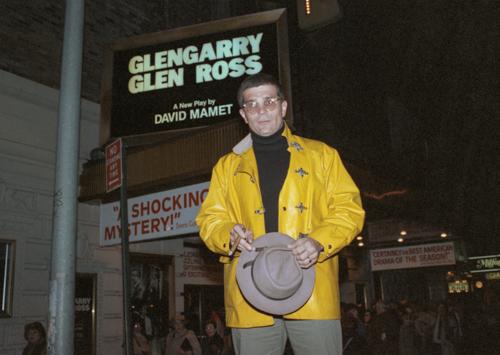
David Mamet discusses his play Glengarry Glen Ross
Jan. 13, 1984 David Mamet discusses his play Glengarry Glen Ross. Includes two scenes from the play recited by both David Mamet and Studs Terkel.