

-

Studs Terkel talks with artist Gene Hall and Dr. Paul Mundy about the painting "The Black Christ Not Worthy of Its Cross" ; part 1
Sep. 21, 1965 Studs Terkel interviews the artist Gene Hall who created "The Black Christ Not Worthy Of Its Cross" and the head of the Loyola University Sociology Department, Dr. Paul Mundy, who used the title and painting reproduction to spark classroom discussions. Hall describes the creation of his 6 ft tall by 2 1/2 feet wide painting and how seeing the color of Christ diminishes Christ. You don't see Christ when you see color. Hall uses barbed wire instead of thorns in the painting to signify there is no time in painting, it is up to date.
-
Studs Terkel talks with artist Gene Hall and Dr. Paul Mundy about the painting "The Black Christ Not Worthy of Its Cross" ; part 2
Sep. 21, 1965 Studs Terkel interviews the artist Gene Hall who created "The Black Christ Not Worthy Of Its Cross" and the head of the Loyola University Sociology Department, Dr. Paul Mundy, who used the title and painting reproduction to spark classroom discussions. Hall describes the creation of his 6 ft tall by 2 1/2 feet wide painting and how seeing the color of Christ diminishes Christ. You don't see Christ when you see color. Hall uses barbed wire instead of thorns in the painting to signify there is no time in painting, it is up to date.
-
Studs Terkel presents a performance of the Rhos Welsh Choir
Aug. 23, 1988 Terkel comments and presents musical performance by the Rhos Welsh Choir
-
Studs Terkel discusses religion with Msgr. John Egan, Dr. Howard Schomer and Rabbi Arnold Wolf ; part 2
Feb. 13, 1965 Studs continues his discussion of religion in contemporary society with Catholic Msgr. John Egan, Dr.
-
Studs Terkel discusses religion with Msgr. John Egan, Dr. Howard Schomer and Rabbi Arnold Wolf ; part 1
Feb. 12, 1965 Studs discusses religion in contemporary society with Catholic Msgr. John Egan, Dr.
-
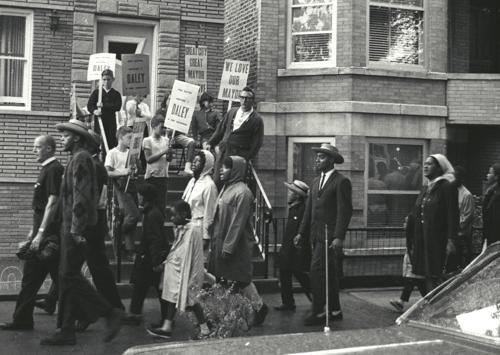
Studs Terkel discusses race relations and economic disparity with four Chicago area women ; part 2
Jan. 27, 1965 Studs discusses race relations and economic disparity with four Chicago area women in a program entitled "Each of us can act". This recording was the last of a 6-part series, "Rearing the Child of Good Will", broadcast under the auspices of the National Conference of Christians and Jews.
-
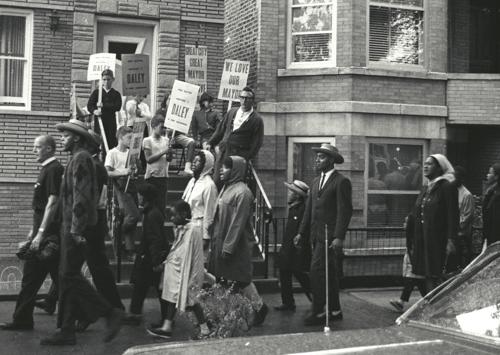
Studs Terkel discusses race relations and economic disparity with four Chicago area women ; part 1
Jan. 27, 1965 Studs discusses race relations and economic disparity with four Chicago area women in a program entitled "Each of us can act". This recording was the last of a 6-part series, "Rearing the Child of Good Will", broadcast under the auspices of the National Conference of Christians and Jews. The series focused on prejudice, race, religion, and community. Interviewees are: Madeline Bonsigniore of Chicago's south suburbs, Naomi Brodky of the Marynook neighborhood of Chicago, Lynn Williams of Winnetka, and Harriet White of the NCCJ.
-
Studs Terkel discusses literature, Judaism, and the Holocaust with Richard Elman ; part 2
1967 Studs Terkel discusses literature, Judaism, and the Holocaust with the novelist, poet, journalist, and teacher Richard M. Elman (1934-1997). Their discussion revolves around Elman's recently published work of historical fiction, "The 28th Day of Elul", much of which takes place in the village of Clig, Hungary, during the time of the Nazi occupation of Hungary during World War II. Topics include Jewish identity, The Holocaust, persecution of The Jews, feelings of guilt and social prejudice among Holocaust survivors.
-
Studs Terkel discusses literature, Judaism, and the Holocaust with Richard Elman ; part 1
1967 Studs Terkel discusses literature, Judaism, and the Holocaust with the novelist, poet, journalist, and teacher Richard M. Elman (1934-1997). Their discussion revolves around Elman's recently published work of historical fiction, "The 28th Day of Elul", much of which takes place in the village of Clig, Hungary, during the time of the Nazi occupation of Hungary during World War II. Topics include Jewish identity, The Holocaust, persecution of The Jews, feelings of guilt and social prejudice among Holocaust survivors.
-
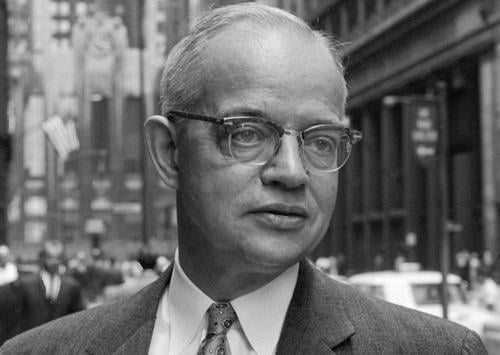
Studs Terkel discusses church architecture with William Cooley and Martin Marty
Apr. 27, 1965 Studs Terkel discusses church architecture William Cooley, a church architect, and Martin E. Marty, a theologian and scholar at the University of Chicago.
-
Studs Terkel continues his interview with Erich Luth in Hamburg discussing the aftermath of the war on Germany's youth ; part 3
1967 There is a silence in the tape from 3:48 to 3:58 due to Studs changing the tape. It should be noted that the word "clever" in this discussion means intelligent. The interview concludes at 35:36 where Studs offers his reflections on his stay. Luth is the retired Press Chief of Hamburg and has also helped with remunerations for the Jewish people in the aftermath of World War II. He has also facilitated detente between Israel and West Germany.
-
St. Clair Drake and Paul Mundy discuss prejudice ; part 2.
1965 Discussing prejudice in communities with Dr. St. Clair Drake and Dr. Paul Mundy. They discuss prejudice towards the races, religions, and ethnicities of people.
-
Son House discusses his life and career as a blues musician
Apr. 19, 1965 Son House discusses his life and career as a preacher and blues musician. He talks about his family, his religious background as a preacher, and his recent comeback after disappearing from music scene in 1943. He performs several songs during the interview, which have been removed due to copyright.
-
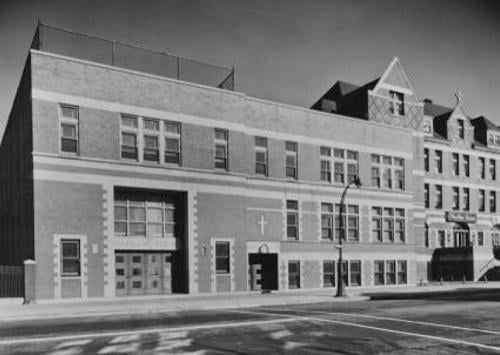
Sister Mary William discusses the importance of Marillac House
Apr. 10, 1968 Content Warning: This conversation includes racially and/or culturally derogatory language and/or negative depictions of Black and Indigenous people of color, women, and LGBTQI+ individuals. Rather than remove this content, we present it in the context of twentieth-century social history to acknowledge and learn from its impact and to inspire awareness and discussion. When she was a teenager, Sister Mary William told her parents that she wanted to become a nun. Sister Mary wanted to become a nun so that she could love and help many people.
-
Sister Dorothy Gartland in conversation with Studs Terkel
May. 2, 1985 Discussing the arrest and subsequent trial of peace demonstrators at the Great Lakes Naval Base near Waukegan, Illinois with Sister Dorothy Gartland.