

-

Studs Terkel talks with Erich Lüth on his first hand experiences living in Hamburg through the rise and fall of Hitler ; part 1
1968 Erich Lüth discusses his experiences, observations, and accounts of life in Hamburg, Germany during the rise and fall of Hitler. He recounts how as a member of Parliament he brought in Hitler's, "Mein Kampf" and read portions aloud and was laughed at by his colleagues. He states they were blind to what Hitler declared in his book he would do and some are still blind by wanting to rub out their past, their history.
-

Studs Terkel discusses literature, Judaism, and the Holocaust with Richard Elman ; part 2
1967 Studs Terkel discusses literature, Judaism, and the Holocaust with the novelist, poet, journalist, and teacher Richard M. Elman (1934-1997). Their discussion revolves around Elman's recently published work of historical fiction, "The 28th Day of Elul", much of which takes place in the village of Clig, Hungary, during the time of the Nazi occupation of Hungary during World War II. Topics include Jewish identity, The Holocaust, persecution of The Jews, feelings of guilt and social prejudice among Holocaust survivors.
-
Studs Terkel discusses literature, Judaism, and the Holocaust with Richard Elman ; part 1
1967 Studs Terkel discusses literature, Judaism, and the Holocaust with the novelist, poet, journalist, and teacher Richard M. Elman (1934-1997). Their discussion revolves around Elman's recently published work of historical fiction, "The 28th Day of Elul", much of which takes place in the village of Clig, Hungary, during the time of the Nazi occupation of Hungary during World War II. Topics include Jewish identity, The Holocaust, persecution of The Jews, feelings of guilt and social prejudice among Holocaust survivors.
-
Studs Terkel continues his interview with Erich Luth in Hamburg discussing the aftermath of the war on Germany's youth ; part 3
1967 There is a silence in the tape from 3:48 to 3:58 due to Studs changing the tape. It should be noted that the word "clever" in this discussion means intelligent. The interview concludes at 35:36 where Studs offers his reflections on his stay. Luth is the retired Press Chief of Hamburg and has also helped with remunerations for the Jewish people in the aftermath of World War II. He has also facilitated detente between Israel and West Germany.
-
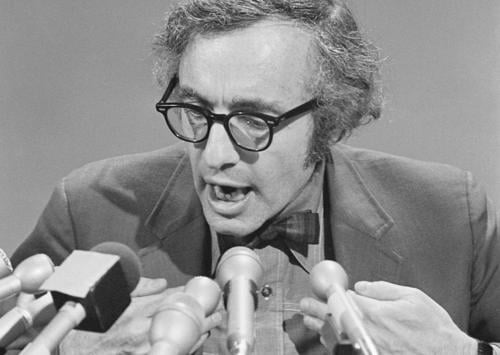
Robert Jay Lifton discusses his book "Living and Dying"
Jan. 6, 1975 With his book, "Living and Dying," Robert Jay Lifton, said the point he wanted to make clear is that individuals have to confront death in order to live well. Lifton also talks about deniers of death and their numbing feelings. Social change with regards to death, explained Lifton, will need to occur.
-
Gitta Sereny discusses her book "Into That Darkness"
Feb. 7, 1983 While in a Dusseldorf prison, Gitta Sereny spent 70 hours interviewing Franz Stangl, the commandant of the Treblinka extermination camp. Her book, "Into That Darkness: An Examination of Conscience," questions how could an ordinary man with a wife and children become such an evil monster. Stangl rationalized his job by saying he never hurt anyone, that he never murdered anyone. Sereny said in the end, the only guilt Stangl harbored was that of still being alive.*Please note: some sections have been edited out from the original recording due to copyright considerations
-
David Hamlin discusses his book, "The Nazi/Skokie Conflict: A Civil Liberties Battle"
Mar. 5, 1981 David Hamlin, author and former Executive Director of ACLU, discusses his book "The Nazi/Skokie Conflict: A Civil Liberties Battle." Hamlin talks about Frank Collin, a jewish man turned leader of American Nazi Party leader and the court battle over the right to demonstrate in Skokie, Illinois. He also talks about the retaliation against the ALCU for defending Collin's case in court. At the end of the interview, Hamlin gives some advice on how to deal with people like Frank Collin.
-
Bruno Bettleheim discusses his book "The Informed Heart: Autonomy in a Mass Age"; part 2
1961 Psychologist, Holocaust survivor and author Bruno Bettelheim discusses his imprisonment in Dachua and how it influenced his view on life with the effect of Freud and Kant’s philosophy. Bettelheim was known as an early adopter on the topic of autism.
-
Allan Ryan discusses his book "Quiet Neighbors: Prosecuting Nazi War Criminals in America"
Jan. 29, 1985 Allan A. Ryan, former Director of the Department of Justice's Office of Special Investigations, speaks about his book on the investigation and prosecution of Nazi war criminals in the United States. Ryan says that after WWII, Nazi collaborators and war criminals fled prosecution under the guise of fleeing the threat of communism. Ryan worked on the investigations of prominent war criminals like Ivan the Terrible and John Demjanjuk, and he discusses how he successfully worked with the Soviet Union to obtain crucial evidence located within the USSR for these trials.
-
Albert Alvarez discusses his book "Beyond All This Fiddle: Essays, 1955-1967;" part 2
1972 Albert Alvarez, poet, writer and critic, discusses how technology advancement is changing society. Specifically he discusses war in general, the Holocaust and advancements in destructive weapons. "Beyond All This Fiddle: Essays, 1955-1967."
-
Albert Alvarez discusses his book "Beyond All This Fiddle: Essays, 1955-1967," [part 1] and Jack LaPorte [part 2]
1972 Part 2 of a discussion with Jack LaPorte while Studs was in England. Conversation cuts out at 05:06 and begins the coversation with Al Alvarez. Albert Alvarez, poet, writer and critic, discusses how technology advancement is changing society. He specifically discusses war in general, the Holocaust and advancements in destructive weapons. He speaks fondly of Sylvia Plath, and discusses his current book, "Beyond All This Fiddle: Essays, 1955-1967."