

-
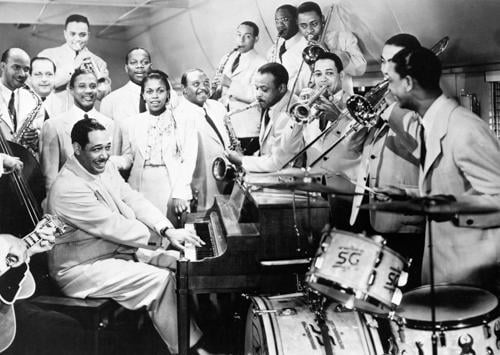
Harriet Choice discusses the career of Duke Ellington and promotes the Grant Park 5th Annual Tribute to Duke Ellington concert
Aug. 25, 1978 Studs interviews Harriet Choice, Jazz critic for the Chicago Tribune. They reflect on the music, talent and career of Duke Ellington. Choice describes several Ellington songs and the history behind them. She shares how Duke created music and wrote specifically for individual people. Studs reads what Ellington wrote about his song “Harlem Airshaft.” Choice and Terkel reflect on Ellington’s music and those who made music with him. Choice shares how a Duke Ellington performance at the Newport Jazz Festival rejuvenated Ellington’s career.
-
Harriet Choice discusses jazz
Aug. 7, 1978 Chicago Tribune jazz critic Harriet Choice plays and discusses some favorite records from her own personal collection with Studs Terkel.
-
Harriet Choice discusses jazz
Aug. 7, 1978 Chicago Tribune jazz critic Harriet Choice plays and discusses some favorite records from her own personal collection with Studs Terkel.
-

Harold Taylor, scholar and former president of Sarah Lawrence College, talks with Studs Terkel
Aug. 8, 1965 An interesting, half-hour interview conducted while Taylor was visiting Chicago on a lecture tour. The two discuss student discontent on campuses across the United States, intellectuals' work in military defense and cynicism among those in the professional-education hierarchy.
-
Harold Taylor on his book "Students Without Teacher: The Crisis in the University" ; part 2
May. 16, 1968 Discussing the book, "Students Without Teachers: The Crisis in the University," and interviewing its author, Dr. Harold Taylor (2 parts). Dr. Taylor is an educator.
-
Harold Taylor on his book "Students Without Teacher: The Crisis in the University" ; part 1
May. 16, 1968 Discussing the book, "Students Without Teachers: The Crisis in the University," and interviewing its author, Dr. Harold Taylor (2 parts). Dr. Taylor is an educator.
-
Harold Rosenberg discusses action painting and other trends in art
Apr. 9, 1966 Harold Rosenberg, a provocative and loquacious art critic, joins Studs Terkel to discuss trends in the art world. The interview begins with a clip from Sonia Delaunay, who remarks that Pablo Picasso does not create art, but transforms it. Rosenberg disagrees with this statement, elaborating on his beliefs that tradition and past experiences and influences are present in any work. The desire to create “new” art is also a complicated concept, according to Rosenberg, as art transcends time and can be considered “new” to new viewers.
-
Harold Prince discusses his direction of Madame Butterfly for the Lyric Opera, Chicago
Sep. 24, 1985 Harold Prince discusses his direction of Madame Butterfly while also discussing operas, musicals, and theater in general.
-
Harold Clurman discusses the theatre and his book "The Fervent Years"
Mar. 20, 1978 Being both a theatre critic and a theatre director prompted Harold Clurman to write his book, "The Fervent Years: The Group Theatre and the 30's". Clurman hopes that with every play a viewer sees, he or she then takes that material and ponders the message. Clurman explained that plays were a way to communicate truth about life.
-
Harald Edelstam discusses his work in Chile before and after the military coup of 1973
Jun. 3, 1974 Former Swedish ambassador to Chile Harald Edelstam discusses his work in Chile before and after the military coup of 1973. At length, he discusses Salvador Allende, the 1973 Chilean coup d'état, and his work to protect Chilean, Cuban, Brazilian, Uruguayan, Bolivian, and Swedish individuals that were targeted by the military junta led by Augusto Pinochet.
-
Hans W. Mattick and Father Robert Taylor discuss the scandal at Cook County Jail
1968 Content Warning: This conversation includes racially and/or culturally derogatory language and/or negative depictions of Black and Indigenous people of color, women, and LGBTQI+ individuals. Rather than remove this content, we present it in the context of twentieth-century social history to acknowledge and learn from its impact and to inspire awareness and discussion. Former Assistant Warden of the Cook County Jail, Hans W.
-
Hans Koning discusses his book "Pursuit of a Woman on the Hinge of History: A Novel"
Dec. 10, 1997 Hans Koning discusses his book "Pursuit of a Woman on the Hinge of History: A Novel," published by Brookline Books; reads passages from book.
-
Hank De Zutter, Betty Jane Wagner, Barbara Kotto in conversation with Studs Terkel
Sep. 16, 1992 Discussing the Chicago Area Writing Project with authors and educators Hank De Zutter, Betty Jane Wagner and Barbara Kotto.
-
Handasyde Buchanan and Miss Dillon discuss life in London, England and Scotland, bookshops, and book selling; part 1
1962 Interviewing booksellers Handasyde Buchanan and Miss Dillon while Studs was in England. They discuss life in London, England and Scotland, their bookshops, and book selling.
-
Hal Holbrook discusses his Mark Twain impersonation
Oct. 23, 1959 *Please note: some sections have been edited out from the original recording due to copyright considerations