

-
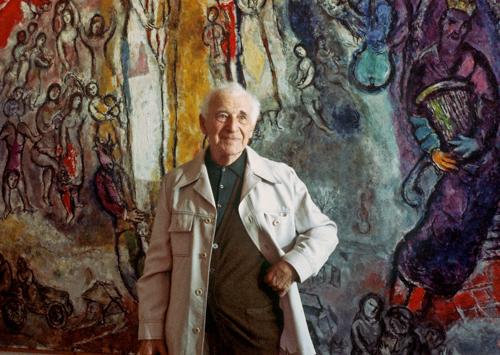
Through an interpreter, Marc Chagall discusses his approach to art and his views on people
1970 Professor John Nef explained that Marc Chagall came from an environment of nothing. From his dreams, Chagall created joy in his pieces of art. Nef lets the audience know that Chagall said he still has a lot of unfinished artwork to complete. The 3rd and last part of this program is a colloquy. Again, through another translator, Chagall’s words are translated. Chagall said his life’s purpose is art. Chagall said any man could be a bad artist but that no man can be an artist unless he is in fact, a good man.
-

Through an interpreter, Marc Chagall discusses his approach to art and his views on people
1970 Professor John Nef explained that Marc Chagall came from an environment of nothing. From his dreams, Chagall created joy in his pieces of art. Nef lets the audience know that Chagall said he still has a lot of unfinished artwork to complete. The 3rd and last part of this program is a colloquy. Again, through another translator, Chagall’s words are translated. Marc and Valentina Chagall speak French.
-
-
-
-
-
-
-
Discussing the Irish Civil Rights Movement with Mairead Corrigan
Jun. 8, 1978 Content Warning: This conversation has the presence of outdated, biased, or offensive language. Rather than remove this content, we present it in the context of twentieth-century social history to acknowledge and learn from its impact and to inspire awareness and discussion.*Please note: some sections have been edited out from the original recording due to copyright considerations
-
C.D.B. Bryan talks with Studs Terkel
Jul. 14, 1976 C.D.B. Bryan discusses his book "Friendly Fire" and the Vietnam War. Bryan discusses the true story of Michael Mullen who was killed by friendly fire in Vietnam and his family.
-
Bruce Kent discusses the peace movement
Mar. 14, 1996 A retired admiral told Bruce Kent, without even making a single request, they receive lots of money for weapons. Kent explained that currently, he believes both the right and left sides are willing to see reform in the United Nations. Kent was surprised at Americans' silent opinions when it came to nuclear arms, noting that they could blow up the world 50 times over. There is an excerpt of James Cameron talking about nuclear disarmament.