Listen to New Voices on Studs Terkel our partnership with 826CHI-here! Read the Story


Showing 46 - 60 of 103 results
-

Harrison Salisbury discusses his book "The Long March"
Oct. 15, 1985 "The Long March: The Untold Story" is a piece of history that took place but wasn't reported by anyone until Harrison Salisbury wrote his book. Salisbury was 75 when he returned to China to talk to people who marched back in October of 1934. Most of the boys and some girls who went on the 6,000 mile/march were peasants.
-
Haig Allahverdian discusses Armenian music and arts
May. 2, 1975 Haig Allahverdian discusses Armenian music and culture as well as the Armenian massacre and its effects on the Armenian people on the whole. Copyrighted material has been removed from this program.
-
-
George Feifer discusses his book “Tennozan”
Jun. 30, 1992 Journalist, novelist, and historian George Feifer discusses his book “Tennozan,” focusing on Okinawa Island during World War II and the impact of the atomic bomb. Includes a 20 second test tone. Content Warning: This conversation includes racially and/or culturally derogatory language and/or negative depictions of Black and Indigenous people of color, women, and LGBTQI+ individuals. Rather than remove this content, we present it in the context of twentieth-century social history to acknowledge and learn from its impact and to inspire awareness and discussion.
-
George Anagnastopoulous discusses Greek history through songs
Mar. 24, 1975 Greek songs about history, freedom and the Greek people are covered in this interview with George Anagnastopoulous. Greek songs are played throughout and both George and Studs read the English translations of the songs.
-
Geoffrey Bridson BBC broadcaster and Joyce Bridson public relations at BBC talk about their work in radio through the years
Oct. 30, 1970 Geoffrey Bridson and his wife Joyce, discuss his book "Prospero and Ariel: The rise and fall of radio a personal recollection.", as well as his life and career as a producer/broadcaster for BBC radio. The interview is interspersed with several excerpts from recordings: Excerpt of conversation at the home of Bridsons in England 1962. He talks about the play "Aarons field" and the sequel "Aarons Fallout shelter". Excerpt from Joyce Bridson backstage after the play "Oh what a lovely war" in New York.
-
Garry Davis discusses his book "Ready or Not: World Government"
Jun. 18, 1985 Garry Davis, an international peace activist and founder of the World Government Authority, discusses his philosophy on world peace and his stance on being a world citizen.
-
Fred Freed discusses the atom bomb
Author Fred Freed discusses the history of the atom bomb, its impact on the world, and the scientists involved in its making. He also touches on Japan during World War II and the bombings of Hiroshima and Nagasaki.
-
Frances Moore Lappe in conversation with Studs Terkel
Oct. 13, 1986 Discussing the book "World Hunger: Twelve Myths" (published by Grove Press) with author and world hunger policy analyst Frances Moore Lappe.
-
-
Edward W. Said discusses Palestine, history of and struggles in the Middle East
Oct. 1, 1984 Edward W. Said talks about the importance of language in shifting perceptions of Middle Eastern people, refutes some opinions about Palestine, identities, and overlapping Eastern and Western cultures.
-
Dr. Carlo Levi discusses Italian literature; Julio & Phillipo sing nursery rhymes, Maria Caniglia discusses opera; part 2
1962 Dr. Carlo Levi talks about the differences in Italian and American literature in the first part. In the second part, children Julio and Phillipo sing Italian nursery rhymes. In the last part, Maria Caniglia and husband Pino Donati discuss opera; part 2.
-
Dr. Carlo Levi discusses his exile and humanity in southern Italy after WW2; part 1
1962 Dr. Carlo Levi talks about his book "Christ Stopped at Eboli", the human condition, and compassion for those suffering during and after World War 2.
-
Dr. C. L. R. James discusses his book "Black Jacobins"
1970 Trinidadian historian Dr. C.L.R. James discusses his book "The Black Jacobins: Toussaint L'Ouverture and the San Domingo Revolution." The book was originally published in 1938. At the end of the interview, the song "Voodoo American: Bya Bulako" by Michel LaRue is played (00:46:26-00:51:
-
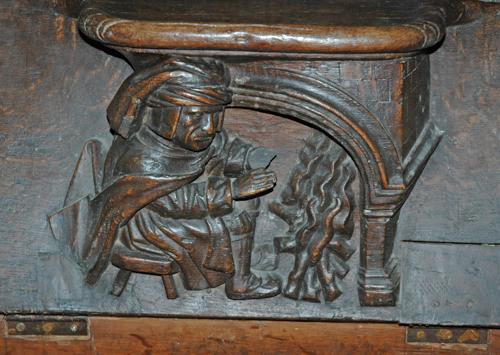
Dorothy and Henry Kraus discuss the book "The Hidden World of Misericords."
Feb. 10, 1976 Dorothy and Henry Kraus describe how they discovered an entire European collection of church-located woodcarvings depicting a wide variety of scenes crafted by local artisans. Hundreds of years of political, religious, and social events shaped the portrayals, and they explore many of the illustrations in their book, focusing on the themes of labor, animals, and religion. They marvel at the skill and craftsmanship and observe that the works can be a rich source of primary research material for modern scholars.