

-

Woody Allen discusses his work as a comedic writer and performer
Jun. 1, 1965 Woody Allen discusses his life and art, the influence of both success and failure on his work, and how he finds comedy in life’s difficulties and trials. He discusses his first screenplay, “What’s Up Pussycat?” and other comedians who have influenced the development of his own comedic work, including Mort Sahl, Charlie Chaplin, the Marx Brothers, and George S. Kaufman.
-

-
Vic Greco and Fred Willard discuss their original comedy skits
Oct. 4, 1962 While performing some of their original material, comedians Vic Greco and Fred Willard talk about how they come up with their ideas for their shows. Always the entertainers, and while talking over one another, Greco and Willard explain that most of what they do on stage is improvisation.
-
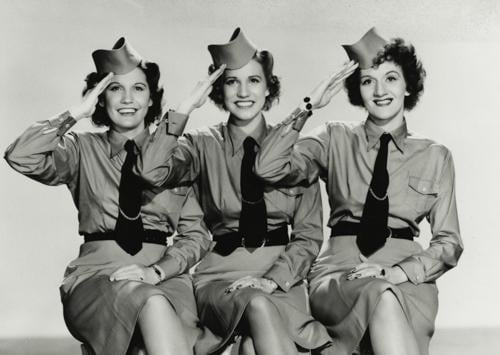
Terkel interviews Maxene Andrews of The Andrews Sisters
Aug. 23, 1982 Maxene Andrews reminisces over Andrews Sisters songs with Studs Terkel. She acknowledges the heavy influence the Boswell Sisters played in the creation of their image. She relays musical stories surrounding songs in Abbott and Costello such as "Bugle Boy" from their movie "Buck Privates". How they found the song "Mir Bist Du Schon" and Sammy Cahn and Saul Chaplin helped with the lyrics. How song pluggers brought The Andrews Sisters "Tip-Pi-Tin". How "Apple Blossom Time" helped an injured soldier at Oak Knoll Hospital upon his return to the states.
-
Terkel comments and presents German Lach und Schiess Gesellschaft (political cabaret)
1967 Terkel comments and presents German Lach und Schiess Gesellschaft (political cabaret). Freilien Margo Schtega is the interpreter for Sammy Drechsel. However, Terkel comments that Sammy understands him 'just fine'.
-
Terkel comments and presents Chicago comedy revisited
Oct. 1, 1976 Terkel comments and presents Chicago comedy revisited. Includes excerpts of Dick Gregory's routine and an interview with him, Mike Nichols, Bob Newhart and Burr Tillstrom.
-
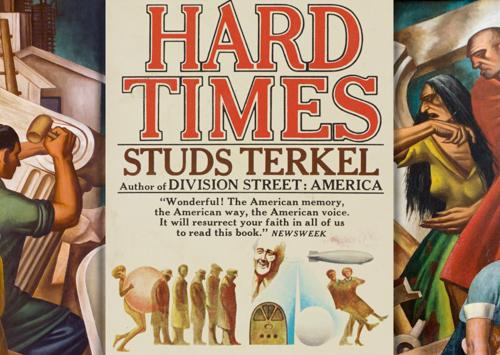
Terkel comments and presents "Hard Times: an Oral History of the Great Depression" ; Chapter 7
1971 Presenting "Hard Times: an Oral History of the Great Depression" High Life, Sixteen Ton: Chapter 7. Sally Rand talks about the creation of her signature fan dance and predictions for future depressions. Doc Graham discusses his upbringing, Chicago mobs, and Count Victor Lustig. Tony Soma talks about prohibition before and after the 1929 crash. Jerome Zerbe talks about inventing paparazzi photography, spending 2 weeks working in a coal mine, and the New Deal. Buddy Blankenship recalls working 16 hour days in West Virginia coal mines. Mary Owsley remembers life as a coal miner's wife.
-
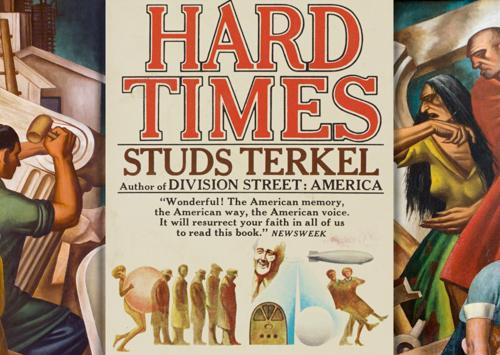
Terkel comments and presents "Hard Times: an Oral History of the Great Depression" ; Chapter 7
1971 Presenting "Hard Times: an Oral History of the Great Depression" High Life, Sixteen Ton: Chapter 7. Sally Rand talks about the creation of her signature fan dance and predictions for future depressions. Doc Graham discusses his upbringing, Chicago mobs, and Count Victor Lustig. Tony Soma talks about prohibition before and after the 1929 crash. Jerome Zerbe talks about inventing paparazzi photography, spending two weeks working in a coal mine, and the New Deal. Buddy Blankenship recalls working 16 hour days in West Virginia coal mines. Mary Owsley remembers life as a coal miner's wife.
-
Talking with Lily Tomlin, and her collaborators George Boyd, Cheryl Swannack, and Larry Freeman
Jul. 22, 1981 The American actress and comedian gives some insight into how she develops her vivid characters, and how her colleagues help bring them to the stage and screen. Four of Tomlin's comic pieces are included in the interview.*Please note: some sections have been edited out from the original recording due to copyright considerations
-
Talking with Jules Feiffer
Nov. 30, 1979 The cartoonist and author talks about his latest work, Tantrum, which Studs describes as a novel-in-cartoon-form. The oddly-compelling story of a respectable business man who regresses to toddler-like behavior can be seen as an early example of a graphic novel.*Please note: some sections have been edited out from the original recording due to copyright considerations
-
Talking about Groucho Marx, with Charlotte Chandler
Jul. 20, 1978 The biographer discusses the early life of comedian Groucho Marx, his stage career, his brothers, and their mother/manager, all further described in the book, Hello, I Must be Going: Groucho & His Friends.*Please note: some sections have been edited out from the original recording due to copyright considerations
-
Talking about dogs and dog training with Barbara Woodhouse
1980 While on her book tour, author Barbara Woodhouse discusses canine training and the book, No Bad Dogs: The Woodhouse Way. Ms. Woodhouse talks about using the three T's with dogs - Touch, Tone, and Telepathy. Her fundamental belief is that all animals and humans are good, and if a dog exhibits bad behavior, it's a learned behavior from humans.*Please note: some sections have been edited out from the original recording due to copyright considerations
-
Studs Terkel reflects on trip to People's Republic of China to describe Inner Mongolian music
Jun. 11, 1981 Studs Terkel travels to a Yurt shepherd's farm commune to hear the old song ballad of a Mongolian hero. It concerns a slave uprising from 200 years ago and shows the unity of the Mongolian people. Terkel compares this music to the Hungarian legacy before moving to the School of Story Telling and School of Music and Story Telling in the capital of Inner Mongolia, Hohhot. We are introduced to the four string hu that played Homeric ballads of drinking songs that could last four days.
-
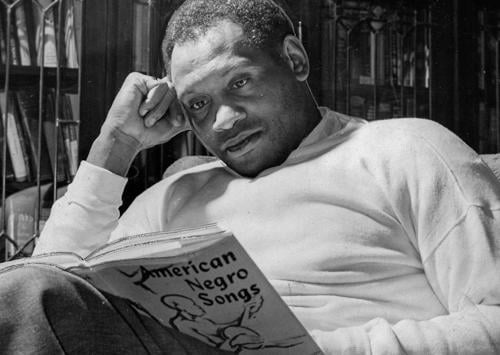
Studs presents a tribute to singer, actor, athlete, author and civil rights crusader Paul B. Robeson
Jan. 28, 1976 Studs presents a tribute to singer, actor, athlete, author and civil rights crusader Paul B. Robeson. Studs talks about his personal memories, the social impact and music of Paul Robeson. Excerpts from 1925362-4-1 Mr Robeson' friends recall memories of him: Earl Dickerson one of the 1 st black aldermen of Chicago, J. Mayo "Ink" Williams football player, Studs Terkel, Claudia Cassidy(1925655-4-1), Eddie Balchowski, Veteran, painter, poet(1934701-3-1) Includes excerpts from 1925362-4-1 and music. Similar to 1925362-3-1, but not identical. 01/23/1976 date of death.
-
Sid Caesar and Imogene Coca talk about comedy and their work together
Sep. 26, 1990 Comedians Sid Caesar and Imogene Coca talk about their work together. They explore the meaning and emotions behind comedy, improv, and pantomime and how the audience is involved with their shows. Sid recalls several of their skits and does a few examples of his dialects.