Listen to New Voices on Studs Terkel our partnership with 826CHI-here! Read the Story


Showing 16 - 30 of 281 results
-

Talking about piano instruction, with David Sudnow
Dec. 14, 1987 The sociologist, music teacher, and author joins Studs to talk about his book, Ways of the Hand: The Organization of Improvised Conduct, and his unconventional approach to piano instruction.*Please note: some sections have been edited out from the original recording due to copyright considerations
-
Studs, teachers and students have a conversation at a high school where there is controversy over the use of the book "Working"
1982 Discussing the controversy over the use of the book "Working" by author Studs Terkel in a senior vocational class. Interviews with Kay Nichols, teacher, and two high school classes, as well as Bob Burns and Jim Richardson. The students talk of how the "bad" language in the book is heard from their peers on a daily basis and they don't find it offensive. [recorded in Girard, Pennsylvania]
-
Studs Terkel talks with artist Gene Hall and Dr. Paul Mundy about the painting "The Black Christ Not Worthy of Its Cross" ; part 1
Sep. 21, 1965 Studs Terkel interviews the artist Gene Hall who created "The Black Christ Not Worthy Of Its Cross" and the head of the Loyola University Sociology Department, Dr. Paul Mundy, who used the title and painting reproduction to spark classroom discussions. Hall describes the creation of his 6 ft tall by 2 1/2 feet wide painting and how seeing the color of Christ diminishes Christ. You don't see Christ when you see color. Hall uses barbed wire instead of thorns in the painting to signify there is no time in painting, it is up to date.
-
Studs Terkel talks with artist Gene Hall and Dr. Paul Mundy about the painting "The Black Christ Not Worthy of Its Cross" ; part 2
Sep. 21, 1965 Studs Terkel interviews the artist Gene Hall who created "The Black Christ Not Worthy Of Its Cross" and the head of the Loyola University Sociology Department, Dr. Paul Mundy, who used the title and painting reproduction to spark classroom discussions. Hall describes the creation of his 6 ft tall by 2 1/2 feet wide painting and how seeing the color of Christ diminishes Christ. You don't see Christ when you see color. Hall uses barbed wire instead of thorns in the painting to signify there is no time in painting, it is up to date.
-
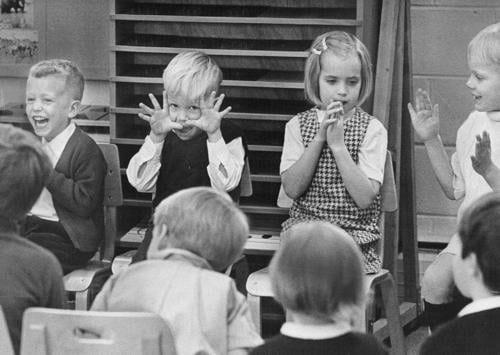
Studs Terkel moderates and comments on a round-table debate about the Montessori educational theory
Nov. 3, 1964 A round-table debate about the Montessori educational theory. Four early childhood development professionals speak of the pros and the cons of the program. Speakers include: Fay Bauling advisor at Wilson Jr. College, Dr. Urban Fleege of DePaul University, Dr. Ner Littner from the Institute of Psychoanalysis, and Hannah MacLaren, head teacher from Ancona School.
-
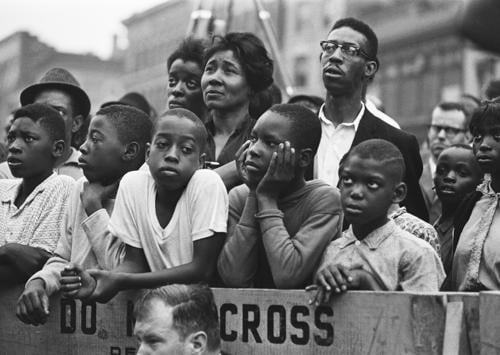
Studs Terkel interviews Professor Charles V. Hamilton on his book written with Stokely Carmichael entitled "Black Power: Politics of Liberation in America" ; part 1
Nov. 21, 1967 Using the backdrop of James Baldwin's "Nobody Knows My Name" and Baldwin's feelings that Blacks were ashamed of where they came from, Terkel interviews Professor and Chairman of the Political Science Department of Roosevelt University on his book coauthored with Stokely Carmichael entitled" Black Power: Politics of Liberation in America". Hamilton states that Blacks were taught to hate themselves and leave school believing that. Institutional racism and the deliberate oppression it creates, holds blacks back. Blacks are left out of crucial decision making processes that concern them.
-
Studs Terkel interviews Professor Charles V. Hamilton on his book written with Stokely Carmichael entitled "Black Power: Politics of Liberation in America" ; part 2
Nov. 21, 1967 Using the backdrop of James Baldwin's "Nobody Knows My Name" and Baldwin's feelings that Blacks were ashamed of where they came from, Terkel interviews Professor and Chairman of the Political Science Department of Roosevelt University on his book coauthored with Stokely Carmichael entitled" Black Power: Politics of Liberation in America". Hamilton states that Blacks were taught to hate themselves and leave school believing that. Institutional racism and the deliberate oppression it creates, holds blacks back. Blacks are left out of crucial decision making processes that concern them.
-
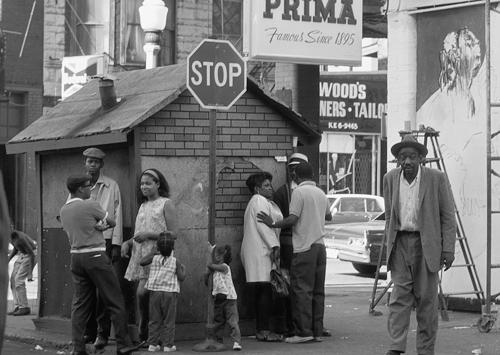
Studs Terkel interviews Curtiss Brooks, Jane Weston and Philip Hauser on the status of Blacks and housing, jobs and education in Chicago ; part 4
1965 Discussing "Discrimination in metropolitan Chicago" with Curtiss Brooks, employment specialist, Chicago Urban League, Jane Weston, housing specialist, American Friends Service Committee, and Philip Hauser, Sociology Department of University of Chicago. Brooks, Weston and Hauser provide data, reports and statistics to debunk the myths concerning the Black market for housing in Chicago. Weston states that public attitudes have changed and Real Estate must listen and accommodate open occupancy. Another myth that is discussed is that property values will go down if Blacks move in.
-
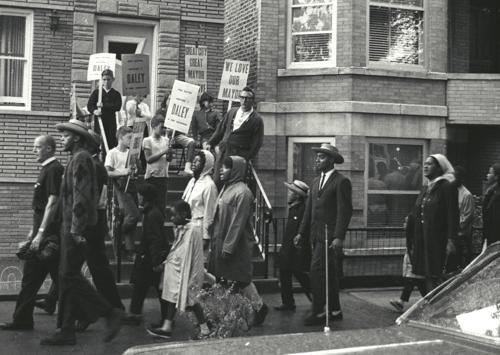
Studs Terkel discusses race relations and economic disparity with four Chicago area women ; part 2
Jan. 27, 1965 Studs discusses race relations and economic disparity with four Chicago area women in a program entitled "Each of us can act". This recording was the last of a 6-part series, "Rearing the Child of Good Will", broadcast under the auspices of the National Conference of Christians and Jews.
-
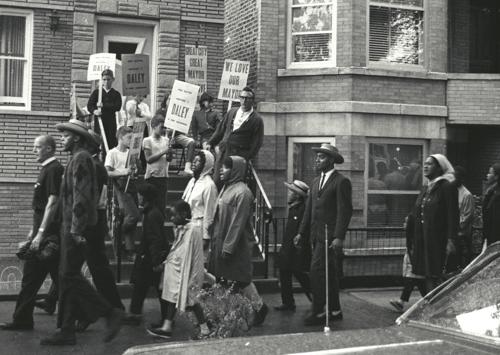
Studs Terkel discusses race relations and economic disparity with four Chicago area women ; part 1
Jan. 27, 1965 Studs discusses race relations and economic disparity with four Chicago area women in a program entitled "Each of us can act". This recording was the last of a 6-part series, "Rearing the Child of Good Will", broadcast under the auspices of the National Conference of Christians and Jews. The series focused on prejudice, race, religion, and community. Interviewees are: Madeline Bonsigniore of Chicago's south suburbs, Naomi Brodky of the Marynook neighborhood of Chicago, Lynn Williams of Winnetka, and Harriet White of the NCCJ.
-

Studs Terkel discusses his life with Dorothy Hajek and Sylvia McDonnel of Rosary College
Mar. 21, 1963 Dorothy Hajek and Sylvia McDonnel discuss Studs Terkel's life. Includes Studs talking about his life, early career, and opinions on American society. Cuts off at 31:38 to 31:50.
-
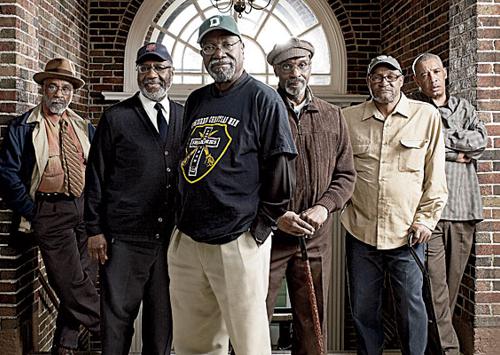
Studs Terkel discusses gang life with Allan Evans and Henry Jordan
1969 Studs Terkel discusses gang life with Allan Evans and Henry Jordan, members of the Vice Lords, an urban street gang based in Chicago. Evans and Jordan were both born and grew up in Chicago.
-
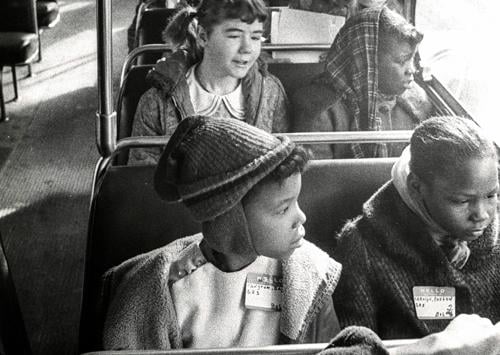
Studs Terkel discusses busing for school integration with psychologist Thomas J. Cottle
Oct. 11, 1976 Studs Terkel discusses the transportation of students for school integration with psychologist Thomas J. Cottle. The main topic of conversation is Cottle's book, "Busing" (1976, Boston, MA, Beacon Press). Terkel and Cottle discuss busing in several cities, focusing on Boston, MA, where Cottle did his research and writing. They each read passages from the book, and discuss the relationship between busing and racism in America.
-
Studs Terkel comments and delivers Francis Parker high school commencement address
1968 Terkel comments and delivers Francis Parker high school commencement address
-
Students, teachers, and a parent from St. Mary's Center for Learning talk to Studs Terkel
Dec. 11, 1968 Interviewing at the Saint Mary's Center for Learning, an alternative school on the West Side of Chicago, with students Theresa Gonzales, Joan Perry, Cheryl Petrats and teachers Janice Eritch, Rozelle Nesbit, Sister Elaine Shuster and a parent, Mrs. Lori Waslewski.