Listen to New Voices on Studs Terkel our partnership with 826CHI-here! Read the Story


Showing 46 - 60 of 154 results
-

Marion Clark and Rudy Maxa discuss their book, "Public Trust, Private Lust: Sex, Power, and Corruption on Capitol Hill"
Jul. 12, 1977 Marion Clark and Rudy Maxa, investigative journalists, discuss their book, "Public Trust, Private Lust: Sex, Power, and Corruption on Capitol Hill." The two recall how Elizabeth Ray contacted them about an affair she was having with U.S. Representative Wayne Hays, who was using taxpayer's money to pay her. The journalists also discuss Koreagate and other corruptions going on in Washington D.C. in the 1970s.
-

Louis Lomax discusses the book "Thailand: The War That Is, The War That Will Be"
1967 Discussing Thailand and interviewing journalist Louis Lomax. Includes passage from book.
-
Lawrence Weschler discusses his book “Mr. Wilson’s Cabinet of Wonder”
Jan. 22, 1997 Lawrence Weschler discusses his book “Mr. Wilson’s Cabinet of Wonder” and the Museum of Jurassic Technology. Weschler discusses the director of this museum, David Hildebrand Wilson, and the surreal and often humorous exhibits on display in the museum. Studs plays "Suite Anglaise No. 2 in A Minor: II. Bourrée 1 et 2" - Jean-Frédéric Neuburger.
-
Laurence Shoup discusses his book, "The Carter Presidency and Beyond: Power and Politics in the 1980s"
1970 Author Laurence Shoup discusses his book, "The Carter Presidency and Beyond: Power and Politics in the 1980s," and explains how President Carter came to be elected. He describes the Trilateral Commission and other groups created by corporations and the richest American families to lobby. the government. He also discusses the Carter presidency and his double-dealing with major issues such as unions and regulating big businesses.
-
John Egerton discusses his book "Generations: An American Family"
Nov. 3, 1983 Kentucky writer John Egerton discusses his book "Generations: An American Family." The song "Will the Circle Be Unbroken" by Nitty Gritty Dirt Band is played at the opening and closing of the interview. The timestamps are as follows: 00:01:29-00:02:36 (opening) 00:55:33-00:58:40 (closing)
-
John Dinges discusses his book "Assassination on Embassy Row"
Sep. 6, 1980 Because there' s murder, torture, prison terms and terrorism involved, Studs Terkel, mentions that this book reads like a crime novel. "Assassination on Embassy Row," is John Dinges' account of what happened to Orlando Letelier in Washington, D.C. in 1976.
-
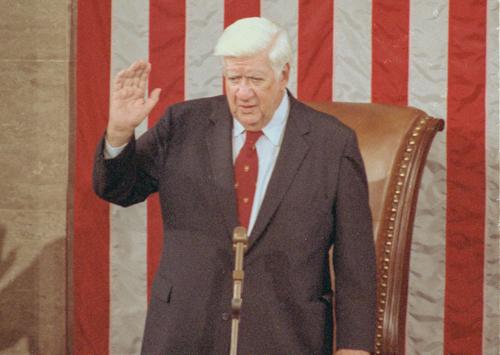
Jimmy Breslin, journalist and author discusses his book about the Watergate Affair
May. 22, 1975 Discussing "How the Good Guys Finally Won : Notes from an Impeachment Summer" and interviewing Jimmy Breslin.
-
-
James M. Cameron discusses his book "Here Is Your Enemy"
1966 James Cameron describes his experiences while in North Vietnam during the Vietnam War as the first Western correspondent admitted.
-
James David Barber discusses his book, "The Pulse of Politics: Electing Presidents in the Media Age," with the author James David Barber
May. 30, 1980 James David Barber, author and political scientist, discusses his book, "The Pulse of Politics: Electing Presidents in the Media Age." He explains the premise of his beliefs that presidential elections run a cycle of "conflict, conscience, conciliation," and how media affects this. He uses examples of elections from Teddy Roosevelt to Jimmy Carter. Presidential campaign songs are played throughout the interview. A record is played to hear the voices of Teddy Roosevelt and Franklin D. Roosevelt.
-
James Cameron discusses journalist responsibility and expectations of political leaders with Studs in Ashburn Gardens, London ; part 2
1970 Studs Terkel interview with James Cameron, Brittish journalist. They discuss the objective truth and facts of journalism. Cameron shares his experience with a dying Winston Churchill and his views on science and human values. Politics, youth, and the atomic bomb are also topics in this interview. Studs quotes Albert Einstein and Sidney Burnstein, while Cameron quotes Oliver Cromwell. James Cameron's book, "Point of Departure" is also mentioned in the interview.
-
James Cameron discusses his experiences as a Brittish Journalist and his political and social beliefs ; part 4
Jun. 4, 1973 Studs Terkel interview with James Cameron, Brittish journalist. They discuss a variety of topics with politics and young people's attitudes the majority of the interview. This interview is done in Chicago, while the other three parts were done at Lewis and Clark College.
-
James Cameron discusses his experiences as a Brittish journalist and his book "Point of Departure" ; part 3
Jun. 4, 1973 Studs Terkel interviews James Cameron about his experiences as a journalist that includes thoughts about Cameron's book, "Point of Departure." They talk about his relationships with Winston Churchill, Lord Beaverbrook, Charlie Templeton, and Bertrand Russell. Cameron discusses his education, poverty, and the depression during his youth. They talk about Cameron's career with the "News Chronicle" and his home of Dundee, Scotland. This is part 3 of a total of 4 parts. The interview takes place at Lewis and Clark Community College.
-
Jack Newfield discusses his book "Robert Kennedy: A Memoir"
Oct. 31, 1978 According to Jack Newfield's book, "Robert Kennedy: A Memoir," Robert Kennedy spent a good part of his first 38 years of life in service to his brother. Robert was JFK's campaign manager, advisor, and Attorney General. Objectivity and seeking the truth as a journalist is also discussed in the interview.
-
Irwin Silber discusses music from the Civil War and his book “Songs of the Civil War” ; part 2 ; followed by Abdullah Ariff discussing Malayan culture
Jul. 1, 1960 Studs Terkel and Irwin Silber, a writer and Civil War historian, talk about music from the Civil War and Silber’s book “Songs of the Civil War.” This is the final part of the interview with Silber. A brief interview with Malayan artist Abdullah Ariff follows the Silber interview. Ariff discuss Malayan culture and the artwork he has on display in the United States.