Listen to New Voices on Studs Terkel our partnership with 826CHI-here! Read the Story


-

Frank Galati discusses the play "She Always Said, Pablo"
Mar. 5, 1987 Director Frank Galati explains that the play "She Always Said, Pablo," was about Gertrude Stein's relationship with Pablo Picasso. Referring to the play itself, Galati also said that he tried to marry their narrative writings with some operatic song.
-
Frank Galati discusses the play "Cry, the Beloved Country"
Jul. 20, 1993 Frank Galati and some cast members of "Cry, the Beloved Country," talk about the play. Fathers, sons, relationships, faith and redemption are all areas covered in the play. Galati explains how the story of the play itself draws the audience inward and gets them mesmerized.
-
Frank Galati and cast members of "Mother of Us All" discuss the play
May. 10, 1984 When asked what the play meant to her, cast member Carmen Pelton, said the play was a presentation of Susan B. Anthony and her struggles. Alan Stone explained why he felt chills when Anthony spoke of her troubles. "Mother of Us All," explained director Frank Galati was a look at the good fight Susan B. Anthony pursued toward women's suffrage.
-
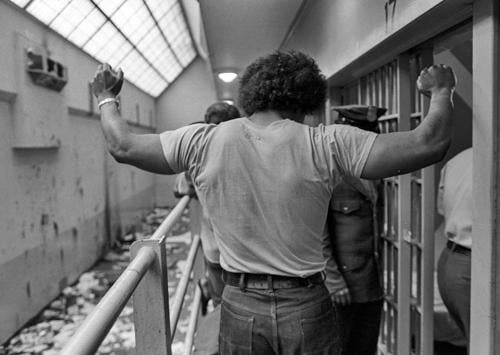
Frank Elli discusses his time as a prisoner and his novel "The Riot"
1968 Begins with a reading by Frank Eli from the opening of the book "The Riot." Mr. Elli discusses his early life, his time in three different prisons, and the writing of his book "The Riot," a personal account of a riot in Walla Walla Prison. (Note: last 5 minutes missing)
-
Frank Donner discusses the article he wrote "Theory and Practice of American Political Intelligence" ; part 2
In his article, "Theory and Practice of American Political Intelligence," Frank Donner brings up the poisonous effect of surveillance on people's invasion of privacy. Donner explained people adjust their lives to it. Donner's last reflection is for people to not just be frightened by surveillance but rather to do something about it like study how much money is spent on surveillance and who is accountable.
-
Frank Donner discusses the article he wrote "Theory and Practice of American Political Intelligence" ; part 1
Surveillance, informants, and provocateurs are some of topics covered by Frank Donner with his article, "Theory and Practice of American Political Intelligence". Donner explained that intelligence practices exist so that everyone has something to fear.
-
Frank Carney, Susie Gelaga, Linda Gelaga, Molly Gelaga and Fred Christy discuss the youth of Chicago ; part 2
1968 Interviewing Frank Carney, Susie Gelaga, Linda (daughter-in-law), Molly (daughter), and Fred Christy. They discuss the youth in Chicago, their own life experiences, and wants.
-
Frank Carney, Susie Gelaga, Linda Gelaga, Molly Gelaga and Fred Christy discuss the youth in Chicago ; part 1
1968 Interviewing Frank Carney, Susie Gelaga, Linda (daughter-in-law), Molly (daughter), and Fred Christy. They discuss the youth of Chicago and their own life experiences.
-
Francis S. Chase discusses education, art, and science ; part 2
Dec. 30, 1964 Francis S. Chase discusses education, art, and science. Chase also discusses creativity, human behavior, and technology among other topics.
-
Francis S. Chase discusses education, art, and science ; part 1
Dec. 30, 1964 Francis S. Chase discusses education, art, and science. Chase also discusses creativity, human behavior, and technology among other topics. Includes a clip of an interview with Dr. Jay Bernofsky.
-

Francis Edmonds discusses education and the Waldorf School, part 2
Mar. 9, 1970 Educator Francis Edmonds discusses education and the Waldorf School, part 2 of 2. Topics include the London Waldorf School philosophy, which can be summed up by a quote from founder Rudolf Steiner-- "Accept the children with reverence, educate them with love, send them forth in freedom."
-
Francis Edmonds discusses education and the Waldorf School, part 1
Mar. 9, 1970 Educator Francis Edmonds discusses education and the Waldorf School, part 1 of 2. Topics include art therapy, color philosophy, and the London Waldorf School philosophy, which can be summed up by a quote from founder Rudolf Steiner-- "Accept the children with reverence, educate them with love, send them forth in freedom." The interview also includes a brief clip from Mr. Ogletree from the Esperanza School in Chicago.
-
Frances Moore Lappe in conversation with Studs Terkel
Oct. 13, 1986 Discussing the book "World Hunger: Twelve Myths" (published by Grove Press) with author and world hunger policy analyst Frances Moore Lappe.
-
Frances FitzGerald in conversation with Studs Terkel
Oct. 23, 1986 Discussing the book "Cities on a Hill: A Journey Through Contemporary American Cultures" (published by Simon & Schuster) with the author, journalist Frances FitzGerald. Program includes an excerpt of a June 3, 1986 interview with activist and social worker Maggie Kuhn.
-
Frances Cuka discusses the play "A Taste of Honey" and her career ; part 1
Mar. 8, 1962 British actress Frances Cuka discusses the play "A Taste of Honey" and her career. Audio cuts off abruptly at the end of the interview.