Listen to New Voices on Studs Terkel our partnership with 826CHI-here! Read the Story


Showing 1 - 15 of 31 results
-

Valentin Pluchek and Stanislaw Pchenikov discuss Russian theater, specifically Moscow ; part 1
Jan. 19, 1962 Studs Terkel interviews Valentin Pluchek and Stanislaw Pchenikov on Russia theater, focusing mainly on the city of Moscow.
-
Studs Terkel discusses the creation of the U.S.-U.S.S.R. Initiatives with founder Sharon Tennison
Jun. 17, 1988 Sharon Tennison was concerned with U.S. and U.S.S.R. relations in the early 1980's when there was a nuclear threat and decided to form a group of ordinary citizens to travel to Moscow and immerse themselves in the culture. They got firsthand accounts and dispelled decades old myths. They not only formed the Center for U.S.-U.S.S.R. Initiatives but created branches of Alcoholics Anonymous in the Soviet Union as well as teacher and young adult exchanges. The ordinary citizen has created participatory democracy and began a dialogue and exchange with a former enemy.
-
Stanislaw Pchenikov and Valentin Nikolaevich Pluchek discuss theater with Studs Terkel ; part 2
Jan. 19, 1962 Studs Terkel discusses Russian theater with Stanislaw Pchenikov and Theater director Valentin Nikolaevich Pluchek.
-
Soviet intellectuals discuss Soviet arts and culture
May. 28, 1962 Soviet intellectuals Tamara Mamedova, Nicolai Pogodin, and Anatol Safronov talk with Studs Terkel about their work with the Institute for Soviet-American Relations (U.S.) and Soviet arts and culture.
-
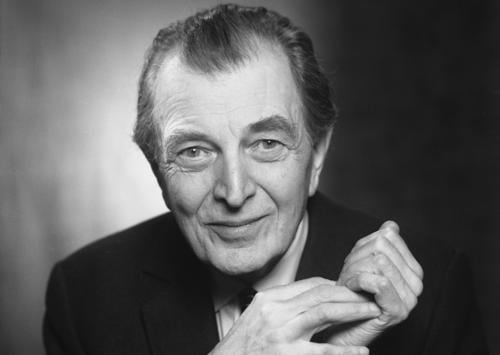
Russian-born composer Alexander Tcherepnin talks with Studs Terkel
Apr. 13, 1965 Studs Terkel and Tcherepnin discuss Tcherepnin's early years in Leningrad, his creative drive and its relation to real-life experiences and the influence of Chicago on his 1953 Op. 87 Suite for Orchestra.
-
Nikolay Akimov, Theodore Komisarjevsky and Pavel Markov discuss the Soviet theater
Aug. 16, 1959 Nikolay Akimov, Theodore Komisarjevsky and Pavel Markov discuss the Soviet theater. The ending music on this record was edited out
-
Joshua Rubenstein discusses his book Tangled Loyalties: The Life and Times of Ilya Ehrenburg"
Sep. 25, 1996 Joshua Rubenstein discusses his book "Tangled Loyalties: The Life and Times of Ilya Ehrenburg" and the importance of Ehrenburg during the Stalin regime.
-
-
-
Interviewing Harrison Salisbury
Nov. 13, 1975 The New York Times correspondent in Moscow discusses and reads from his novel, The Gates of Hell. The book closely mirrors the life of Russian novelist and Soviet dissident Aleksandr Isayevich Solzhenitsyn.*Please note: some sections have been edited out from the original recording due to copyright considerations
-
Interviewing Alexander Tcherepnin
Jun. 8, 1964 A wide-ranging conversation with the Russian composer, pianist, and music professor - about his time in Chicago and his upcoming departure for New York.*Please note: some sections have been edited out from the original recording due to copyright considerations
-
Interview with Ruth Meyer
1969 After spending time with foreign affairs correspondents in Moscow, college student and folk singer Ruth Meyer returns to the States to share some of her experiences.*Please note: some sections have been edited out from the original recording due to copyright considerations
-
Igor Youskevitch talks with Studs Terkel
Dec. 1, 1959 Terkel interviews ballet dancer and choreographer Igor Youskevitch who would be staying in town until January 3.
-
Harrison Salisbury discusses his views on the constantly changing world of Russia ; part 2
Jun. 8, 1962 Salisbury continues talking about the artists like writers, musicians and dancers being national assets to Russia. In a country with its history of tyranny, Russian society is becoming more permissive and relaxed, explained Salisbury. Khrushchev keeps the peace right now, says Salisbury but wonders, like the title of a new book he's working on, is this "A New Russia?".
-
Harrison Salisbury discusses his views on the constantly changing world of Russia ; part 1
Jun. 8, 1962 Being a correspondent for the New York Times in Moscow gave others the chance to see Russia through Harrison Salisbury's reporting. Inside their country, the people, says Salisbury, they have started to loosen up and they have started to talk to one another. The freedoms of the arts have come back, too.