

-
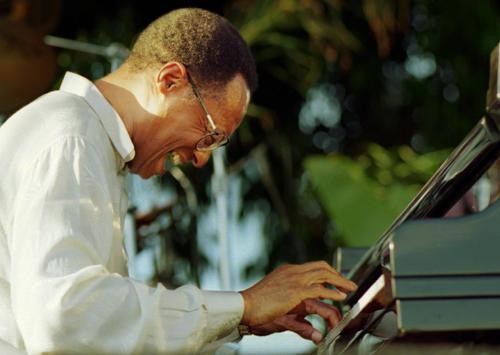
Ramsey Lewis discusses his career
Dec. 22, 1980 Starting at a young age, Ramsey Lewis really loved music and as he got older, he'd practice five or six hours a day. Lewis says he knew nothing about jazz until he met Wallace Burton at the age of 15. Burton hired Lewis on the spot to play in his band. Church music, Spanish music, Duke Ellington and the Beatles, says Lewis, were all great influences to him.
-

Jud Newborn discusses the book "Shattering the German Night"
Aug. 23, 1987 Sophie and Hans Scholl and their underground, anti-violent, anti-Nazi group is the subject matter of the book, "Shattering the German Night: The Story of the White Rose." Co-author of the book, Jud Newborn, talks about the brother and sister duo were leaders of this movement that college students followed. In time, Nazi authorities found both Sophie and Hans and they were both executed.
-

Judy Tenuta discusses being a Love Goddess
Self-proclaimed Love Goddess, Judy Tenuta, was also known as the Aphrodite of the Accordion, to her fans. Tenuta talks about how she saw Elvis in her Cheese Whiz and he told her to start her own religion, which is known as Judyism. Calling herself the Love Goddess came to be after her brothers literally kissed her hands and feet when she asked them to. This is a very short conversation that ends abruptly.
-
Dalton Trumbo reads from and discusses his book ; part 2
Content Warning: This conversation includes racially and/or culturally derogatory language and/or negative depictions of Black and Indigenous people of color, women, and LGBTQI+ individuals. Rather than remove this content, we present it in the context of twentieth-century social history to acknowledge and learn from its impact and to inspire awareness and discussion. Resuming the conversation with regards to his book, "Additional Dialogue: Letters of Dalton Trumbo, 1942-1962," Dalton Trumbo now talks about his time after being in prison for 10 months.
-
Gary DeWalt discusses the film “Genbaku-Shi: Killed by the Atomic Bomb”
Aug. 8, 1985 Independent film director, writer, and producer Gary W. DeWalt discusses the film “Genbaku-Shi: Killed by the Atomic Bomb” and the U.S. citizens who died along with the Japanese in Hiroshima. Corky Siegel performs "Southwest Coast Blues (1980)" in the studio.
-
Sam Pilafian and Gerhard Meinl discuss the tuba
Aug. 30, 1991 While in town for the Chicago Jazz Festival, Sam Pilafian and Gerhard Meinl discuss the history of the tuba. With demonstrations on the tuba, they play scales and other short pieces. Gerhard Meinl's family business of making instruments like the tuba has been around since 1810, explained Meinl.
-
Lawrence Weschler discusses his book “Mr. Wilson’s Cabinet of Wonder”
Jan. 22, 1997 Lawrence Weschler discusses his book “Mr. Wilson’s Cabinet of Wonder” and the Museum of Jurassic Technology. Weschler discusses the director of this museum, David Hildebrand Wilson, and the surreal and often humorous exhibits on display in the museum. Studs plays "Suite Anglaise No. 2 in A Minor: II. Bourrée 1 et 2" - Jean-Frédéric Neuburger.
-
A. V. Krebs discusses his book "The Corporate Reapers: The Book of Agribusiness"
Sep. 10, 1992 A.V. Krebs discusses his book "The Corporate Reapers: The Book of Agribusiness" (published by Essential), farming, and food manufacturing. A clip of an interview with a family farmer with the last name [Nermeyer] and her husband is included. Songs have been removed due to copyright.
-
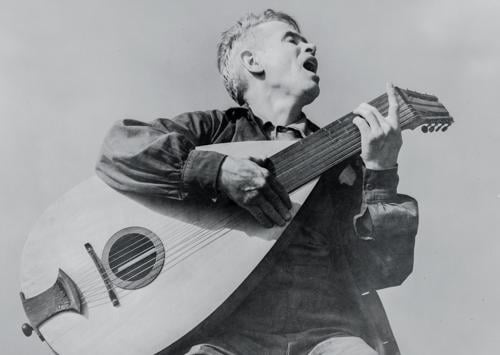
John Jacob Niles discusses his music
May. 10, 1957 The dulcimer is not only a musical instrument that John Jacob Niles plays, but he builds them too. Playing some scales, Niles gives a brief demonstration of the dulcimer, Niles explained people often requested he play his love songs. Niles believed love is something that is easily relatable to many people.
-
Gana M'Bow discusses Senegalese folk music
Oct. 1, 1965 In addition to talking about Senegalese music, Gana M'Bow goes over the history of the "talking drum." M'Bow also plays various songs from Senegal and West Africa. Through the State Department, M'Bow was touring various cities across the US.