

-

An interview with Jane B. Katz
Feb. 13, 1981 Visual arts and literature are covered in Jane B. Katz's book, This Song Remembers: Self-Portraits of the Native Americans in the Arts. When talking to artists, Katz learns that they aren't just capturing their past, but that they're keeping their cultures alive for future generations.*Please note: some sections have been edited out from the original recording due to copyright considerations
-
Discussing the book "James Earl Jones: Voices and Silences" with the author, actor James Earl Jones
Sep. 17, 1993 *Please note: some sections have been edited out from the original recording due to copyright considerations
-
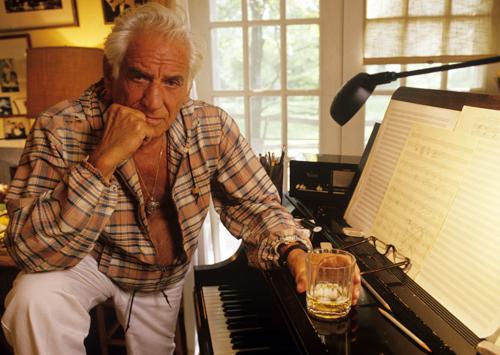
Leonard Bernstein discusses his career, music, and education
Feb. 1, 1985 Leonard Bernstein discusses his career as a composer along with his thoughts on American culture, musical theater, Black music, classical music, and education; music is played throughout the program including songs from Marc Blitzstein's play "The Cradle Will Rock."
-
David T. Dellinger discusses his book "From Yale to Jail"
Apr. 23, 1993 The early influences of his father, his time in prison, and a bomb being sent to his home are among the topics covered in Dellinger’s book, “From Yale to Jail: The Story of a Moral Dissenter”. Dellinger is best known for being one of the Chicago Eight. He recalls a time in Lincoln Park, IL when he was warned to get out of there quickly because the police were told to attack Dellinger and his group.
-
Douglas W. Druick discusses the book "Odilon Redon: Prince of Dreams, 1840-1916"
Aug. 30, 1994 Douglas W. Druick, scholar and curator of the Art Institute of Chicago, discusses his book "Odilon Redon: Prince of Dreams, 1840-1916." The interview explores Redon's life and art work, including his techniques he developed because of the time period he lived in.
-
-
A discussion with Dr. S. Frederick Starr, Perrin Yang, and Glen Nikitin
Aug. 1, 1988 Studs sits down with a musicologist and jazz musician, an American violinist, and a Russian violinist to discuss their cross-cultural and musical genre-bending collaboration - the American Soviet Youth Orchestra (AKA the American Russian Young Artists Orchestra).*Please note: some sections have been edited out from the original recording due to copyright considerations
-
Talking about Gilbert and Sullivan, with Jane W. Stedman
May. 29, 1985 The theater scholar and biographer talks about some of the Gilbert and Sullivan operas staged at the D'Oyly Carte Opera Company in the United Kingdom and elsewhere.*Please note: some sections have been edited out from the original recording due to copyright considerations
-
Discussing the book "The Mountain People"with the author, anthropologist Colin Turnbull ; part 1
Mar. 15, 1973 A generation ago, the Iks displayed the human values of devotion to family, caring of the elderly, young, sick, and compassion for human suffering. With the loss of territory and increasing population coupled with limited mobility, the Iks suffered a reversal of compassion and in order to survive became mean, despicable, and inhumane. Examples are drawn from Turnbull's book, "Mountain People" as discussed with the author. Comparisons of the Iks to United States society are drawn.
-
Discussing The Atomic Cafe with Jayne Loader
Sep. 28, 1982 The filmmaker joins Studs to discuss her documentary about the pervasive propaganda, newsreels, and pop culture of the Cold-War era.*Please note: some sections have been edited out from the original recording due to copyright considerations