

-

Interviewing people on the train ride to Washington, D.C., going to the civil rights March on Washington
Aug. 28, 1963 Content Warning: This conversation includes racially and/or culturally derogatory language and/or negative depictions of Black and Indigenous people of color, women, and LGBTQI+ individuals. Rather than remove this content, we present it in the context of twentieth-century social history to acknowledge and learn from its impact and to inspire awareness and discussion. While aboard a train with 803 passengers, Studs Terkel spoke to various people about what this train meant to them. A female passenger said she was so happy to be on the train.
-
Horace Cayton discusses his book "Long Old Road" ; part 1
Sep. 7, 1966 Content Warning: This conversation includes racially and/or culturally derogatory language and/or negative depictions of Black and Indigenous people of color, women, and LGBTQI+ individuals. Rather than remove this content, we present it in the context of twentieth-century social history to acknowledge and learn from its impact and to inspire awareness and discussion. In "Long Old Road: An Autobiography," Horace Cayton talks about growing up in Seattle in a well to do, mostly white neighborhood. Cayton's grandfather was the first Black man elected to the U.S.
-
Horace Cayton discusses is book "Long Old Road" ; part 3
Sep. 7, 1966 Content Warning: This conversation includes racially and/or culturally derogatory language and/or negative depictions of Black and Indigenous people of color, women, and LGBTQI+ individuals. Rather than remove this content, we present it in the context of twentieth-century social history to acknowledge and learn from its impact and to inspire awareness and discussion.
-
Horace Cayton discusses his book "Long Old Road" ; part 2
Sep. 7, 1966 Content Warning: This conversation has the presence of outdated, biased, offensive language. Rather than remove this content, we present it in the context of twentieth-century social history to acknowledge and learn from its impact and to inspire awareness and discussion. Loneliness and hardships of both fitting in and finding a job are covered in the continuation of Horace Cayton's, "Long Old Road: An Autobiography." By living in a middle class home in Seattle with a full time Japanese servant, Cayton was seen as better off than most people.
-
-

Queen Ida discusses Zydeco
Sep. 1, 1988 Interviewing Zydeco composer, singer and accordionist Queen Ida. Songs played include "Chere Duloone," "Willie on the Washboard," "Cotton Eyed Joe," "Every Now and Then," "Passe la Porte," "La Louisianne," "Celimene," and "La Femme du Doigt."
-

Indian musicians, vocalists, and University of Chicago students discuss Indian art and culture
May. 3, 1961 Discussing Indian poetry, music, and drama with Indian musicians, vocalists, and University of Chicago students.
-
-
Charles Richard Johnson reads from and discusses his book "Middle Passage"
Jan. 30, 1991 Rutherford Calhoun is the main character of Charles Richard Johnson's novel, "Middle Passage." In his quest to get away from his marriage and a bill collector, a freed slave himself, Rutherford stows away onto a ship not realizing that the cargo being carried are slaves from Africa.
-
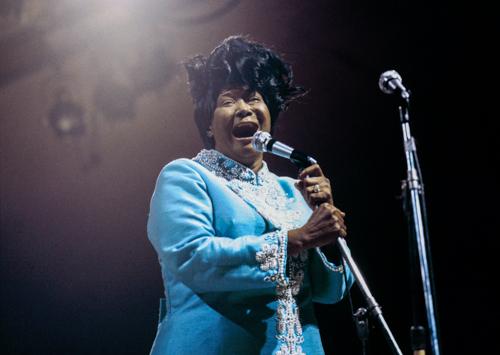
Mahalia Jackson discusses the civil rights movement and the upcoming freedom rally
May. 17, 1963 Studs Terkel interviews gospel vocalist Mahalia Jackson. Jackson discusses the freedom rally that will be taking place at McCormick's Place in Chicago, IL.