Listen to New Voices on Studs Terkel our partnership with 826CHI-here! Read the Story


Showing 111 - 120 of 365 results
-

-
In conversation with Michael Harrington, author of "The Other America: Poverty in the United States," and Ralph Helstein, a union leader
Feb. 17, 1977 Interviewing Michael Harrington, author of "The Other America: Poverty in the United States," and Ralph Helstein, a union leader.
-
Laurence Shoup discusses his book, "The Carter Presidency and Beyond: Power and Politics in the 1980s"
1970 Author Laurence Shoup discusses his book, "The Carter Presidency and Beyond: Power and Politics in the 1980s," and explains how President Carter came to be elected. He describes the Trilateral Commission and other groups created by corporations and the richest American families to lobby. the government. He also discusses the Carter presidency and his double-dealing with major issues such as unions and regulating big businesses.
-
Jennifer Davis, Bill Sutherland and Zola Zembe discuss South Africa and apartheid
Feb. 27, 1979 Jennifer Davis, Bill Sutherland, and Zola Zembe discuss the South Africa and their experiences with apartheid. Jennifer Davis grew up in the white middle class society of Johannesburg, whereas Zola Zembe, a native black man who lives in Capetown. They, along with Bill Sutherland, an American who works as a Representative for the American Friends Service Committee, talk about the changes that need to made and how American people and companies can help. An earlier interview of Carl Douglas Fuchs is also played.
-
Jadwiga Lopez and Andrew Patner discuss their recent visits to Poland
Sep. 10, 1981 Jadwiga Lopez and Andrew Patner discuss Poland and tell stories about their latest visits before and during the Poland Crisis of 1980-1981. Topics discussed include the economic hardships, food shortages, the Solidarity Union, politics, and the arts. Parts of polish music is played at the start and end.
-
Gordon Adams discusses his book, "The Iron Triangle: The Politics of Defense Contracting"
Nov. 1, 1981 Gordon Adams, political scientist, discusses his book, "The Iron Triangle: The Politics of Defense Contracting." He explores the military budget how it is a drain on the taxpayer's money. Adams explains how private contractors, such as Rockwell Corporation, enter into defense contracts and make money off the government's dependence on the military weapons.
-
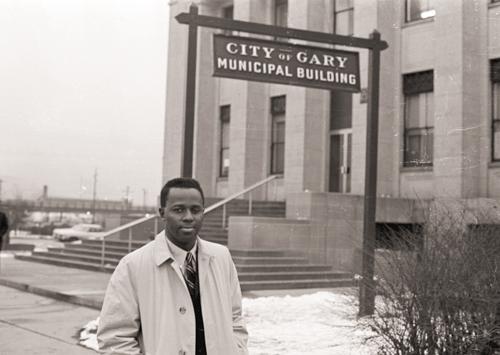
Richard G. Hatcher and Alexander Poinsett discuss Gary, Indiana, their book "Black Power: Gary Style," and politics
Jan. 18, 1971 Richard G. Hatcher and Alexander Poinsett discuss Gary, Indiana, their book "Black Power: Gary Style," politics, and race relations. They discuss the corruption in Gary, Indiana and Gary politics. Includes Richard G. Hatcher reading his old speech from his book "Black Power: Gary Style."
-

Three employees from the Hanes factory in Galax, Virginia discuss their work environment
Oct. 28, 1982 Dorothy Andrers, Berlene Bernette, and Fay Williams talk about the rapid and repetitive work they do inspecting Hanes tee shirts. Without a union to protect them, the women said they are treated like animals. They all suffer from tendonitis but the company refuses to acknowledge that their suffering is from work on the job.
-
Interview with Holly Arntzen
Mar. 25, 1992 Interviewing Holly Arntzen, a folk singer and songwriter of political and social protest songs.
-