Listen to New Voices on Studs Terkel our partnership with 826CHI-here! Read the Story


Showing 21 - 30 of 39 results
-

Studs Terkel discusses religion with Msgr. John Egan, Dr. Howard Schomer and Rabbi Arnold Wolf ; part 2
Feb. 13, 1965 Studs continues his discussion of religion in contemporary society with Catholic Msgr. John Egan, Dr.
-
St. Clair Drake and Paul Mundy discuss prejudice ; part 1
1965 Discussing the community and prejudice with Dr. St. Clair Drake and Dr. Paul Mundy. Includes an interview with a boy named Tony discussing relations with African American people.Content Warning: This conversation includes racially and/or culturally derogatory language and/or negative depictions of Black and Indigenous people of color, women, and LGBTQI+ individuals. Rather than remove this content, we present it in the context of twentieth-century social history to acknowledge and learn from its impact and to inspire awareness and discussion.
-
St. Clair Drake and Paul Mundy discuss prejudice ; part 2.
1965 Discussing prejudice in communities with Dr. St. Clair Drake and Dr. Paul Mundy. They discuss prejudice towards the races, religions, and ethnicities of people.
-
St. Clair Drake and Paul Mundy discuss prejudice ; part 3
1965 Discussing prejudice in communities with Dr. St. Clair Drake and Dr. Paul Mundy. They discuss stereotypes, racism, and race relations.
-
St. Clair Drake and Paul Mundy discuss prejudice ; part 4
1965 Discussing prejudice in communities with Dr. St. Clair Drake and Dr. Paul Mundy. They discuss discrimination, racism, integration, and other similiar topics.
-
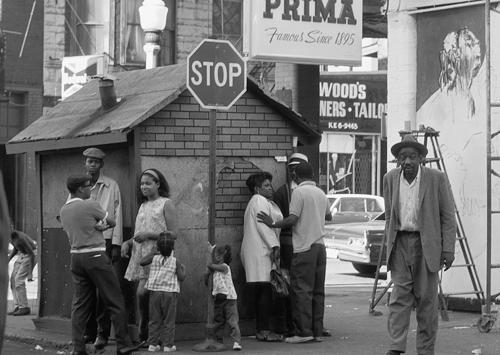
Jan Hestor, Curtiss Brooks and Dr. Philip Hauser discuss racial discrimination in Chicago ; part 5
1965 The discussion of discrimination in metropolitan Chicago continues with Jan Hestor, Curtiss Brooks and Dr. Philip Hauser talking about bigotry, prejudices, open occupancy and education. Included in this part of the interview is an excerpt of 17 year-old Jimmy talking about how his grandmother would rather work than be on welfare.
-
Dick Gregory discusses American politics
Dec. 17, 1964 This interview begins with a clip of one of Dick Gregory’s performances, where he talks about nonviolence and Native Americans. Studs Terkel introduces his guest as an observer, explaining that comedians are the best observers in society. Gregory offers extended analogies to communicate his views on a variety of topics, including the Vietnam War, race relations, segregation, human rights, and urban renewal. [The date is unclear, but it has to be after 1970, since the Kent State Shootings were mentioned]
-
Anne Guerrero discussing event in her life ; part 2
1968 Anne Guerrero discusses the impact her divorce has had on her younger children. She also discusses her own career and her future plans as well as her connection to the Roman Catholic Church. This recording ends abruptly and is part 2 of 3.
-
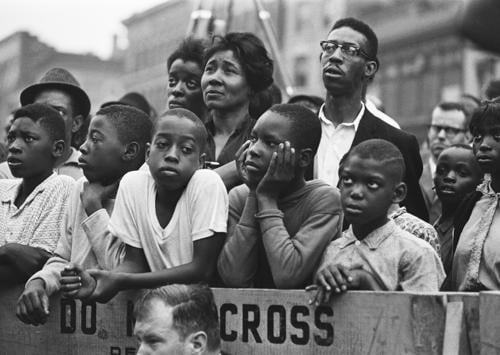
Studs Terkel interviews Professor Charles V. Hamilton on his book written with Stokely Carmichael entitled "Black Power: Politics of Liberation in America" ; part 1
Nov. 21, 1967 Using the backdrop of James Baldwin's "Nobody Knows My Name" and Baldwin's feelings that Blacks were ashamed of where they came from, Terkel interviews Professor and Chairman of the Political Science Department of Roosevelt University on his book coauthored with Stokely Carmichael entitled" Black Power: Politics of Liberation in America". Hamilton states that Blacks were taught to hate themselves and leave school believing that. Institutional racism and the deliberate oppression it creates, holds blacks back. Blacks are left out of crucial decision making processes that concern them.
-

Nancy Milio reads from and discusses her book "9226 Kercheval"
Jun. 13, 1970 Nancy Milio's book, "9226 Kercheval: The Storefront That Did Not Burn," is about community health services offered in a ghetto on the south side of Detroit, Michigan. As a nurse, Milio knew how important it was to offer quality health services to poor and uneducated individuals. With their real names changed, Milio talks about her experiences with Mrs. Watkins, Johhnie West and others at the center.