Listen to New Voices on Studs Terkel our partnership with 826CHI-here! Read the Story


Showing 1 - 10 of 21 results
-

Gordon Zahn discusses his book "In Solitary Witness" ; part 1
Jan. 15, 1965 One's conscience, morals and religion are all apart of Gordon Zahn's book, "In Solitary Witness: The Life and Death of Franz Jagerstatter". Zahn talks about who Jagerstatter was and what made him decide to say "No" to Hitler's army. Jagerstatter chose to lay with the community of saints rather than kill Jewish people.
-
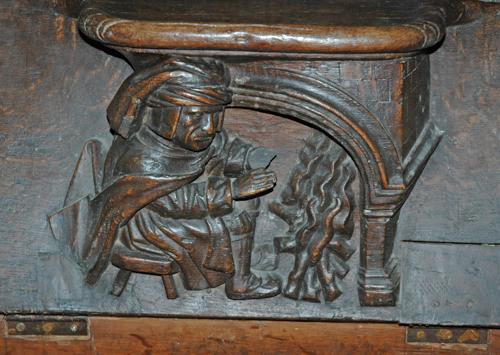
Dorothy and Henry Kraus discuss the book "The Hidden World of Misericords."
Feb. 10, 1976 Dorothy and Henry Kraus describe how they discovered an entire European collection of church-located woodcarvings depicting a wide variety of scenes crafted by local artisans. Hundreds of years of political, religious, and social events shaped the portrayals, and they explore many of the illustrations in their book, focusing on the themes of labor, animals, and religion. They marvel at the skill and craftsmanship and observe that the works can be a rich source of primary research material for modern scholars.
-
Gordon Zahn discusses his book "In Solitary Witness" ; part 2
Jan. 15, 1965 Gordon Zahn continues to talk about his book, "In Solitary Witness: The Life and Death of Franz Jagerstatter". When doing his research for the book, it puzzled Zahn to find out that very few young people in Jaggerstatt's home village knew who Franz Jaggerstatt was. Zahn explained Jaggerstatt knew he was doing the right thing by objecting to Hitler's army because a Catholic priest had done the same thing.
-
Gordon Zahn talks with Studs Terkel
1970 Terkel interviews Gordon Zahn about war and peace.
-
Father John McKenzie and Dr. Howard Schomer discuss personal responsibility, morality and hate, as it pertains to the Vietnam War ; part 2
1965 The interview continues with Father John McKenzie and Dr. Howard Schomer talking about fear and dissent. Schomer says Christians have the duty to dissent when they believe their beliefs are being contradicted by policy. He also talks about not understanding a dampening down of the human mind when it comes to human issues. Father McKenzie adds that society is made up of the best educated ignoramuses that ever existed.
-
Father John McKenzie and Dr. Howard Schomer discuss personal responsibility, morality and hate, as it pertains to the Vietnam War ; part 1
1965 Whether in the United States or Vietnam, Dr. Schomer asks what are our personal responsibilities for the atrocities? Father John McKenzie talks about a lowering of people's moral tone. People have put their morality in their pockets, so as to get cleared of something and not get involved, added Father McKenzie.
-
Sister Betty Campbell and Father Peter Hind discuss El Salvador
Sep. 3, 1981 Sister Betty Campbell and Father Peter Hind discuss their missionary trips to Latin America. They talk about their time in Peru, Brazil, and El Salvador and working against difficult governments to help struggling people. They also recall some of violence they witnessed or heard about during the El Salvador Civil War, including the execution of four American missionary women.
-
Studs Terkel discusses literature, Judaism, and the Holocaust with Richard Elman ; part 1
1967 Studs Terkel discusses literature, Judaism, and the Holocaust with the novelist, poet, journalist, and teacher Richard M. Elman (1934-1997). Their discussion revolves around Elman's recently published work of historical fiction, "The 28th Day of Elul", much of which takes place in the village of Clig, Hungary, during the time of the Nazi occupation of Hungary during World War II. Topics include Jewish identity, The Holocaust, persecution of The Jews, feelings of guilt and social prejudice among Holocaust survivors.
-
Studs Terkel discusses literature, Judaism, and the Holocaust with Richard Elman ; part 2
1967 Studs Terkel discusses literature, Judaism, and the Holocaust with the novelist, poet, journalist, and teacher Richard M. Elman (1934-1997). Their discussion revolves around Elman's recently published work of historical fiction, "The 28th Day of Elul", much of which takes place in the village of Clig, Hungary, during the time of the Nazi occupation of Hungary during World War II. Topics include Jewish identity, The Holocaust, persecution of The Jews, feelings of guilt and social prejudice among Holocaust survivors.
-
St. Clair Drake and Paul Mundy discuss prejudice ; part 2.
1965 Discussing prejudice in communities with Dr. St. Clair Drake and Dr. Paul Mundy. They discuss prejudice towards the races, religions, and ethnicities of people.