Listen to New Voices on Studs Terkel our partnership with 826CHI-here! Read the Story


Showing 1 - 10 of 31 results
-

Peter Sellars discusses his production of "The Merchant of Venice"
Sep. 14, 1994 Peter Sellars talks about his production of "The Merchant of Venice." Peter Sellars also compares Los Angeles California to the world of "The Merchant of Venice". Sellars also discusses the history of the Jewish people, immigrants, the ghetto, and race relations.
-
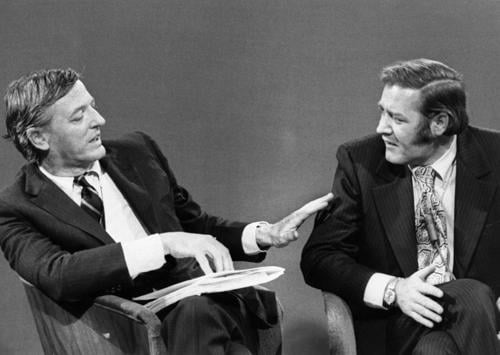
Discussing the book, "Getting out", and interviewing its author, Edgar Smith
Feb. 14, 1973 Discussing the book, "Getting out," and interviewing its author, Edgar Smith. Topics include imprisonment, the legal system, and capital punishment. Includes a clip of an interview with Hermann Field a former Polish prisoner. Includes clip of an interview with former prison inmate Jimmy Blake.
-

Claude Brown talks with Studs Terkel
Sep. 13, 1965 Discussing the book "Manchild in the Promised Land" with Claude Brown. Brown also discusses growing up in Harlem, New York as an African American man. Includes a clip of a man speaking from the county jail. Includes a song sung by Mahalia Jackson. Includes a clip of children singing.
-

James Blake pianist, author, and petty thief talks about his book "The Joint"
Jun. 19, 1971 Mr. Blake talks to Studs about his book "The Joint." The book is a collection of letters written by Mr. Blake while in prison off and on for 13 of 20 years. He reads out loud some of the letters from the book.
-
Derek Freeman discusses the book "Margaret Mead and Samoa"
Mar. 15, 1983 Discussing the book "Margaret Mead and Samoa the making and unmaking of an anthropological myth" with the author Derek Freeman.
-

Interview with Derrick Bell
Oct. 25, 1967 Interviewing lawyer, activist and author Derrick Bell.
-
James Mills discusses his book "Report to the Commissioner," his newest publication
Oct. 3, 1972 James Mills, a novelist and journalist, talks to Studs about his book "Report to the Commissioner". Mr. Mills and Studs discuss the story and Mr. Mills goes in depth into the process of police detectives working a case. Studs plays an excerpt of a Chicago policeman talking about working on the tactical squad on the police force. The policeman tells of how they go into a neighborhood as civilians to stop crime.
-

Jean Cau discusses his book "La pitié de Dieu" ; part 1
Nov. 1, 1962 Through an interpreter, Jean Cau discusses his book "La pitié de Dieu", or translated, "The Mercy of God". Cau's book is about four prisoners and their interactions with one another. Cau explained, in one way or another, with a reference to Kafka, we are all condemned and it will be a great surprise to all to learn what we are guilty of.
-
Jimmy Breslin discusses his book “The Gang That Couldn't Shoot Straight” ; part 1
Jimmy Breslin discusses and reads excerpts from “The Gang That Couldn't Shoot Straight,” his novel about a Brooklyn Mafia boss. Content Warning: This conversation has the presence of outdated, biased, offensive language. Rather than remove this content, we present it in the context of twentieth-century social history to acknowledge and learn from its impact and to inspire awareness and discussion.
-
Jimmy Breslin discusses his book “The Gang That Couldn't Shoot Straight” ; part 2
Jimmy Breslin discusses and reads excerpts from “The Gang That Couldn't Shoot Straight,” his novel about a Brooklyn Mafia boss.