Listen to New Voices on Studs Terkel our partnership with 826CHI-here! Read the Story


Showing 51 - 60 of 60 results
-

Gar Alperovitz discusses his book “Atomic Diplomacy: Hiroshima and Potsdam”
Gar Alperovitz, historian, writer, and political economist, discusses the bombing of Hiroshima, the Potsdam Conference, and the American confrontation with Soviet power.
-
Willard Van Dyke discusses American history and its effects on the film, photography, and the arts
Apr. 3, 1985 Willard Van Dyke, cinematographer and co-director of documentaries like "The City" and "The River," talks about 20th century American history and how it effected the arts. Using his documentaries and other artists' work, he explores how the Great Depression, World War II, and the Cold War changed American art and culture. He discusses Public Works of Art, war propaganda, and McCarthyism and their challenges for artists. Near the end of this interview, Van Dyke discusses the changes in modern still photography and documentaries as Americans forget history.
-
Discussing the book "Solidarity and Treason: Resistance and Exile, 1933-1940" with the author Lisa Fittko
Jan. 28, 1993 Lisa Fittko discusses her experience as an anti-fascist resistance fighter in Berlin, Germany during World War II. They also explore accounts from her book "Solidarity and Treason: Resistance and Exile, 1933-1940".
-
Studs Terkel talks with three World War Two veterans
Apr. 17, 1985 Interviewing Ed Ruff, Joe Polowski, and Leroy; three veterans of the meeting of U.S. and Soviet forces at the Elbe River on April 25, 1945. The result of this meeting was the splitting of Nazi Germany into two parts and the ensuring of victory in Europe.
-
Daniel Yergin discusses his book, "Shattered Peace: The Origins of the Cold War and the National Security State"
1970 Daniel Yergin, author and economic historian, discusses his book, "Shattered Peace: The Origins of the Cold War and the National Security State." He explains the key players in the Cold War and his thoughts on the Yalta and Riga Axioms. Yergin also explores the end of World War II and other events that led to the tensions between US and the Soviet Union.
-
Blanche Wiesen Cook discusses her book, "The Declassified Eisenhower: A Divided Legacy of Peace and Political Warfare"
Aug. 6, 1981 Blanche Wiesen Cook, historian, professor, and author discusses her book, "The Declassified Eisenhower," and explains Eisenhower's peace and war beliefs. She describes his beliefs at the end of World War II and his relationships with fellow generals and leaders.
-
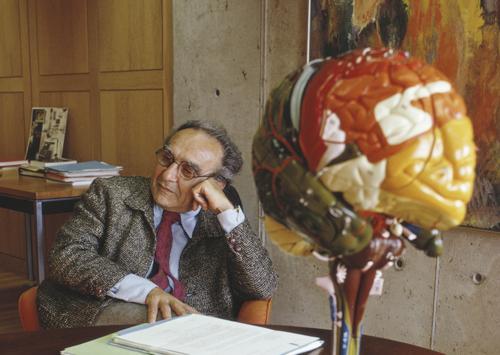
Dr. Jacob Bronowski discusses the philosophy of science in the post World War II world
Jan. 1, 1971 Dr. Jacob Bronowski, a mathematician and philosopher, discusses how the study of science has changed since the onset of government regulation or the military industrial complex. He also talks about humanity and explains how humans are the best species and therefore should come together to continue progress instead of killing each other. Content Warning: This conversation has the presence of outdated, biased, offensive language.
-
Studs Terkel is interviewed by Mitch Kraus and Edward Teller and Albert Szent-Gyorgy discuss science and politics
Dec. 29, 1970 Part 1 of this recording is Mitch Kraus interviewing Studs Terkel on his thoughts of self-indulgence, stereotypes, generational challenges, and historical events.
-
Marcel Ophuls discusses his documentary films
Apr. 30, 1984 Discussing the showing of his films with film maker Marcel Ophuls.
-