Listen to New Voices on Studs Terkel our partnership with 826CHI-here! Read the Story


Showing 21 - 30 of 33 results
-

Hamilton Fish III discusses American history
Colonel Hamilton Fish III discusses American history. Major topics include The Great Depression, Franklin D. Roosevelt, World War II, and Communism. Fish also reads a personal letter sent to him from Martin Dies, Jr. Content Warning: This conversation has the presence of outdated, biased, offensive language. Rather than remove this content, we present it in the context of twentieth-century social history to acknowledge and learn from its impact and to inspire awareness and discussion.
-
Dr. Robert Jay Lifton discusses the psychological impact of the nuclear arms race
1980 Dr. Robert Jay Lifton, psychiatrist and psycho-historian, discusses the acceptance and embrace of nuclear disaster, doctors' opposition to nuclear weapons, difference in Americans' and Europeans' opposition to nuclear weapons, psychological impact of nuclear bombings in Japan, and the mental disconnect experienced by those who build atomic weapons who then see the bombs' effects.
-
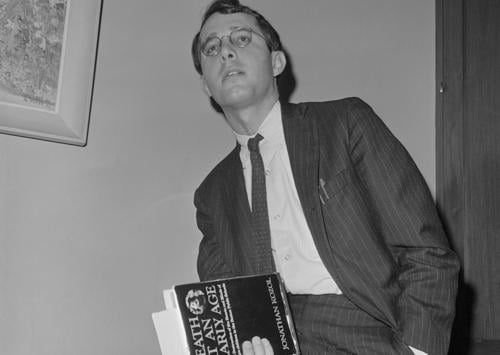
Jonathan Kozol discusses his book "Children of the Revolution: A Yankee Teacher in the Cuban Schools"
Nov. 10, 1978 Studs has a spirited discussion with Jonathan Kozol who shares his adventures and learnings in Cuba that formed the basis of his book "Children of the Revolution: A Yankee Teacher in the Cuban Schools." Kozol explains the ambitious Cuban Literacy Campaign begun in the 1960s that aimed to educate the entire population, tells of children teaching adults in remote villages by lantern light, and the unity and national pride that resulted. He and Studs explore the idea of generative words in literacy education and contemplate Kozol's hope to adapt a similar approach to American education.
-
Discussing the Soviet military, with Andrew Cockburn
Jun. 30, 1983 The British journalist assesses the real military power behind the Iron Curtain in his book, The Threat: Inside the Soviet Military Machine. He and Studs attempt to separate the myth from the reality of the late Cold War USSR.*Please note: some sections have been edited out from the original recording due to copyright considerations
-
-
-
-
Willard Van Dyke discusses American history and its effects on the film, photography, and the arts
Apr. 3, 1985 Willard Van Dyke, cinematographer and co-director of documentaries like "The City" and "The River," talks about 20th century American history and how it effected the arts. Using his documentaries and other artists' work, he explores how the Great Depression, World War II, and the Cold War changed American art and culture. He discusses Public Works of Art, war propaganda, and McCarthyism and their challenges for artists. Near the end of this interview, Van Dyke discusses the changes in modern still photography and documentaries as Americans forget history.
-
Daniel Yergin discusses his book, "Shattered Peace: The Origins of the Cold War and the National Security State"
1970 Daniel Yergin, author and economic historian, discusses his book, "Shattered Peace: The Origins of the Cold War and the National Security State." He explains the key players in the Cold War and his thoughts on the Yalta and Riga Axioms. Yergin also explores the end of World War II and other events that led to the tensions between US and the Soviet Union.
-
Daniel Ellsberg Discusses the publication of "The Pentagon Papers" ; part 1
1980 Daniel Ellsberg, political activist and former military analyst, discuses his release of the Pentagon Papers and his thoughts on how the Vietnam War played out. He also discusses what he believes the next war could look like and how America, and the world, would be affected by nuclear war.