Listen to New Voices on Studs Terkel our partnership with 826CHI-here! Read the Story


Showing 71 - 80 of 136 results
-

Abe Peck discusses his book “Uncovering the Sixties: The Life and Times of the Underground Press”
Jun. 10, 1985 Editor and writer Abe Peck discusses and reads from his book “Uncovering the Sixties: The Life and Times of the Underground Press.” Peck discusses the social and political forces, such as the lack of questioning authority forces seen during this time, that drove the alternative press to formation. This program includes audio clips of Studs interviewing attendees of a Vietnam War protest in Chicago. Studs also includes a clip of British journalist James Cameron discussing the 1968 Chicago Democratic Convention. Studs plays "The Times They Are A-Changin'" - Bob Dylan (1964).
-
Discussing a trip to the Soviet Union with Sharon Tennison and Barbara Rinnan of The Center for Citizen Initiatives (CCI)
Feb. 1, 1985 CCI maintains citizen-to-citizen networks between the US and the USSR in an attempt to empower ordinary citizens to take responsibility.
-
Interviewing Arnold True, United States Navy Rear Admiral, about his anti-war political activity
Jan. 20, 1977 Program includes songs about the Vietnamese Conflict.
-
Dr. Charles Clements talks with Studs Terkel
Apr. 13, 1984 Discussing observations and experiences as a medical practioner in Vietnam and then Central America, principally, El Salvador with Charlie Clements M.D.
-
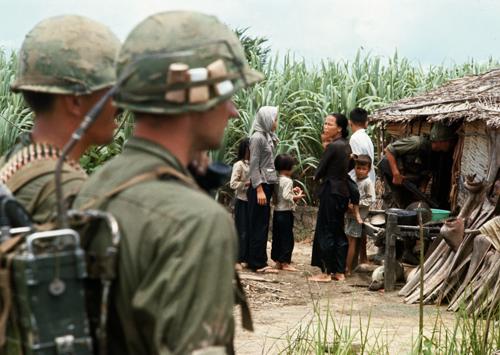
Louis Font and Ed Fox discuss their time in the military and the Vietnam War
Jun. 11, 1971 Louis Font and Ed Fox discuss their time in the military, the Vietnam War, military rituals, and West Point military academy. They express their anti-war sentiments and describe atrocities committed in Vietnam.
-
-
Bertrand Russell discusses science and world peace. Phyllis Evans discusses the National Health Plan ; part 1
1962 Sir Bertrand Russell says scientists have a fundamental obligation to let the authorities know if and when what they're working on could lead to or cause a war. Russell claims, no matter the side, there are no winners as a result of war. The world could be a far better place, Russell explained, if it weren't for the fact of man's hatred toward other men. If one lives in the United States and has a grave illness or needs a major surgery, Phyllis Evans says one should not have to go into bankruptcy because of all the costs.
-
Interview with Bertrand Russell and Phyllis Evans Part 2
1962 Interviewing Bertrand Russell and Phyllis Evans while Studs was in England.
-
Thich Nhat Hanh discusses poetry and Vietnam
Apr. 21, 1971 In an interview with Studs Terkel, Buddhist monk, peace activist, and poet Thich Nhat Hanh. The conversation focuses on the devastating effects of the Vietnam War; they discuss the loss of culture and poetry in Vietnam, the anti-war protestors in America and Vietnam, and the sadness and resignation of the Vietnamese. Thich Nhat Hanh talks about America’s role in the war, and his experiences campaigning for peace in the United States and speaking with U.S. anti-war veterans.
-
Interview with Dagmar Wilson
1967 Terkel interviews activist and children's author Dagmar Wilson. She discusses how she goes from a children's author to an activist for anti-nuclear testing.