Listen to New Voices on Studs Terkel our partnership with 826CHI-here! Read the Story


Showing 171 - 180 of 182 results
-

Dr. Samuel Floyd, Jr. discusses his book "The Power of Black Music: Interpreting Its History from Africa to the United States"
Feb. 21, 1996 Author Dr. Samuel Floyd discusses his projects in relation to black music and elements from his book "The Power of Black Music: Interpreting Its History from Africa to the United States." Includes an interview with Langston Hughes.
-
Dr. Samuel Floyd, Jr. discusses Black music, history, and culture
Oct. 11, 1990 Interviewing Dr. Samuel Floyd, author and scholar of Black music. He discusses prominent Black musicians and composers who shaped their perspective genres.
-
James Graham-Lujan discusses the works of Federico Garcia Lorca; part 2
1964 James Graham-Lujan concludes by talking about Garcia Lorca's most celebrated plays, Blood Wedding, Yerma, and The House of Bernarda Alba. Tragedy is brought about due to the passion of a woman in each of the plays.
-
Interviewing St. Clair Drake, author of "Black Metropolis: A Study of Negro Life in a Northern City."
May. 10, 1976 A discussion with sociologist and anthropologist St. Clair Drake at the time of his receiving an honorary award from Roosevelt University on the themes of his convocation address. A fascinating deep-dive into race relations from the Revolution to the Bicentennial, touching on the contradictions, crises, and struggles that led to Black institutions and liberation. Studs plays several excerpts from previous programs with St.
-
Dr. Christine K. Cassel discusses gerontology
Apr. 23, 1987 The chair of General Internal Medicine at the University of Chicago, Dr. Christine K. Cassel, discusses gerontology and the problems the field currently faces, such as patient access to, and knowledge of, healthcare. Dr. Cassel is a strong advocate for giving agency back to the patient, primarily by allowing the patient to become knowledgeable of their own health in order to promote successful aging and self-sufficiency when confronted with health concerns. Studs plays “Hello In There” - John Prine (1971).
-
Thor Heyerdahl discusses his book "The Ra Expeditions" and his sailing adventures
Sep. 16, 1971 Thor Heyerdahl, an adventurer and ethnographer, discusses his newly published book, "The Ra Expeditions." He talks about his adventures sailing from Africa to South America on the ships "Ra" and "Ra II" which were made from papyrus. Heyerdahl explains the trial and error he had getting the papyrus reeds, building the ship, and sailing. Briefly the two discuss environmental concerns with the ocean. Heyerdahl also talks about ancient peoples and their cultures and technologies they used. Near the end of the interview Thor reads a passage of his book.
-
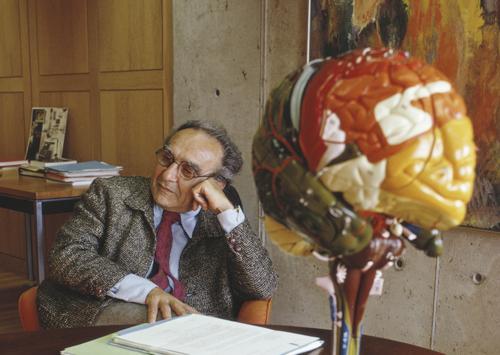
Dr. Jacob Bronowski discusses the philosophy of science in the post World War II world
Jan. 1, 1971 Dr. Jacob Bronowski, a mathematician and philosopher, discusses how the study of science has changed since the onset of government regulation or the military industrial complex. He also talks about humanity and explains how humans are the best species and therefore should come together to continue progress instead of killing each other. Content Warning: This conversation has the presence of outdated, biased, offensive language.
-
Joan Cook discussing her book "In Defense of Homo Sapiens"
Jan. 13, 1975 Joan Cook discusses her book "In Defense of Homo Sapiens" and talks about research done by other scientists working with Chimps and other primates. She explains her stance that not all humans lean towards violence and that nature, not nurture, and the environment creates aggression and violence. The conversation compares economics and Darwinism for a view of humanistic economics.
-
Edward T. Hall discusses his book "Beyond Culture"
Apr. 28, 1976 Edward T. Hall talks about his beliefs on culture. The discussion includes how cultures differ between countries with a focus on Vietnam. They also discuss the cultural differences in America. Hall also explores how technologies, such as computers and vehicles change culture and cause people to become more like the machine itself. The end of the interview includes a short reading of "Beyond Culture".
-
Dr. Richard Selzer discusses his book "Mortal Lessons: Notes on the Art of Surgery"
Feb. 17, 1977 Dr. Richard Selzer, a surgeon, reads essays from his book, "Mortal Lesson: Notes on the Art of Surgery." Dr. Selzer recalls moments of his profession that stuck with him including the removal of a diabetic women's leg and the removal of a botfly larvae. He also takes a poetic look at the liver and the skin, including a story about Henry Moss. Dr. Selzer finishes his interview with a story about his first time witnessing an abortion. A comedy skit by Mike Nichols and Elaine May is also played.