Listen to New Voices on Studs Terkel our partnership with 826CHI-here! Read the Story


Showing 11 - 20 of 146 results
-

Panel discusses nuclear warfare and its consequences
Jun. 19, 1981 Discussing nuclear armageddon and the medical consequences of nuclear war with panel Herbert Scoville, George Kistiakowsky, Dr. Jack Geiger and Dr. Quentin Young.
-

Discussing a rebuttal to editorials opposing the nuclear arms freeze
Oct. 27, 1982 Presenting a rebuttal to editorials opposing the nuclear arms freeze with Dr. Jack Geiger, Dr. George Kistiakowsky, Dr. Herbert (Peter) Schoville and Dr. Kosta Tsipis of MIT.
-
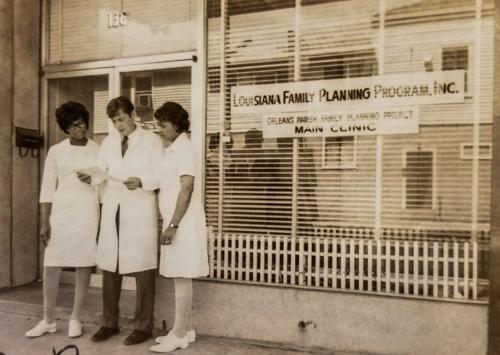
Dr. Aviva Weissman discusses Planned Parenthood and the use of contraception
Mar. 24, 1966 Dr. Aviva Weissman discusses the emergence of family planning services in England and the importance of women having access to contraception and other services. Weissman discusses her experience with families who have benefitted from the services of Planned Parenthood.
-
Dr. Meir Yoeli discusses medicine
1969 It is not enough to just treat a disease, explained Dr. Meir Yoeli. Dr. Yoeli said there needs to be a bridge for both science and for the truth of the heart. Also a poet, Dr. Yoeli reads a poem in English and then in Hebrew.
-
Drs. Quentin Young, Ron Shansky and Mike Gray talks with Studs Terkel
Dec. 3, 1975 Interviewing Dr. Quentin Young and others about Cook County Hospital and public health services in Chicago and throughout the country.
-
Jeanne Stellman discusses her book "Work Is Dangerous to Your Health: A Handbook of Health Hazards in the Workplace and What You Can Do About Them"
Feb. 11, 1974 Jeanne Stellman discusses her book, "Work Is Dangerous to Your Health: A Handbook of Health Hazards in the Workplace and What You Can Do About Them," and workplace safety issues in a variety of industries. Topics of discussion include the importance of prioritizing health in the workplace and consulting workers on workplace safety issues, and industry responses to occupational hazards.
-

South African gold miners discuss their work
1963 Studs Terkel talks with Mr Law, the chief of the miners hospital, and the workers in the mine as he tours the gold mine. He he speaks to the miners about where they are from and talks with them about their jobs.
-
Interviewing Scottish psychiatrist and author of "The politics of experience," R. D. Laing ; part 1
1968 Content Warning: This conversation has the presence of outdated, biased, offensive language. Rather than remove this content, we present it in the context of twentieth-century social history to acknowledge and learn from its impact and to inspire awareness and discussion.
-
Discussing British depression with a physician at Tavistock Square [part 3] while Studs was in England
Sep. 21, 1970 Studs interviews a physician at Tavistock Square while visiting England. This is an interview done in three parts.
-
Studs Terkel discusses "The Man Who Mistook His Wife For a Hat and Other Clinical Tales" with Oliver W. Sacks
Mar. 3, 1986 Oliver Sacks sits down with Studs Terkel to discuss aspects of "other clinical tales" from his book "The Man Who Mistook His Wife for a Hat and Other Clinical Tales". Sacks discusses the important role played by the visual arts, music, drawing and math in the lives of people suffering from autism, Parkinson's disease, and mental challenges. He also discusses the repercussions and loss of unique abilities to make patients more socially acceptable.