Listen to New Voices on Studs Terkel our partnership with 826CHI-here! Read the Story


Showing 1 - 10 of 92 results
-

Sterling "Red" Quinlan discusses the book "The Hundred Million Dollar Lunch"
Jul. 30, 1974 Mr Quinlan a pioneering Chicago TV executive and one time general manager of Chicago's ABC affiliate WBKB, discusses the book "The Hundred Million Dollar Lunch." Mr Quinlan and Studs converse about the trials against RKO General/General Tire, a struggle that lasted 15 years. Includes an excerpt of an interview with Denis Mitchell.
-
In this interview with Random House President and CEO Bob Bernstein and James Mitchell, Editor-in-Chief of the new Random House Encyclopedia talk with Studs Terkel
Sep. 26, 1977 In this interview with Random House President and CEO Bob Bernstein and James Mitchell, Editor-in-Chief of the new Random House Encyclopedia, the three gentlemen discuss the content and revolutionary layout of the single-volume 3,000 page tome, which was divided into 2 sections: the Colorpedia and the Alphapedia. Bernstein and Mitchell demonstrate how to use the encyclopedia and point out the explanatory diagrams throughout, which served a two-fold purpose: to catch the reader's attention, and then provide further information.
-
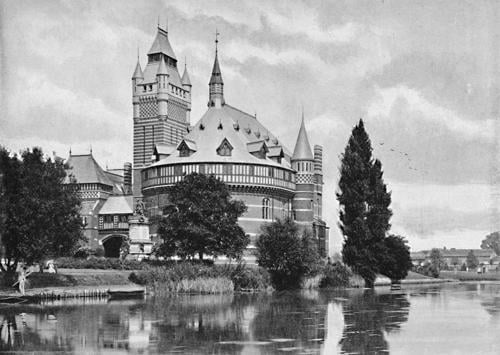
Studs Terkel discusses the changing role accents play on class distinctions in England with guests in the parlor of the Mayor in Stratford-upon-Avon ; part 2
1962 Studs Terkel gathers a cross section of opinions on accents and their changing role on class distinctions in British Society. He asks the Mayor and Mayoress of Stratford-upon-Avon, the Huxleys, their opinions on the influence of education on accents and class. Also present to offer opinions are Mr. & Mrs. Lawrence, pub owners from Lower Quinton near Stratford-on-Avon, and Mr. Morris, a London stockbroker and his wife. Bookending the conversation at the mayor's home are two conversations with Mr. and Mrs. Lawrence.
-
-
Berthold Spangenberg talks with Studs Terkel commenting and reflecting on Munich, Germany
1968 While in Munich, Studs speaks with Berthold Spangenberg about postwar cultural reconstruction of Germany through the lens of Spangenberg's mid-sized publishing house. Spangenberg notes international influences and regional variances among German cities and the significance of a divided Berlin. Terkel ends with musings on his travels in Germany.
-
Inteviewees discuss a variety of topics from the Hard Times: an Oral History of the Great Depression program; excerpts part 3
Excerpts from different episodes of "Hard Times: an Oral History of the Great Depression". Concerning The New Deal: Ed Paulsen talks about conflicting feelings regarding the New Deal and how the government seemed more present in daily life. Gardner C. Means explains how the New Deal was created to help save the country. Joe Marcus remembers feeling like his ideas were valued and were making a difference in his government job. John Beecher talks about working in the transient camps.
-
Interview with neighborhood residents
1970 Interviewing neighborhood residents in the people's park (Lincoln Park) with Steve Schaumburg, Hans the puppeteer, French hand laundry owner, and architect Howard Alan (part 4).
-
Terkel comments and presents "Hard Times: an oral history of the great depression"; Program 9; Part 1
1971 Presenting "Hard Times: an oral history of the great depression": "Concerning The New Deal" with Ed Paulsen, Hank Oettinger, Gardner C. Means, Raymond Moley, Alf Landon, James A. Farley, C. B. Baldwin, Andy Kull, and John Beecher (program IX).
-
Terkel comments and presents "Hard Times: an Oral History of the Great Depression" ; Chapter 7
1971 Presenting "Hard Times: an Oral History of the Great Depression" High Life, Sixteen Ton: Chapter 7. Sally Rand talks about the creation of her signature fan dance and predictions for future depressions. Doc Graham discusses his upbringing, Chicago mobs, and Count Victor Lustig. Tony Soma talks about prohibition before and after the 1929 crash. Jerome Zerbe talks about inventing paparazzi photography, spending 2 weeks working in a coal mine, and the New Deal. Buddy Blankenship recalls working 16 hour days in West Virginia coal mines. Mary Owsley remembers life as a coal miner's wife.
-
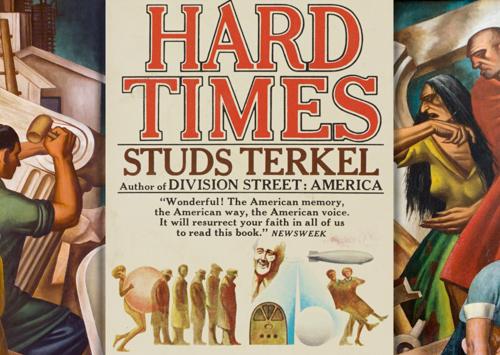
Terkel comments and presents "Hard Times: an Oral History of the Great Depression"; Chapter 3
1971 Presenting "Hard Times: An Oral History of the Great Depression" Chapter 3: Big Business & A Portrait of Two Women. William Benton credits Pepsodent's survival of the Great Depression to Amos 'n Andy. Arthur Robertson talks about the initial aftermath of the 1929 crash as a Wall Street businessman. Sidney Weinberg discusses the confusion on Wall Street after the crash and praises FDR's programs. Jimmy McPartland talks about the importance of working and the success of WPA to boost morale.