Listen to New Voices on Studs Terkel our partnership with 826CHI-here! Read the Story


Showing 201 - 210 of 216 results
-

Renault Robinson discusses public housing, crime, and Chicago police
Jun. 20, 1979 Renault Robinson, founder of the Afro-American Police League in Chicago and Chicago Housing Authority board member, discusses police programs in public housing projects. He discusses how public housing breeds crime because families are struggling and the building conditions are terrible, and how a new police program can help fix problems.
-
Dick Simpson discusses neighborhood government system
Mar. 1, 1979 Dick Simpson, alderman of Chicago, discusses neighborhood governments. He describes the history, explains the uses of wards, and shows how the system can work in light of a recent election in Chicago. Studs reads an article about the recent election by Mike Royko.
-
Renault Robinson and Robert McClory, author of "The Man Who Beat Clout City" discuss the the Chicago Police Department and race relations
Jul. 24, 1978 Renault Robinson, founder of the African American Patrolman's League in Chicago, and Robert McClory, journalist and author of a biography of Robinson, "The Man Who Beat Clout City," discuss Robinson's life and court case, Robinson v. Chicago Police Department. Robinson recalls how he was seen as a model policeman until he created the Afro-American Police League, when the Police Department started treating him differently.
-
David Lewis discusses Canadian culture and politics
Nov. 12, 1976 David Lewis, Canadian politician, discusses Canada's domestic and foreign affairs, including their relationship with America. He also spends some time talking about Canadian socialism including universal health insurance.
-
Gregory Dell Discusses his visit to the American hostages in Iran
Mar. 11, 1980 Reverend Greg Dell talks about the Iran Hostage Crisis and his visit to Iran to meet with the hostages and the student captures. He gives an overview of the students' thoughts about America's involvement in Iran and ideas on how to fix the relations between the two countries.
-
Daniel Ellsberg Discusses the publication of "The Pentagon Papers" ; part 1
1980 Daniel Ellsberg, political activist and former military analyst, discuses his release of the Pentagon Papers and his thoughts on how the Vietnam War played out. He also discusses what he believes the next war could look like and how America, and the world, would be affected by nuclear war.
-
Blanche Wiesen Cook discusses her book, "The Declassified Eisenhower: A Divided Legacy of Peace and Political Warfare"
Aug. 6, 1981 Blanche Wiesen Cook, historian, professor, and author discusses her book, "The Declassified Eisenhower," and explains Eisenhower's peace and war beliefs. She describes his beliefs at the end of World War II and his relationships with fellow generals and leaders.
-
Mohammed Milham and Joseph Abileah discuss Israeli-Palestinian issues
May. 8, 1981 Mohammed Milham, Mayor of Halhoul, and musician Joseph Abileah discuss their lives and Israel-Palestinian issues. The two men discuss the creation of Israel after World War II and the tensions that caused with Palestine, Jordan, and Syria. They also talk about their views on how to fix the problem such as an autonomy plan or teaching children to not hate.
-
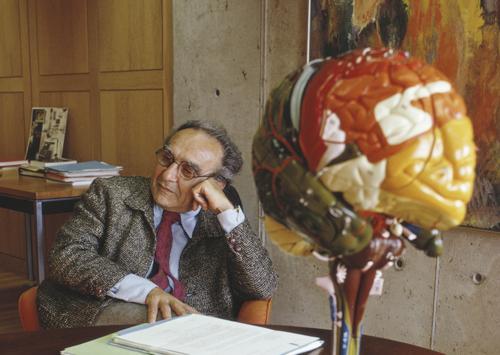
Dr. Jacob Bronowski discusses the philosophy of science in the post World War II world
Jan. 1, 1971 Dr. Jacob Bronowski, a mathematician and philosopher, discusses how the study of science has changed since the onset of government regulation or the military industrial complex. He also talks about humanity and explains how humans are the best species and therefore should come together to continue progress instead of killing each other. Content Warning: This conversation has the presence of outdated, biased, offensive language.
-
Arnold A. Hutschnecker discusses his book "The Drive For Power"
Jan. 8, 1975 Arnold A. Hutschnecker, a doctor with specialization in psychiatry, talks about his book, "The Drive For Power." He explores mental illness and its negative connotation. He explores how people who look for power tend to need mental help, but that the negative stigma around it tends to make them shy away, which leads to national aggravation and war. He also recalls his meetings with Richard Nixon from before he was president and how continued help may have changed the Vietnam War.