Listen to New Voices on Studs Terkel our partnership with 826CHI-here! Read the Story


Showing 271 - 280 of 535 results
-

James Cameron and Studs Terkel discuss their experience in Lincoln Park and how the peaceful demonstration changed to violence with the use of police tear gas ; part 1
Aug. 28, 1968 Studs Terkel and James Cameron talk about their witness of the peaceful demonstration at Lincoln Park the night before. They discuss the kind and caring interaction between older adults and the young. Both reflect on how the event changed from peaceful to somewhat violent when police gathered and used tear gas on the crowd.
-
James Cameron discusses his experiences as a Brittish journalist and his book "Point of Departure" ; part 3
Jun. 4, 1973 Studs Terkel interviews James Cameron about his experiences as a journalist that includes thoughts about Cameron's book, "Point of Departure." They talk about his relationships with Winston Churchill, Lord Beaverbrook, Charlie Templeton, and Bertrand Russell. Cameron discusses his education, poverty, and the depression during his youth. They talk about Cameron's career with the "News Chronicle" and his home of Dundee, Scotland. This is part 3 of a total of 4 parts. The interview takes place at Lewis and Clark Community College.
-
A cab driver in London and James Cameron discuss housing ; part 1
1970 On his way to meet James Cameron, the taxi cab driver tells Studs Terkel about the demolition site they're passing. The cab driver explains that 30,000 more hotel rooms are needed because of the jumbo jet trade. The cab driver said the rooms are needed to advance London's tourism. James Cameron discusses the demolition that's happening at Ashburn Gardens. Cameron explains how the homes that are being torn down house students, au pairs, and people of color. Cameron also talks about how he never went to school or received an education.
-
James Cameron discusses his experiences as a Brittish Journalist and his political and social beliefs ; part 4
Jun. 4, 1973 Studs Terkel interview with James Cameron, Brittish journalist. They discuss a variety of topics with politics and young people's attitudes the majority of the interview. This interview is done in Chicago, while the other three parts were done at Lewis and Clark College.
-
Jonathan Yardley discusses his book about Ring Lardner
Sep. 15, 1977 Terkel interviews author Jonathan Yardley on his latest book. This book titled "Ring" is a biography of the sports writer columnist Ring Lardner.
-
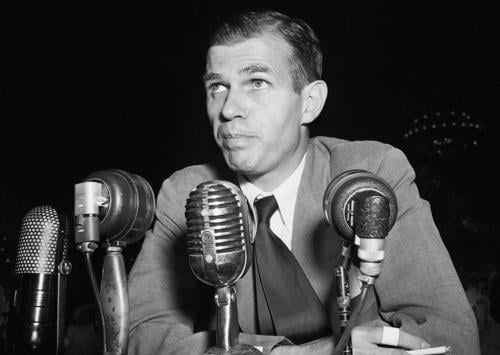
Tony Hiss discusses his book "Laughing Last"
Mar. 14, 1977 Content Warning: This conversation includes racially and/or culturally derogatory language and/or negative depictions of Black and Indigenous people of color, women, and LGBTQI+ individuals. Rather than remove this content, we present it in the context of twentieth-century social history to acknowledge and learn from its impact and to inspire awareness and discussion. The book, "Laughing Last: Alger Hiss" is the biography of Tony Hiss' father. Although Alger Hiss was convicted of perjury and did time in prison, Tony Hiss said his father, Al, was doing all right.
-
-
-
-