Listen to New Voices on Studs Terkel our partnership with 826CHI-here! Read the Story


Showing 91 - 105 of 365 results
-

Maud Russell social worker, educator, and writer, discusses U.S./China relations
Jun. 1, 1976 Ms. Russell was a social worker with the YWCA in China from 1917-1943, and the executive director of the Committee for a Democratic Far Eastern Policy from 1946-1952. Ms Russell speaks of her time and work in China, about U.S./China relations and the cultural revolution taking place in China. Includes excerpt of Joshua Horn talking about a worker who got burned while working at a steel factory in China. He speaks of the outpouring help for the man from the community of Shanghi.(1934055-3-1)
-
Marya Mannes discusses book "But Will It Sell?" ; part 2
Dec. 1, 1964 Marya Mannes discusses her book But Will It Sell?, published in 1964. Mannes talks about American life and consumerism.
-
Marya Mannes discusses book "But Will It Sell?" ; part 1
Dec. 1, 1964 Marya Mannes talks about her book But Will It Sell?, published in 1964. Mannes talks about American life and consumerism.
-

Mary Runyon and Kathy Ann Keller on the Ashtabula, OH nurses' strike ; part 2
1982 Interviewing an organizer of a nurse's strike in Ashtabula, Ohio, which was the longest nurses' strike in U.S. history (July 21, 1980-Feb. 8, 1982): Kathy Keller and Mary Runyon (tape 2 of 2).
-

Mary Runyon and Kathy Ann Keller on the Ashtabula, OH nurses' strike ; part 1
1982 Interviewing an organizer of a nurse's strike in Ashtabula, Ohio, which was the longest nurses' strike in U.S. history (July 21, 1980-Feb. 8, 1982): Kathy Keller and Mary Runyon (tape 1 of 2).
-
Mark Singer discusses his book “Funny Money” and the Penn Square Bank failure
Jun. 22, 1985 Author and journalist Mark Singer discusses and reads from his book “Funny Money.” This book, and interview, documents the events of the Penn Square Bank failure. Studs plays "Easy Come, Easy Go" - Johnny Green and His Orchestra (1934) and "Patriotic Diggers" - John Allison (ca. 1800).
-

Marge Guthrie discusses Woody Guthrie's life and music
Mar. 14, 1975 Marge Guthrie, Woody Guthrie’s second wife and Arlo Guthrie’s mother, joins Studs Terkel to discuss her late husband’s music and the lasting impact it made. Marge calls Woody a “chronicler,” remarking on his great ability to write songs about and for the common man, and informs Terkel of honors that Woody received from the state and federal government to commemorate his contribution to conservation efforts.
-

Loren Baritz discusses the relationship between education and work
Jul. 31, 1974 Loren Baritz, Executive Vice President of Empire State College (part of the State University of New York), discusses the purpose of higher education and the relationship between higher education and work. Topics of discussion include the current state of student apathy driven by economic insecurity, vocationalism, the structure of higher education institutions, and how the generation gap affects learning. Baritz also discusses the redefining of work in American culture and ideas for making liberal arts education more relevant to work.
-
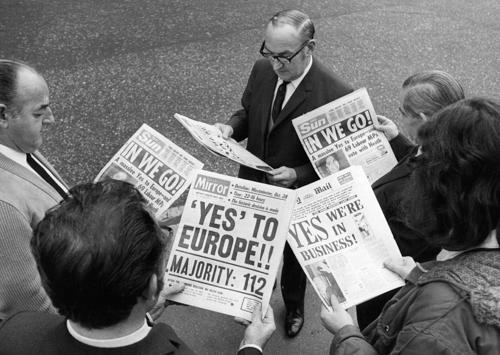
London newspaper vendor, George Curry, discusses politics and art, while Studs Terkel was in London, England
Sep. 1975 While in London, England, Studs Terkel interviews George Curry, a newspaper vendor with a storefront in a hotel. The two discussed Curry’s hometown of Dundee, Scotland and its politics, in addition to London’s current political atmosphere. They also talk about Curry’s political leanings; he is a socialist, and he criticizes England’s immigration policies. Curry comments on his interest in the arts and speaks on stereotypes surrounding the working class. The interview is interrupted intermittently by customers buying their morning paper.
-
Lois Wheeler Snow discusses her book "China on Stage"
Dec. 19, 1972 The Peking Opera and "Taking Tiger Mountain by Strategy" are among topics discussed in Lois Wheeler Snow's book, "China on Stage: An American Actress in the People's Republic". While visiting China, Snow learned the Chinese plays were both of the traditionally old ways and of the new revolutionary ways. Snow also adds that performances of Chinese acrobatics is like nothing in the United States.
-
Lewis H. Lapham in conversation with Studs Terkel
Feb. 22, 1988 Discussing the book "Money and Class in America: Notes and Observations on Our Civil Religion" (published by Weidenfeld & Nicolson) with author and editor and chief of Harper's magazine Lewis Lapham.
-

Laurie Abraham reads from and discusses her book "Mama Might Be Better Off Dead"
Oct. 1, 1993 What started out as a 5-piece article on health care became Laurie Abraham's book, "Mama Might Be Better Off Dead: The Failure of Health Care in Urban America". Through her stories, Abraham points out the many hardships and catch-22 scenarios of some poor families. One woman, after caring for her mother all day, Julie, wanted to work part time in the evenings. However, she soon learned that she'd be making too much money and she'd no longer be eligible for Medicaid for herself and her children.
-
Laurence Shoup discusses his book, "The Carter Presidency and Beyond: Power and Politics in the 1980s"
1970 Author Laurence Shoup discusses his book, "The Carter Presidency and Beyond: Power and Politics in the 1980s," and explains how President Carter came to be elected. He describes the Trilateral Commission and other groups created by corporations and the richest American families to lobby. the government. He also discusses the Carter presidency and his double-dealing with major issues such as unions and regulating big businesses.
-
Laurel Snyder discusses prostitution and the COYOTE organization
Aug. 26, 1980 Laurel Snyder describes to Studs Terkel her journey into prostitution and her involvement in the organization COYOTE, which advocates for the rights of sex workers and the decriminalization of prostitution.
-